
Feeding the future: Can prosperity exist without endless growth?
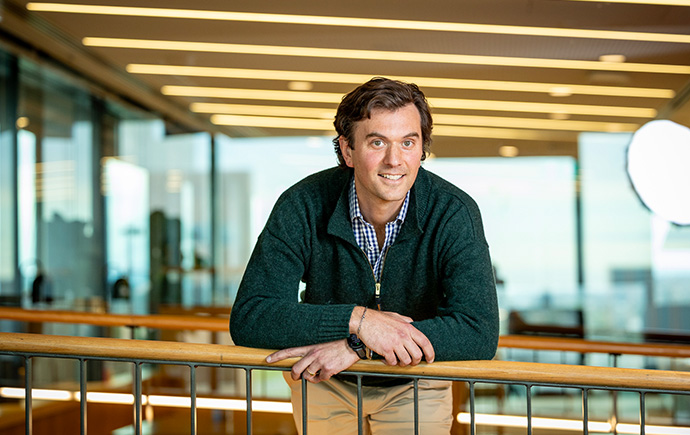
Monash Business School PhD candidate George Ellis.
12 August 2026
What happens when a system built on perpetual expansion collides with a planet of finite resources?
As concerns about inequality, food security and environmental decline intensify, that question is becoming increasingly difficult to ignore.
For Monash Business School PhD candidate George Ellis, it’s the starting point for research into the future of Australia’s food system.
“We’ve recently seen the world’s first trillionaire declared,” Mr Ellis said.
“At the same time, around 2.8 billion people globally cannot afford healthy food – a basic human need – and numerous planetary boundaries are being exceeded.”
He believes addressing those challenges will require more than technological solutions alone.
“Changes to political, economic and socio-cultural values are desperately needed to address these vast social and ecological harms,” he said.
“While not easy, they are within our control.”
A new recipe for prosperity
Mr Ellis’s doctoral research examines how Australia’s food system could transition towards what is known as degrowth - an emerging perspective that prioritises human wellbeing and ecosystem health over continual economic expansion.
Using qualitative research methods, he is exploring how food can be produced, distributed and consumed in ways that support both people and the environment.
“My research on degrowth highlights the need for, and value in making, paradigmatic changes to social and economic configuration in Australia and globally,” he said.
“I believe a foundational enabler of this is greater diversity in political, economic and public discussion around the pros and cons of economic growth and alternative ways of thinking about prosperity.”
His supervisor, Dr Cameron Allen, a Senior Research Fellow at Monash’s Sustainability Transitions Lab, said the research addresses an important gap in understanding how food systems could evolve.
“This research will help clarify what a ‘degrowth-aligned’ food system could look like in Australia and the social and institutional changes that would underpin such a transition,” Dr Allen said.
“Ultimately, it aims to inform more equitable and sustainable ways of producing, distributing and consuming food.”
Changing systems, not symptoms
As a new recruit to the business school’s Sustainability Transitions Lab, Mr Ellis is working alongside researchers focused on accelerating systemic change.
“The Lab has a great culture and strives for both world-leading research and real-world impact, helping public, private and community organisations navigate and accelerate systemic change,” he said.
“I really enjoy the diversity of people and research perspectives.”
While his research examines some of the world’s most pressing challenges, Mr Ellis sees reasons for optimism.
“Despite the seemingly endless list of geopolitical, social and ecological challenges, I also see evidence of people’s creativity, care and resilience all around me,” he said.
“I’m motivated by a future world where these attributes are the cornerstone of how we relate to each other and the world around us – that is the future I want for my children.”
Read about other Monash Business School PhD students making real-world impact.