
Trust versus technology: Auditing in the age of artificial intelligence
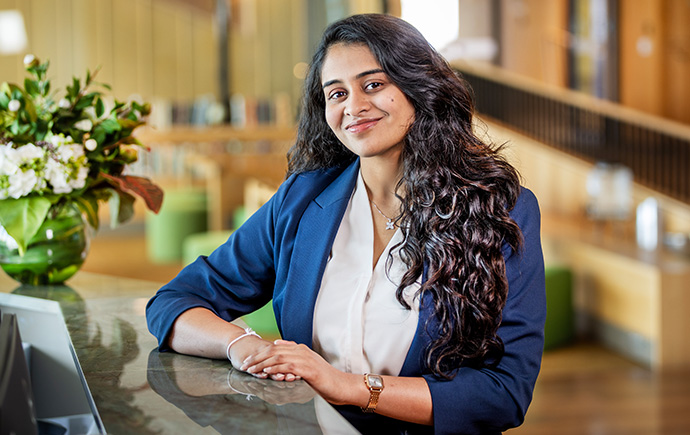
Monash Business School PhD candidate Nithara Godewatta.
16 March 2026
As firms turn to AI to improve audit accuracy and efficiency, new research by Monash Business School Department of Accounting PhD student Nithara Godewatta examines how managers respond when algorithms challenge their expectations.
As a student, Nithara Godewatta was drawn to computer science and technology.
But, as she progressed through her studies, academic specialisation requirements redirected her towards accounting, mathematics, and business, forcing her to set aside her childhood dream of pursuing a career in the tech sector.
“I thought that door had closed for me,” she said.
Everything changed when she began her doctoral studies and her supervisor, Associate Professor Soon-Yeow Phang, asked a simple question: ‘What genuinely excites you?’
“He reminded me that passion should come first, before anything else,” she said.
“That’s when I realised that I didn’t have to choose between accounting and technology – I could combine them.”
Now, the PhD candidate is putting that into practice with her research into how artificial intelligence is changing the auditing profession.
AI, auditing, and human judgment
Ms Godewatta’s research focus is based on her own reactions to the technology.
“I realised I tend to trust AI as long as it gives me the answer I expect,” she said.
“The moment an output falls outside that expectation, I start doubting it.”
That observation became the foundation of her research.
“Audit firms are investing heavily in AI to improve accounting processes consistently and efficiently,” she said.
In theory, this should also improve the quality of financial reporting. But there is a catch.
“AI can only improve financial statements if clients trust it as a reliable source and incorporate the suggested changes,” she said.
“If company managers resist AI-supported audit adjustments, those improvements never translate into better information for investors.”
Testing AI in the real world
To examine how these dynamics play out in practice, Ms Godewatta designed an experiment.
Working with 100 finance executives, including 20 chief financial officers, she found that trust in AI-supported recommendations rises when suggested adjustments align with managers’ expectations.
When outcomes fall outside those expectations, resistance rises sharply.
Her findings also highlight how auditors communicate their use of AI matters.
“When AI is described as a tool that supports human judgment and improves audit quality, this resistance drops significantly,” she said.
Associate Professor Phang said the research addressed a critical gap between technological capability and professional practice.
“Nithara’s research will generate evidence-based insights into how auditors can effectively use artificial intelligence during negotiations with client managers,” he said.
Her work has been presented at major international conferences, including the Accounting and Finance Association of Australia and New Zealand, where it received the Best Paper in Auditing award.
“Presenting at these conferences has been invaluable,” Ms Godewatta said.
“It allows me to discuss findings directly with auditors and standard setters and to think critically about how these results apply in the real world.”
Monash, mentorship, and future impact
Over the course of her academic career, Ms Godewatta has built strong connections at Monash.
“The community at MBUS is incredibly generous, both academically and personally,” she said.
Teaching as a sessional academic has been “deeply grounding”.
“It reminds me why this work matters and how far I’ve come.”
She said she was deeply appreciative of the guidance and support provided by her supervisors, Associate Professor Soon-Yeow Phang,
Associate Professor Xinning Xiao, and Dr Ashna Prasad, as well as the encouragement of her family, throughout her research journey.
Looking ahead, Ms Godewatta hopes to remain in academia, continuing to combine research, teaching, and mentorship.
“I want to continue uncovering the untold stories in auditing and technology,” she said.
“If I can help auditors use AI more effectively, then advances in technology will truly translate into better outcomes for people.”
Learn more about Monash Business School's PhD programs