
Understanding online behaviour
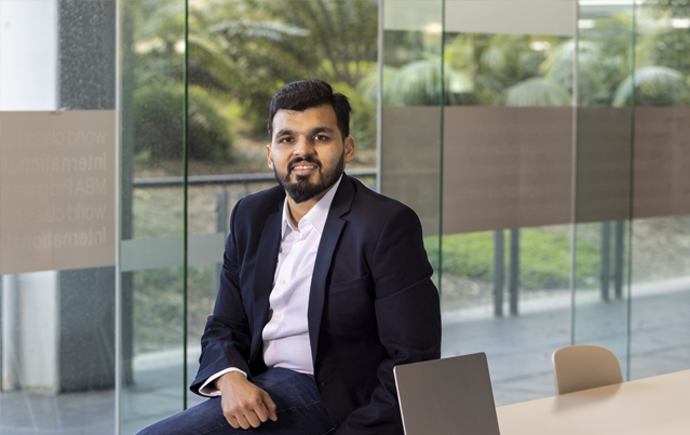
PhD candidate Aakash Shah
Inspiration can come from the most unlikely places.
For Aakash Shah, it was a seminar by a NASA researcher on link-based clustering systems that lit the spark that launched his academic career.
“I had to ask a friend who was a student at that college to somehow get me a pass to attend because I was studying elsewhere,” Aakash said.
“At that point, I was considering doing my thesis on a related topic, but the seminar made me realise that you shouldn’t be limited by conventional norms.
“Every problem has a solution – you just have to change the perspective to find it.”
Fast forward a decadeand the third-year Department of Marketing PhD student is tackling a topic dear to the hearts of business owners across the globe – how online reviews influence consumer spending.
Aakash said the idea for his research paper, The Influence of Online Review Content on Consumer Decisions, was inspired by the online shopping boom during the COVID-19 pandemic.
“Online shopping is a fun and convenient way for people to shop, but it has not been widely adopted until recently,” he said.
“Online shopping rose to USD 4.3 trillion during 2019, and it has doubled in value ever since, making it essential to understand the drivers of consumer behaviour in the online domain.”
Humans are hardwired to be sceptical of unknown experiences, Aakash said, and the online shopping experience is filled with unknowns.
“Customers can’t feel or touch the product, and that makes it hard to evaluate the quality and make an informed decision, which is why they turn to online reviews,” he said.
He said his research aimed to help marketers fine-tune the online shopping experience to make it easier for consumers.
“My research provides business owners with a better understanding of the impact of online reviews, and how they can be leveraged as a tool to improve customer engagement,” he said.
“On a broader level, my findings also have implications for online review approval mechanisms, and how marketers might improve the process to reject reviews which have very low influential power.”
Aakash’s supervisor, senior lecturer Dr Stanislav Stakhovych, said the work would provide a more nuanced understanding of the effects of online reviews.
“The practical contribution will be of benefit to consumers and retailers,” Dr Stakhovych said.
“It will enable the ability to present customers with the most relevant information while increasing conversion rates for retailers.”
Aakash said Monash Business School gives early career researchers every tool required to excel.
“It was my supervisors' guidance and support that has allowed me to hone my critical thinking and research skills,” he said.
“They were a driving force as they pushed me to do my absolute best, which at times felt difficult, but it has shown results. They have been instrumental in my success.”
In the future, Aakash hopes to return the favour.
“I hope to become an academic and spark the flame in my students, as the NASA research did for me, and help shape the future of the world,” he said.