
Blog post #3: It is a journey. Not a sprint!
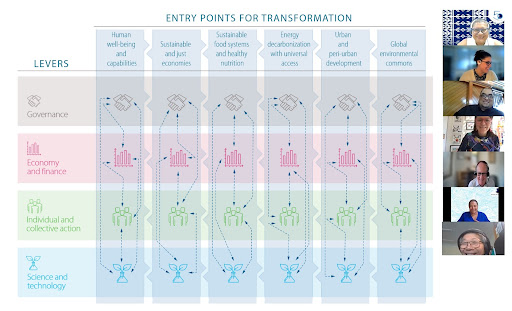 We met with an amazing group of inspiring people today and the conversation has given us so much to reflect upon as our project progresses.
We felt that there were three clear messages that arose from today’s conversation and we will expand on these in this post.
The messages are:
- Partnerships are essential.
- The process of how we do what we do is important but…
- Context is key - only by grounding SDG implementation in people and place (what we will call localisation) can we expect to shift towards a more positive future.
Partnerships
SDG 17, the partnership goal, was described by one participant as the “door opener” - using this SDG is necessary to unlock further programs and further development. But, as our conversation highlighted, it is not just who we partner with - everyone noted that multi-stakeholder partnerships are critical with private sector, governments, non government organisations, civils coety etc, - but it is on what we partner about and, as one participant noted, it may require that approaches “move away from projects to impact”.
The official title of SDG 17 is “Strengthen the means of implementation and revitalise the global partnership for sustainable development.” Its targets focus on: capacity development, finance, financial inclusion, multi-stakeholder partnerships and voluntary commitments, science and technology and trade.
We are determined to mobilise the means required to implement this Agenda through a revitalised Global Partnership for Sustainable Development, based on a spirit of strengthened global solidarity, focussed in particular on the needs of the poorest and most vulnerable and with the participation of all countries, all stakeholders and all people.” Preamble to the 2015 adopting resolution, A/RES/70/1 - Transforming our world: the 2030 Agenda for Sustainable Development
In addition to SDG 17, the other 16 SDGs also have their own set of means of implementation targets (these are the targets labelled with a letter). For example, under SDG 13, Climate Action, there are two means of implementation targets.
13.a: Implement the commitment undertaken by developed-country parties to the United Nations Framework Convention on Climate Change to a goal of mobilising jointly $100 billion annually by 2020 from all sources to address the needs of developing countries in the context of meaningful mitigation actions and transparency on implementation and fully operationalize the Green Climate Fund through its capitalization as soon as possible.
Participants highlighted that when they speak of partnerships, they mean a relationship that ensures all countries, and all citizens, are provided with equal opportunity: that we leave no-one behind (LNOB). (LNOB being the central premise of the SDGs).
Process
All attendees see the SDGs as the common agenda and, as a result, the framework of choice, although the level of engagement differs across organisations, with only a few organisations working with the SDG targets and indicators. For some, this is because their work is at a local level and, where a process of national localistion has not yet occurred, it does not make sense to work specifically on targets and indicators.
Using the SDGs as a tool to drive deeper, transformational change (transformational change being what the SDGs were designed to) is, as one participant noted, a “change in mindset” and requires going beyond seeing the SDGs as merely a box ticking exercise . At this stage, participants see this deeper utilisation as a ”a work in progress” across their organisations, agreeing that ensuring there is a “line of sight” between the organisation’s “job descriptions, work plans, budgets” and the SDG framework should be a focus of future efforts.
For national implementation efforts, participants noted that, in most instances, further work needs to take place on linking the macro (the global goals) to the meso (national plans) to the micro (individual activities at the ground level).
Context
Partnerships and process will only take us so far though: all participants reflected that understanding the local context is critical. Thinking about what this means for the development of the GSDR, participants noted that what they are looking for is advice on how the GSDR’s framework of entry points and levers can be contextualised.
GSDR Levers
- Governance
- Economy and Finance
- Individual and Collective Action
- Science and Technology
We had a rich discussion over whether the levers can or should be prioritised, noting that systems change - which is essentially what we are all focused on here - is messy, complex and not linear?
The two levers of Governance and individual and collective action were interrogated a little more. For some, governance is the priority lever, being seen as “foundational” and “setting the rules of the game”. However, there was also recognition that both individual and collective action is an imperative: “if there is no will to move on certain actions then all of this will be lost.” All participants agreed that more knowledge is needed as to how these two levers can work together for best effect.
----------
As you can see, this conversation has given us plenty to think about. We are so looking forward to our next conversations and seeing what common themes and ideas emerge.
Once again, please get in touch with us if you would like to share your thoughts and reflections. We would love to hear from you.
Until next time.
Domi and Julie