
Blog Post #6: Unpacking vulnerability and resilience in an environment of uncertainty
The concepts of vulnerability and resilience are inextricably linked to the Sustainable Development Goals. Vulnerability is linked to the core principle of the SDGs - Leave No-one Behind - and resilience is included throughout the SDGs with a focus on disaster risk resilience in particular.
Our Pacific neighbours are well versed in both concepts and, unsurprisingly, the relevance of both terms to the achievement of the SDGs has been a common conversation during our consultations on the 2023 GSDR.
One comment in particular got us thinking. Alisi noted that resilience and vulnerability are two sides of the same coin: vulnerability is negative of resilience and resilience is the positive side of vulnerability - a resilience mindset is more positive and seen as a strength.
Other workshop participants have also added to this conversation.
As one participant noted, Pacific countries are already resilient:
We get cyclones every year, we get up on our feet again…we can get through this”.
Yet, in the same workshop, another participant commented that
We are strong in the sense that we are still here, but we also need to recognize that we are more so being forced to rebuild our lives every time there's a cyclone, because the global community is not pulling their weight in terms of climate change”.
While we are not resilience or vulnerability experts, we have reflected on these comments for a few weeks now and asked ourselves whether taking a resilience or a vulnerability mindset has an impact on how the SDGs are being/or can be implemented.
Where vulnerability is described as openness or susceptibility to attack or harm - if you are vulnerable it will affect your ability to achieveing the SDGs. The capacity to persist, adapt and transform in the face of change is crucial for achieving the SDGs and these three traits are exactly what is meant by resilience.
So are Pacific countries vulnerable or resilient? Well, it seems that they are both.
Undoubtedly, resilience can be undermined and perhaps turned into a vulnerability. But does focusing on vulnerability alone adequately reflect the capabilities of the Pacific?
Reframing and refocusing vulnerability
Currently, the conversation regarding vulnerability in the Pacific is shifting. A new Multidimensional Vulnerability Index (MVI) is being developed by the United Nations in collaboration with Small Island Developing States. The Index assesses economic, financial, environmental and geographic vulnerability using 11 indicators.
This Index has been created to move beyond traditional measures of development and more accurately reflect SIDS vulnerability to external shocks such as those brough on by pandemics, economic shocks, disasters, and climate change. Through this measure, SIDS, such as those in the Pacific are able to highlight that though they have the smallest climate and environmental footprint, they face the biggest trouble.
The move towards a MVI represents a reframing of the concept of vulnerability.
Moving away from ideas of weaknesses and defencelessness of certain demographics towards a more broader view that is about reducing exposure to uncertainty and risk that results in a large drop in wellbeing. Additionally, the MVI highlights that this vulnerability is being imposed on the Pacific through the actions of other countries.
Participants in our workshops have welcomed the realignment of focus through the MVI. They have also highlighted that this new measure will complement the Pacific’s SDG efforts as it highlights the different financing mechanisms and development pathways to support resilience and sustainable development.
A focus on both
Perhaps the answer lies somewhere in between that vulnerability and resilience are different ways of looking at or dealing with the same situation. Both concepts are important when it comes to understanding how best to approach the SDGs in the Pacific context. Fundamentally, both concepts of vulnerability and resilience matter as they highlight both the capabilities and needs of the Pacific. The way we think about and use these concepts also matters and really it is the people of the Pacific that we should be listening to in order to understand what is important in their context.
We have to be cognisant that for the Pacific to continue to be resilient, it needs to be recognised that they are vulnerable to shocks that are beyond their control, such as those from climate change. And that chronic vulnerabilities need to be addressed in order for resilience to be strengthened.
As always it comes down to context - we need to ground our SDG application to the concept of sustainability in the particular context we are working in. With that in mind, opening up the complexity of understanding and conversations around concepts like vulnerability and resilience might help us find solutions to achieve the SDGs.
What do you think?
We invite you to get in contact with us if you have something to add to the conversation or just want to hear more.
Yours in complexity,
Domi and Julie
----------
Further background on the terminology
Vulnerability
Noun
Openness to susceptibility to attack or harm
Under the 2030 Agenda there is the core premise of Leave No One Behind. This premise fundamentally ensures that we focus on vulnerable populations. The Agenda seeks to reach the most vulnerable through the goals and targets on poverty; on food security, nutrition and agriculture; on education and learning opportunities; on water and sanitation; and on cities (see our last BP). Paragraph 23 of the 2030 Agenda identifies the most vulnerable groups as “all children, youth, persons with disabilities (of whom more than 80% live in poverty), people living with HIV/AIDS, older persons, indigenous peoples, refugees and internally displaced persons and migrants” as well as “people living in areas affected by complex humanitarian emergencies and in areas affected by terrorism”.
Often these complex factors combine to create vulnerable nations. This is especially true of the Small Island Developing States (SIDS) who face severe structural challenges due to their remoteness, economic concentration and economic dependence on foreign direct investment and tourism revenues.
Resilience
Noun
The ability of a system or organisation to respond to or recover readily from a crisis, disruptive process, etc…
In contract to vulnerability resilience is not as prominent within the 2030 Agenda. It can be found in particular goals, rather than the overall framing of the SDGs. Frequently, resilience is explored in relation to cities and urban development, climate change adaptation and mitigation as well as disaster preparedness, response and recovery.
Beyond these specific applications, resilience thinking has been highlighted as a complementary framework to the 2030 Agenda. Resilience thinking and frameworks emerged from the academic field of ecology in the 1970s. It describes the capacity of natural ecosystems to maintain or recover functionality in the event of disruption or disturbance. Importantly, resilience is not a static concept, it inherently reflects the dynamics of change. Moreover, it acknowledges that change is not linear and instead occurs through slow and abrupt changes with multiple drivers. Nor is resilience a naturally positive concept. Sometimes the first step in sustainable development is to reduce undesired resilience, to facilitate transformation into a new alternate or improved state.
Combining resilience thinking and the SDGs, requires us to think in terms of socio-ecological systems and acknowledge that society and the environment are fundamentally linked. In doing so we can reimagine the organisation of the SDGs, so that the biosphere provides the foundation for society to function, which in turn creates the conditions for a viable economy (see image below). Through acknowledging these links and the dynamics of change we can explore how systems withstand shocks and continue to function in desired ways.
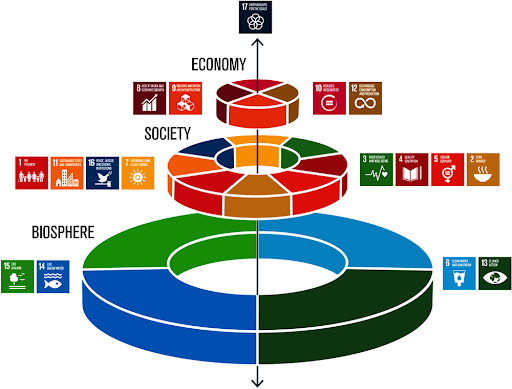
Source: Stockholm Resilience Centre (2016), Contributions to Agenda 2030 – How Stockholm Resilience Centre (SRC) contributed to the 2016 Swedish Agenda 2030 HLPF report.
The Stockholm Resilience Centre, highlights 3 key features of this concept:
- Persistence (sometimes called buffer capacity): the capacity of a system to maintain structure and function when faced with shocks and change (e.g. for a forest or coastal town to withstand the shock of a hurricane);
- Adaptability: the capacity of people in a social-ecological system to manage resilience through collective action in order to stay within a desired state during periods of change (e.g. the ability to safeguard current food production systems under climate change);
- Transformability: the capacity of people in a social-ecological system to learn, innovate and transform in periods of crisis in order to create a new system when ecological, political, social or economic conditions make the existing system untenable (e.g. turning the current financial crisis into an opportunity to transform the global economy and jump start the age of green economics).