
Blog Post #7: Monitoring progress on the SDGs
We’re huge fans of data. HUGE! So it is probably no surprise that we are social scientists. We see data as a necessary part of the evidence that is needed to show what is and is not working. It is also, for us, integral to the story-telling process – it helps to prove the point.
The Sustainable Development Goals (SDGs) were always designed to be monitored. In March 2015, six months prior to the adoption of the SDGs, the UN Statistical Commission (UNSC) created the Inter-agency and Expert Group on SDG Indicators (IAEG-SDGs). The IAEG-SDGs, composed of UN Member States and regional and international agencies as observers, was given the job of developing and implementing the global indicator framework for the SDGs. Two years later, at the March 2017 UNSC meeting, the indicators were agreed upon and this established the current framework: 17 goals, 169 targets and 232 indicators.
This framework created an evidentiary base of progress – the system if you will. But it is one thing to know what we are expected to collect. It is quite a different thing to actually collect the data. We are almost at the halfway mark of the SDGs (remember they are a vision to get us to 2030, which is only 8 years away) and the collection of data against the SDGs is still challenging, for many countries.
The Pacific context
Data collection for the SDGs is an important issue within the Pacific. Through our workshops we heave heard that national statistics offices within the Pacific face a variety of challenges, from the availability of information to the scarcity of resources to run data collection exercises. However, continuing the theme of partnership that we hear about so often in the Pacific, there is a regional organisation that is helping to bridge the data gaps.
Pacific Community (SPC)
The Pacific Community, better known as SPC, is an international development regional organisation that supports the development of its 27 country and territory members.
The Pacific Community "supports sustainable development by applying a people-centred approach to science, research and technology across all of the Sustainable Development Goals (SDGs). We serve our members by interweaving and harnessing the nexus of climate, ocean, land, culture, rights and good governance; through trusted partnerships; investing in Pacific people; and understanding Pacific contexts.”
Across nine broad divisions, including climate change and environment, educational quality, fisheries, geoscience and energy, human rights and social development, land resources, public health, statistics and integrated programs, SPC works "for the well-being of Pacific people through the effective and innovative application of science and knowledge, guided by a deep understanding of Pacific Island contexts and cultures.”
An important branch of SPC is the Statistics for Development Division (SDD), who plays an integral role in both the engagement with and the reporting of the SDGs in the Pacific. Its role can be traced back to September 2015 and the 46th Pacific Islands Forum Communique where the Pacific leaders supported the adoption of the SDGs but emphasised that a consultation process would be required to “select the relevant global SDG indicators to the Pacific context.” This work was assigned to the Pacific SDGs Taskforce, the "inclusive regional coordination mechanism established to coordinate regional efforts in implementing the directives of leaders on sustainable development.”
A Pacific-specific subset
In June 2017, 132 Pacific indicators were agreed to. These were subsequently endorsed as a part of The Pacific Roadmap for Sustainable Development, the roadmap which “guides regional responses for the achievement of the 2030 Agenda and the Sustainable Development Goals within the context of national plans and priorities, the SAMOA Pathway and the Framework for Pacific Regionalism”.
The on-going role of the Statistics for Development Division (SDD)
Our most recent consultation included three SPC employees:
- David Abbot, Head statistician; Manager, Data Analysis and Dissemination, SDD
- Alison Culpin, Social Statistics Adviser, SDD
- Nadeem Akhtar, Statistics Adviser, SDD
We learnt that SDD is playing a vital role in the collection and monitoring of data against the 132 indicators. SDD’s SDG dashboard, the “regional dissemination platform” which holds data on the 132 indicators, is an incredibly helpful, and comprehensive, tool. And its newsletter provides useful insights and stories from the data.
SDGs progress wheels

SDGs progress wheel from Pacific Data Hub
As David told us, SDD’s work focuses on improving both the coverage and the depth of the indicators.
My point is really about the role that SDD plays…from our perspective, we are primarily concerned with the indicators and trying to improve the coverage and the depth of the indicators that are needed in order to monitor all the SDGs. We're also focused on trying to encourage regional governments to make their data more easily available and accessible to researchers so that more analysis of the SDGs and other issues can be done.
SDD is also very much driven by what is needed for the countries themselves. On this David noted that:
“... recently, we have started to emphasise SDG 1, which is an area that we have not been involved in so much in the past that has been done at the regional level, at the Pacific regional level by other agencies…more analysis of the household income and expenditure surveys and look more closely at the poverty indicators…in Goal One and Two.”
However, during our discussion, David noted that “there are huge gaps in the indicators that are available at the moment. Even with the [indicators] that we do still have in the region, we probably only cover maybe a half to two-thirds of those.”
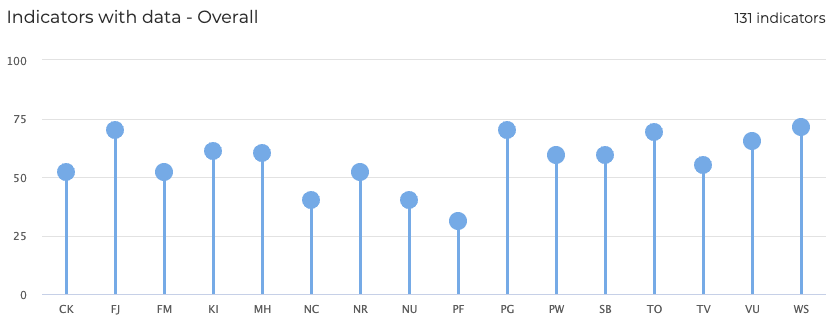
Indicators with data from Pacific Data Hub
Challenges include physical data collection itself and obtaining access to the data at the micro level, neither of which are easily resolvable. However, David believes change can occur. He says:
There are challenges at almost every level across almost every country in the region and the only way that we can address these is by getting the governments to make available more indicators, more data from which the indicators can be derived and also providing more resources so that we can conduct or support the conduct of more census and surveys.”
How does the Global Sustainable Development Report link to this?
The Pacific community deliberately designed a set of Pacific specific indicators, in recognition of the priority issues that the region faces. Given this, how relevant is a report which considers implementation at the global level? More specifically, how significant is the Global Sustainable Development Report for understanding how implementation should take place in the Pacific?
This is precisely the issue we are interrogating, specifically the relevance of the entry points and levers. We found our most recent discussions illuminating here:
There is a need for much more prioritisation to take account of regional circumstances. And again, it's probably why not many people take much notice of the global reports, because the coverage of the Pacific in those global reports is often very limited because there's few indicators, and many governments see their performance is not being properly recorded, and where it is recorded, it's often not very good.”
In terms of data, what we have taken away from the conversation with SPC, and from others across our consultations so far, is that more work is required to prioritise data collection and data utilisation. We have seen that in the Pacific this work begins by identifying a subset of indicators relevant to the country, or area’s particular context. Having a regional organisation, like SPC, that is able to assist like-minded countries to identify and collect data and providing support either through the regional organisation or to countries directly to build their data capacity, especially around collection and dissemination are perhaps absolutes if we are to more fulsomely report on the SDGs.
As we continue with our engagement consultations, at the front of our minds is ensuring that a Pacific story, backed by Pacific specific data, (which prioritises the issues that are relevant for the Pacific as identified by the Pacific), is both told and acted upon.