
Net Zero Precincts Living Lab
What is the Net Zero Precincts Living Lab?
The living lab is a space to explore and accelerate Net Zero transitions, with business, government, non-profits, community and researchers, all in one place.

Shaped by the broader Net Zero Precinct project, the foundations of the Living Lab were established in 2023. In 2024 and 2025 we will run a series of cycles with a range of Precinct stakeholders to support urban experimentation.
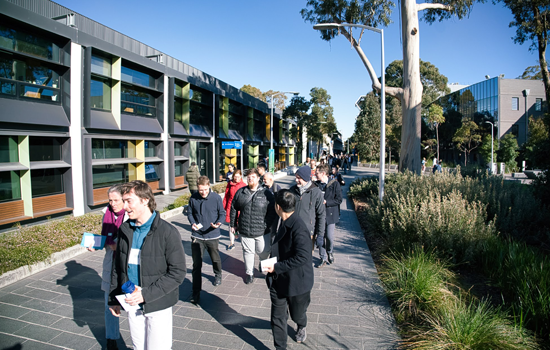
The living lab facilitates collaboration to enable research, development and implementation of solutions across energy, buildings, mobility, urban governance, circularity and data & automation. The precinct has Monash University at the heart, and includes residential, cutting edge research facilities, business parks, hospitals, public transport hubs, localised energy generation and urban road systems - a perfect test bed for the change needed around urban Australia.
The lab aims to support smaller experiments through to bigger projects, which leverage evidence-based research and novel partnerships to make real change happen, support people leading the net zero transition, and share the results with the world.

Living Lab portfolio
- Energy
- Mobility
- Buildings
- Governance
- Data
- Circular economy
- Regenerative rentals – increasing net zero retrofits of residential accommodation
- Pop up events – supporting and increasing active transport use to and from University
- Immersive storytelling approaches to net zero transitions engagement
- Sustainable mobility as a service – investigating approaches to support commuter decision making based on net zero data
- Tackling food waste – a final year project to tackle food waste on the University campus
- AI/ML approaches – improving public transport planning
- Enabling transformative governance for net zero in local governments
How to get involved
Whether you are interested in supporting an experiment, coming to our living lab showcase, or discussing your own initiatives, contact darren.sharp@monash.edu or find out more about the Net Zero Precincts project.