
Access to Justice in a Digital World: Professor Naomi Creutzfeldt

(L to R) Deputy Director Dr Jess Mant, Carman Parsons, Professor Naomi Creutzfeldt, Director Associate Professor Genevieve Grant.
Professor Naomi Creutzfeldt of the University of Kent recently collaborated with Monash Law’s Australian Centre for Justice Innovation (ACJI), presenting its inaugural annual lecture ‘Access to Justice in a Digital World’.
In conversation with Carman Parsons, Director of Impact and Innovation at Tenants Victoria, Professor Creutzfeldt critically examined access to justice, participation and digital legal consciousness against the backdrop of the increasing digitalisation of legal information and services.
Register to receive the quarterly Monash Law Research Newsletter
Justice in a digital landscape
Professor Creutzfeldt reflected on the capacity of watershed events, such as the COVID-19 pandemic, to ingrain, “wave[s] of technology,” which invariably shift engagement with digital legal systems and procedures.
Professor Creutzfeldt explained that our traditional understandings of justice are largely public-facing, with tangible justice infrastructure, such as courthouses, serving as reminders.
Digital justice mechanisms, comparatively, remain ambiguous – scepticism of, and inability to effectively utilise digital systems, such as generative Artificial Intelligence (AI) technology, can prevent those who most need assistance from accessing legal help.
Confronting barriers to justice
Professor Creutzfeldt noted that challenges to accessing justice stem from community members’ diverse personal characteristics and social experiences. Difficulties with access to reliable internet and digital devices, literacy, linguistic and numeracy skills and legal comprehension often disempower individuals attempting to utilise digital justice systems.
To unpack these barriers, Professor Creutzfeldt advocates a ‘bottom-up’ approach, prioritising lived experience with digital barriers to best support people with legal problems through humility and open understanding. Building the evidence base on digital justice journeys requires attention to how digital and legal capabilities develop and interact as people seek to resolve their legal problems.
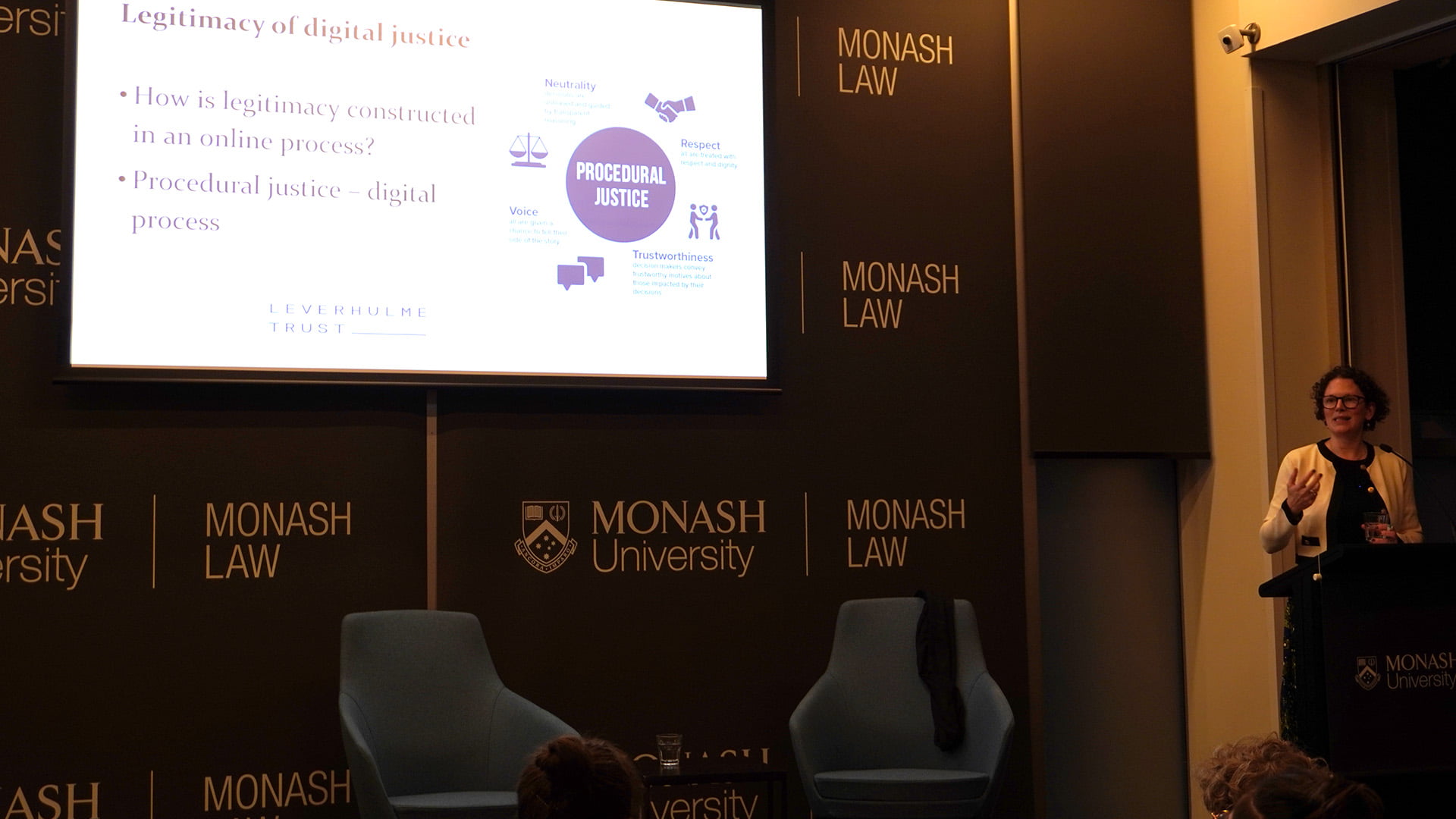
Professor Naomi Creutzfeldt discusses the legitimacy of digital justice at the Australian Centre for Justice Innovation’s inaugural annual lecture.
Digitalisation: a problem, and a solution
Though acknowledging that digitalisation can entrench existing disparities, Professor Creutzfeldt argued that digital technologies can drive improved justice-based outcomes.
During the COVID-19 pandemic, virtual court hearings in the UK were particularly helpful in conducting trials involving young adults and children. Enabling individuals to participate from home reduced intimidation when engaging with formal court procedure, decreasing overall stress and anxiety attached to participants’ experiences.
Virtual hearings also enabled judges to complete multiple hearings in a day, and the promotion of paperless courts came with transparency and efficiency gains.
Professor Creutzfeldt’s current research explores how Londoners navigate the justice system, particularly surrounding housing debt, social welfare benefits and family issues.
At the heart of her work, she seeks to increase digital justice accessibility for those who most need it.
Register to receive the quarterly Monash Law Research Newsletter
Resilience in the Victorian context
Carman Parsons provided an insightful response, emphasising the resilience of everyday Australians in navigating changing digital legal systems.
In her role as Director of Impact and Innovation at Tenants Victoria, Ms Parsons reiterated that, whilst, “great opportunities [arise] with innovation…they do come with a lot of barriers as well”.
Legal and service industries may make assumptions about users’ experiences without prioritising the messiness and complexity of community members’ lived experiences.
Her specific focus in the residential tenancy space is to strike a balance between accessible online resources, such as letter-writing tools, and human connection and tailored support, such as that provided through phone services, to support a diverse group of Victorians seeking to uphold their tenancy rights.
“It’s not helpful to have a binary idea about efficiency versus people-centred [resources]”, she explained.
Ms Parsons additionally pinpointed the resilience of diverse social groups in responding to digital challenges.
Single parent renters were acknowledged to be, “really good at navigating systems,” drawing on support from friends and family, contacting their usual service provider and utilising digital tenancy resources to, “find a way through”.
Ms Parsons concluded that cultivating, “trust in the system,” is essential to supporting vulnerable individuals, empowering them to access tenancy rights, in addition to the provision of robust digital and tangible legal resources.
Register to receive the quarterly Monash Law Research Newsletter
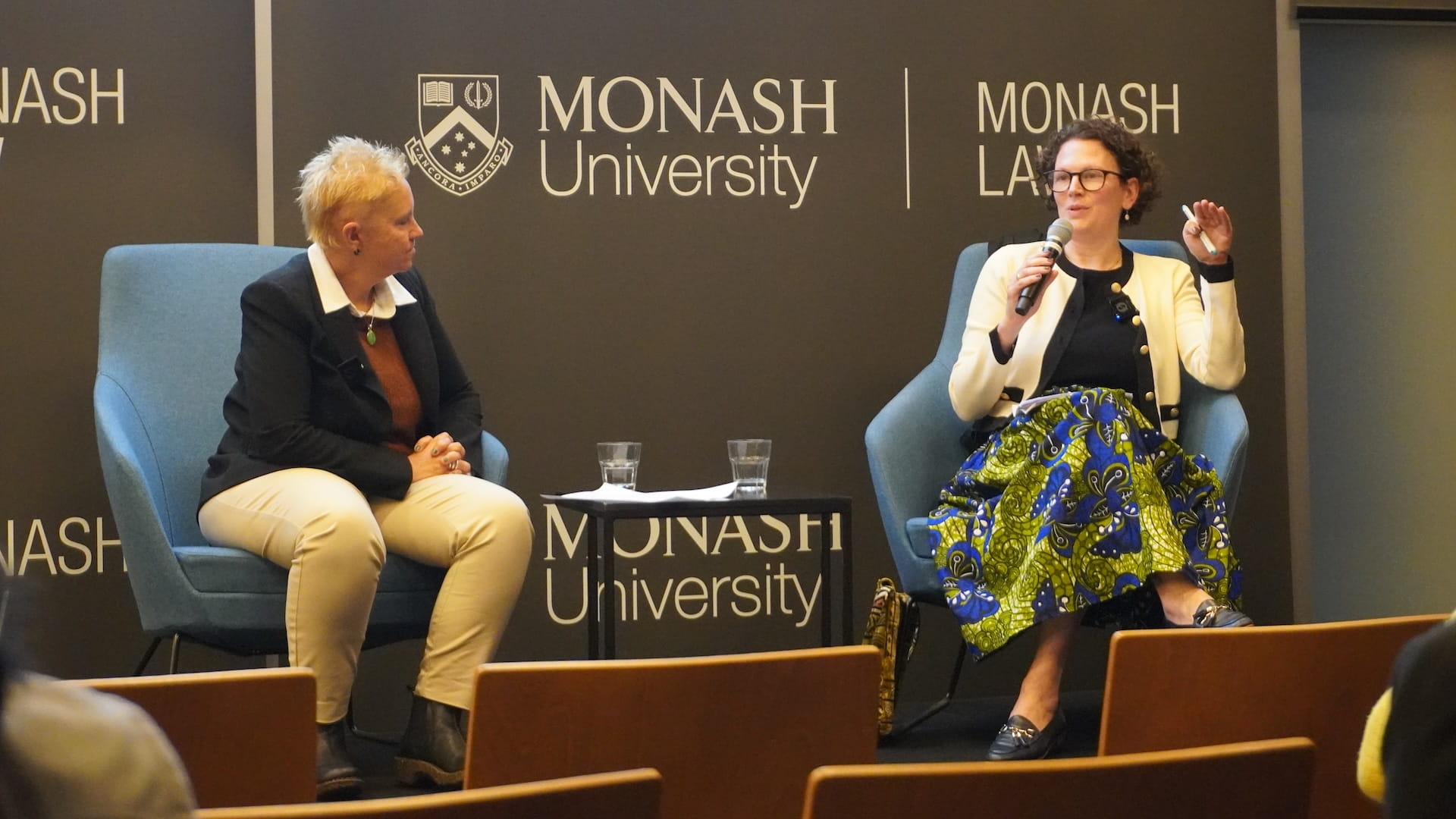
Carman Parsons (left) in conversation with Professor Naomi Creutzfeldt (right).
Subscribe to ACJI's mailing list and follow their Facebook, Twitter and Instagram pages for future ACJI’s events.
Meet other academic collaborators and visitors to Monash Law