
Exploring Clinical Legal Education in a range of global contexts

As Monash Law Clinics marks its 50th anniversary in 2025, the celebration is graced by the release of a significant new book by Professor Jeff Giddings, the Law Faculty’s Associate Dean (Experiential Education). Global Clinical Legal Education is a culmination of decades of research that shines a light on the evolution and impact of clinical legal education worldwide.
Register to receive the quarterly Monash Law Research Newsletter
The Genesis of a Global Clinical Legal Education
Rooted in Professor Giddings's PhD research, the seed of Global Clinical Legal Education was planted over 15 years ago, but it took the disruption of a hiking trip to trigger germination.
"The idea for this book really came about five years ago," Professor Giddings recalls.
"I wanted to take that PhD research further and do some of the things I had identified as needing to be done."
This vision was nurtured during a bushwalk with his partner Judith, where the concept of a collaborative, globally inclusive book started to take shape.
Clinical legal education began in the early 20th century in the United States, with law schools incorporating practical training to complement theoretical learning. The earliest programs focused on providing legal aid to underserved communities, allowing students to gain hands-on experience while serving the public. Many early programs were started and run by students who volunteered their time and energy.
Are you a Monash Law Clinics alumni? Share your story with us!
Today there is an increasing trend towards global collaboration among clinical programs, such as sharing best practices, joint research projects, and international student exchanges.
Exemplifying this trend, Professor Giddings avoided the traditional path of a single author compiling research, and instead used the project to develop the capacity of clinic teachers worldwide.
"I wanted to take it beyond the focus on a small number of English-speaking countries and include stories and insights from places that are non-existent in the English language literature on clinics," he explains.
This ambition led to the inclusion of material from 44 countries, highlighting the development of law clinics in regions like Pakistan, Bhutan, Turkey, and Francophone Africa.

In 2024 Monash Law Clinics launched The Justice Bus - a mobile legal clinic that took Monash Law students on the road in regional Victoria to share elements of the Street Law program in schools.
Collaborative and inclusive research into Clinical Legal Education
Professor Giddings’ collaborative approach to compiling this book involved inviting contributors to write about what is distinctive about clinical legal education in their regions.
"I provided the people who were going to write with a series of questions to focus their work," says Professor Giddings.
This method ensured a cohesive narrative, connecting diverse experiences and insights into a comprehensive global perspective.
Moreover, Professor Giddings encouraged contributors to collaborate with junior or less experienced colleagues.
"I said to each contributor that It'd be really great if you could work with a junior or a less experienced colleague, so as to give them the chance to develop their writing and achieve an international publication," he suggested.
This developmental process enriched the book with fresh perspectives and fostered professional growth among emerging scholars.
The key themes of Global Clinical Legal Education
Global Clinical Legal Education explores several key themes that reflect the evolution, diversity, and impact of clinical legal education worldwide. These are the five main themes highlighted in the book:
1. Global Diversity and Inclusivity
- Broad Geographic Coverage: The book includes contributions from 44 countries and regions, showcasing the development of clinical legal education in places often underrepresented in English-language literature.
- Inclusivity in Perspectives: By incorporating stories and insights from a wide range of countries, the book emphasises the importance of diverse perspectives in understanding and advancing clinical legal education globally.
2. Collaborative and Developmental Approach
- Capacity Building: Professor Giddings aimed to develop the capacity of clinic teachers worldwide, encouraging them to contribute to the book and work with emerging colleagues. This approach not only enriched the content but also fostered professional growth among emerging scholars.
- Organising Principle: The book is structured around the distinctiveness of clinical legal education in different regions, with contributors focusing on what sets their programs apart and the priorities and interests involved.
3. Innovation and Creativity
- Encouraging Innovation: One of the book's purposes is to spark imagination and encourage creativity among clinical legal educators. It highlights the value of trying new things, innovating, and taking sensible risks to improve clinical programs.
- Technological Integration: The book explores the role of technology in clinical legal education, including its use in service delivery and as a subject matter for clinics. It discusses the potential of digital tools and AI in enhancing legal education and service delivery.
4. Challenges and Opportunities
- Addressing Challenges: The book includes accounts of the challenges faced by clinical legal education in various regions, providing a realistic view of the obstacles and opportunities in different contexts.
- Learning from Others: It emphasises the importance of learning from international examples, not to replicate them but to inspire new ideas and approaches that can be adapted to local contexts.
5. Impact and Future Directions
- Global Impact: The book underscores the global impact of clinical legal education, showcasing how it has evolved into a dynamic and integral part of legal training worldwide.
- Future Prospects: It looks ahead to the future of clinical legal education, discussing emerging trends, technological advancements, and the ongoing need for innovation and collaboration.

In 2024 Monash Law Clinics introduced their first international In-House Clinic placement, held in partnership with Anti Death Penalty Asia Network.
Monash Law Clinics: A Beacon of Innovation
Professor Jeff Giddings has a strong, lifelong connection with Clinical Legal Education that began with his own Bachelor of Laws as an undergraduate law student with Monash University.
"I was a law student at Monash and the first in my family to go to university. For me, the clinical program at Springvale Legal Service in 1984 was a truly formative experience."
This experience ignited his passion for clinical legal education, leading to a career dedicated to community legal centres and clinical programs.
“ The law went from black and white to Technicolor and it was fantastic. So that's really the work I've been doing ever since, in community legal centres and clinical programs.”
“I was a volunteer and then a member of the board at Springvale Legal Service. I got a job as a salaried lawyer at Fitzroy Legal Service, and then I was lucky enough to get a job as a clinic teacher at La Trobe. That gave me the chance to develop what I was interested in, then I took a job at Griffith University which gave me the opportunity to create a clinical program in a place that had never imagined that it would have one.”
“There's a full circle element to this because it was then Monash that asked me to come back, and I did!”
After 50 years, Monash Law Clinics stands out from other clinical legal education programs for its depth and breadth, and for balancing creativity and innovation with structured support.
"We're big, but we're also creative in doing a range of interesting things," notes Professor Giddings.
The program's integration within Monash University and its engagement with the Law Faculty have been pivotal in its success.
"We're not seen as just an outpost, we're part of the activities of the university," he emphasises.
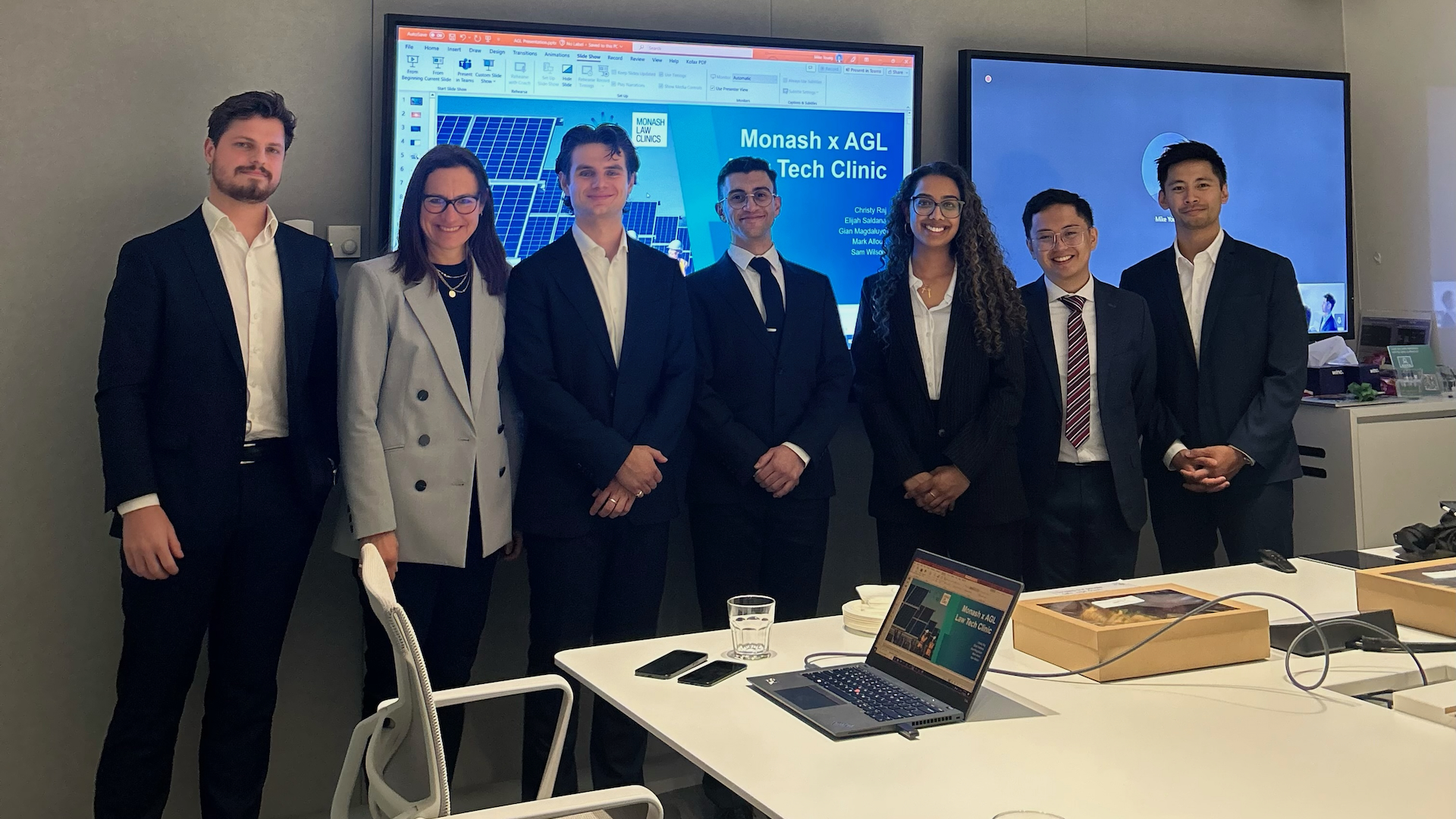
For the AGL Legal Technology Clinic, Monash Law Clinics partnered with AGL to provide law students with hands-on experience utilising technology to solve service delays.
Embracing technology and global connections in clinical legal education
With an eye on the future Global Clinical Legal Education also explores the technological dimensions of clinical legal education.
“ There are several ways in which to harness technology in clinical programs. One is to use it in service delivery and we're already doing that, we're engaging more and more with community legal centers in regional areas using technology,” says Professor Giddings.
The inclusion of a chapter on technology in clinics, co-authored with Monash colleague, Dr Jaqueline Weinberg, highlights the innovative use of digital tools in legal education.
“ There's great potential to make technology the subject matter of a clinic. So we've grabbed that chance and it'll be really interesting to see how these clinics continue to develop.”
Another focus of the book is advancing clinical legal education through networks, something that Professor Giddings has demonstrated in his leadership of Monash Law Clinics.
“ The first Susan Campbell Fellow who came to visit Monash Law Clinics was Frank Bloch - editor of the first global account of clinical legal education.”
“The second Campbell Fellow was Peter Joy and he was the person who suggested Monash Law innovate by offering its students a Clinical Guarantee. That vision has seen our program more than triple in size.”
“Leah Wortham was the third Susan Campbell Fellow - she’s worked with clinical programs in over 30 countries.”
“David McQuoid-Mason, who, but for COVID, would have been the fourth Susan Campbell Fellow has probably had more of an impact in the globalisation of clinical legal education than anybody else.”
It’s these connections with international titans of clinical education that further enrich Monash Law Clinics's program.
"We're lucky in terms of having good connections with a lot of people who have been pivotal in the development of clinics," says Professor Giddings.
A Virtuous Cycle of Growth and Innovation
As Monash Law Clinics celebrates its 50th anniversary, the publication of Global Clinical Legal Education symbolises a virtuous cycle of growth and innovation.
The book not only commemorates Monash Law Clinic's rich history but also sets the stage for future advancements in clinical legal education worldwide.
Global Clinical Legal Education is a fitting tribute to the legacy of Monash Law Clinics. It encapsulates the spirit of collaboration, inclusivity, and innovation that has defined the clinic's journey over the past five decades. As the clinic looks forward to the next 50 years, Global Clinical Legal Education serves as both a milestone and a beacon for the future of clinical legal education globally.
Register to receive the quarterly Monash Law Research Newsletter
Get involved with Monash Law Clinics
Monash Law Clinics combine legal education with real-world impact, supporting access to justice while equipping students with practical, ethical and professional skills.
If you are a student interested in undertaking a clinical unit as part of your studies, explore the available clinical placements and elective options.
Whether you’re an alum, practitioner or organisation keen to support the clinics through hosting placements, partnerships, volunteering or funding, there’s a way to be involved. To learn more, contact Emily Collard, Industry & Alumni Engagement Manager, at emily.collard@monash.edu.