
Professor Melissa Castan’s Inaugural Professorial Lecture: When Life Meets Law

November 11 is always a day for remembrance, but in 2025 it was also the 50th anniversary of The Dismissal. And on a cold, wet evening in Melbourne, it was a gathering of friends, family and colleagues eager to discover when life meets law for one of their favourite academics.
Professor Melissa Castan’s inaugural lecture explored the intersections of personal history, constitutional reform, and Indigenous rights. It highlighted law’s power to drive justice and reconciliation.
Dean of Law, Professor Steven Vaughan, opened proceedings and welcomed an expectant audience.
“An inaugural lecture is always a highlight in the life of a faculty. It is a moment to recognise a scholar’s standing and achievements, a chance to pause and reflect on their journey, the ideas, the impact, the community they’ve helped to build,” said Dean Professor Steven Vaughan.
Watch Professor Melissa Castan’s Inaugural Professorial Lecture on YouTube.
From Monash Student to Global Scholar
Melissa Castan’s journey began at Monash Law in the early 1990s as a law and arts student. Even then, she was deeply engaged in questions of justice, working alongside her father, the late Ron Castan, on the landmark Mabo case.
“That landmark case changed the legal and moral landscape of Australia. And it clearly shaped Melissa’s own understanding of what law can and should do - that sense of law as a living force for recognition, for dignity and for justice,” Vaughan noted.
He highlighted that Professor Castan’s scholarship has informed courts worldwide, including the High Court of Australia and the European Court of Human Rights.
“Her book with Sarah Joseph on the main United Nations Human Rights Treaty is the reference text on the ICCPR found in nearly 900 law libraries. It is cited by courts across the globe,” Vaughan said.
He observed that the audience for Professor Castan’s Inaugural Professorial Lecture included two Chief Justices in the Honourable Richard Niall and the Honourable Marilyn Warren AC KC. And then he drew his opening comments to a close.
“ I sent the middle factual bit of my introduction to Melissa a couple of days ago and said, can you just fact check what I'm saying? And she wrote back and said, yes, the facts were all correct, but not too much gush. But that's the whole point of these inaugural lectures. It is a public opportunity to gush and to be proud.”
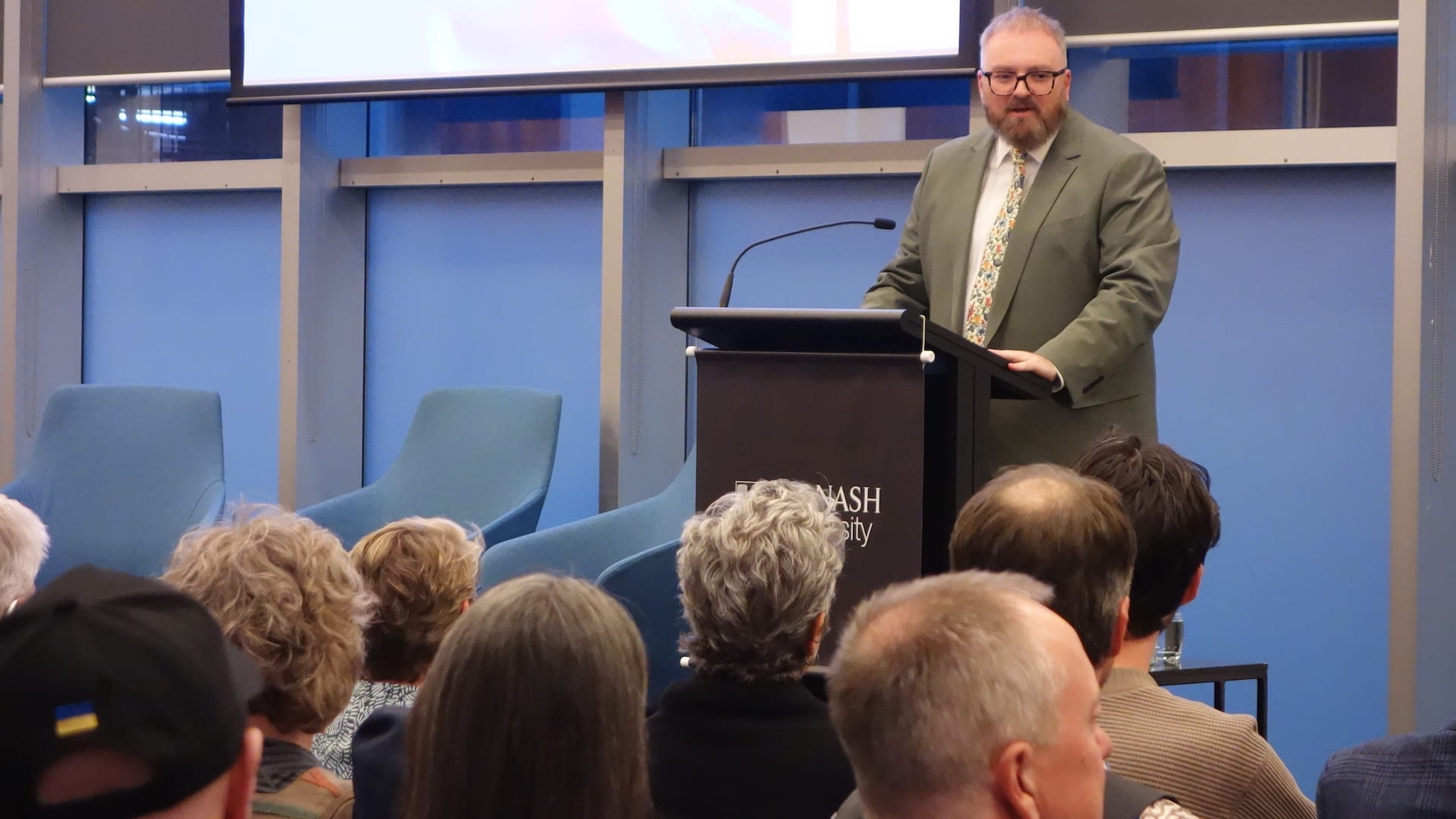
Professor Steven Vaughan introducing Professor Melissa Castan before her presentation in the Inaugural Professorial Lecture series.
When Life Meets Law: The Lecture Theme
Professor Castan opened her lecture with the humour and humility that she is so well known for.
The topic of her Inaugural Professorial Lecture, ‘When Life Meets Law,’ explored the intersections of personal history, constitutional change, and the enduring quest for justice.
Castan began by sharing a vivid memory from 50 years ago, the day of Prime Minister Gough Whitlam’s dismissal.
“ My father came home from work, got out of the car and slammed the door. Clearly, he was very angry. He was not a very volatile person. This was out of character. So I asked Dad, what’s wrong?”
“He said, ‘A very bad man has sacked the Prime Minister.’ Of course, what he was talking about was Sir John Kerr’s dismissal of Prime Minister Gough Whitlam. Exactly 50 years ago today. We were in constitutional crisis,” she recalled.
That moment ignited a lifelong curiosity about power, governance, and constitutional law.
“ The power of my father's anger and upset at Whitlam’s sacking must have had some serious impact on me. I can only think that this was the moment that I developed a deep and abiding curiosity for how government and politics works, and how constitutional law governs the proper distribution of power in the Westminster system,” she said.
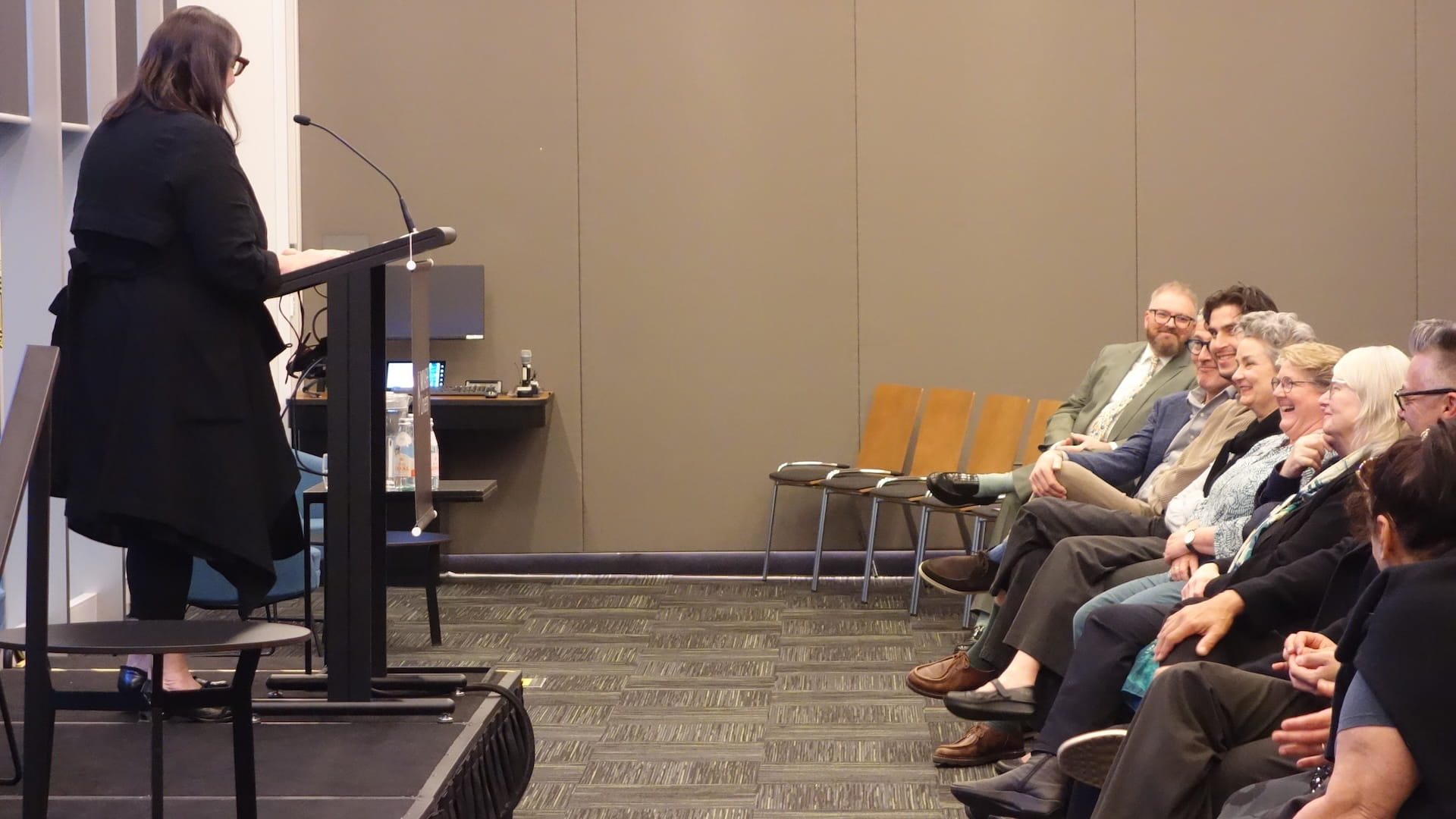
Professor Melissa Castan presenting in the Inaugural Professorial Lecture series.
Lessons from Whitlam: Law as a Driver of Reform
Clearly not one to bury the lead, after starting at the end of the story, Professor Castan went back further to reflect on Whitlam’s transformative reforms and their enduring impact.
“ There are a lot of lessons to be drawn from Whitlam's election and the three years of government, and then the dramatic dismissal. One of the most interesting aspects of Whitlam’s term was his determination and his sense of urgency to bring Australia into modernity and his use of the law and the legal processes to drive forward sweeping social reforms that were so overdue,” she said.
From abolishing the death penalty to establishing the Racial Discrimination Act, Whitlam’s government reshaped Australia’s legal and social fabric.
”So much of the framing of our current law is thanks to the reforms that were set in place by that government. For example, the abolition of the death penalty, the amendment to the Electoral Act to lower the voting age from 21 to 18. The establishment of the Australian Legal Aid Office and the Law Reform Commission. The consumer protections in the Trade Practices Act, and the establishment of the Trade Practices Commission, which was the predecessor to the ACCC.”
“The establishment of a Royal Commission into Aboriginal land rights after the loss of the Gove land rights case, and the historic scenes of Whitlam promising the Gurindji people their title for their traditional lands in the Northern Territory. The enactment of the Racial Discrimination Act to ratify the international Convention on the elimination of all forms of racial discrimination. And the removal of the formal selection criteria underlying the white Australian immigration policies and the Family Law Act, establishing no-fault divorce, and the list goes on.”
“I’ve just chosen my favourite bits,” Castan noted.
Breaking the Silence: Indigenous Rights and Legal Relations
From this point in history, Professor Castan took us back further to discuss the ‘Great Australian Silence,’ a term coined by anthropologist William Edward Hanley Stanner.
“ W.E.H. Stanner discussed the cult of forgetfulness that was practiced on a national scale in Australia. In his ABC Boyer lectures entitled After the Dreaming, he dubbed this the Great Australian Silence.”
“This was a silence in which non-indigenous Australians not only refused to acknowledge the brutality of colonialism and the disease, massacre and dispossession that accompanied it, but also chose not to think about First Nations people at all,” Castan explained.
She emphasised that while progress has been made, reconciliation remains incomplete.
“ You can call it justice, you can call it peace building, you can call it reconciliation. But without discussion, there can be no reconciliation. Without goodwill, there can be no reconciliation. And without relationships, there can be no reconciliation, which is why reconciliation has only partially succeeded, or moved, in Australia.”
“We need a lot more listening, discussion, compassion and goodwill.”
From Mabo to Treaty: A Scholar’s Journey
Castan recounted her involvement in the Mabo case during a break from law school. It was a formative experience that shaped her career.
“ I was asked by Ron to assist with some legal research on a land rights case.”
“I worked with my partner Rob as a legal intern on the Mabo case, assisting with the historical research, taking evidentiary statements from Islander witnesses and arranging logistics,” she said.
The High Court’s rejection of terra nullius in 1992 was groundbreaking, but Castan stressed that systemic change remains elusive.
“ The ruling by the High Court, as we know, rejected the legal fiction that the Australian territory had been unoccupied before 1788, but the ruling only identified the fracture rather than fixing it. Consequently, the enduring impacts and dire consequences of colonialism have not really been remedied,” she observed.
Learning from Canada: Reconciliation in Practice
Fast Forwarding into the present day, Professor Castan shared some insights from a recent study tour to Canada with 15 Aboriginal and Torres Strait Islander leaders who are completing their Masters of Indigenous business leadership at Monash University. .
“ We traveled from British Columbia to Manitoba and Alberta. This was deep learning for me and here's some of the things they told us. Reconciliation is worthless without reconcili-action. Governments and businesses will talk the talk, but resist walking the walk, and sometimes that walk is harder and heavier and more difficult than anticipated, but it has to be done,” she said.
She highlighted the importance of listening and discomfort as part of the learning process.
“ These are really interesting lessons, particularly for someone trained in the law because we are trained to argue our way through problems. We talk a lot. We analyse fastidiously. That's what we're supposed to do.”
“But when working with first peoples, we need to listen more closely, seek justice and stop talking. We don't have to be right. We don't have to be certain. We can listen and then do the work, and we may not like everything that we hear. That's okay. Being uncomfortable is part of the learning. It's part of the reconciliation,” she noted.
Victoria’s Treaty: A Turning Point
Professor Castan delivered her Inaugural Professorial Lecture two days before Australia’s first ever treaty with Aboriginal people, Victoria’s statewide treaty, was signed and formalised by law.
“The treaty is the first to be signed by the Crown in Australia ever. So this is the most significant step in the establishment of proper legal relations between First Peoples and the state,” Castan said.
She explained how the treaty operationalises international human rights obligations and creates mandatory consultation mechanisms.
“ The ultimate decision making authority remains with the Victorian Parliament. Parliamentary sovereignty remains and there's now a procedural obligation to engage with the assembly before advancing first people's specific legislation or policies. Victoria's approach represents a genuinely significant advance in realizing self-determination for first people within our constitutionally conservative Westminster Parliamentary system,” she said.
A Call to Action for the Legal Community
In the end, Castan circled back to her opening remarks and reinforced her lifelong curiosity about power, governance, and constitutional law. She closed with a powerful reminder of the work still to be done, by lawyers, law students, law knowledge holders and the population.
“Governments continue to let down Indigenous people of this country, but governments are voted in by the people of this country, and so we all have to do better. First Peoples deserve better, and Australia must be a better country,” she urged.
Professor Vaughan returned to the stage to thank Professor Castan, summarising the thoughts of all who had experienced the lecture.
“What you did then was very typically you. It was brilliant. It was warm. It was inclusive. It was gently confronting, which I enjoyed,” Vaughan said in closing.