
Sexual Assault Trials Book Launch Highlights Research Impact
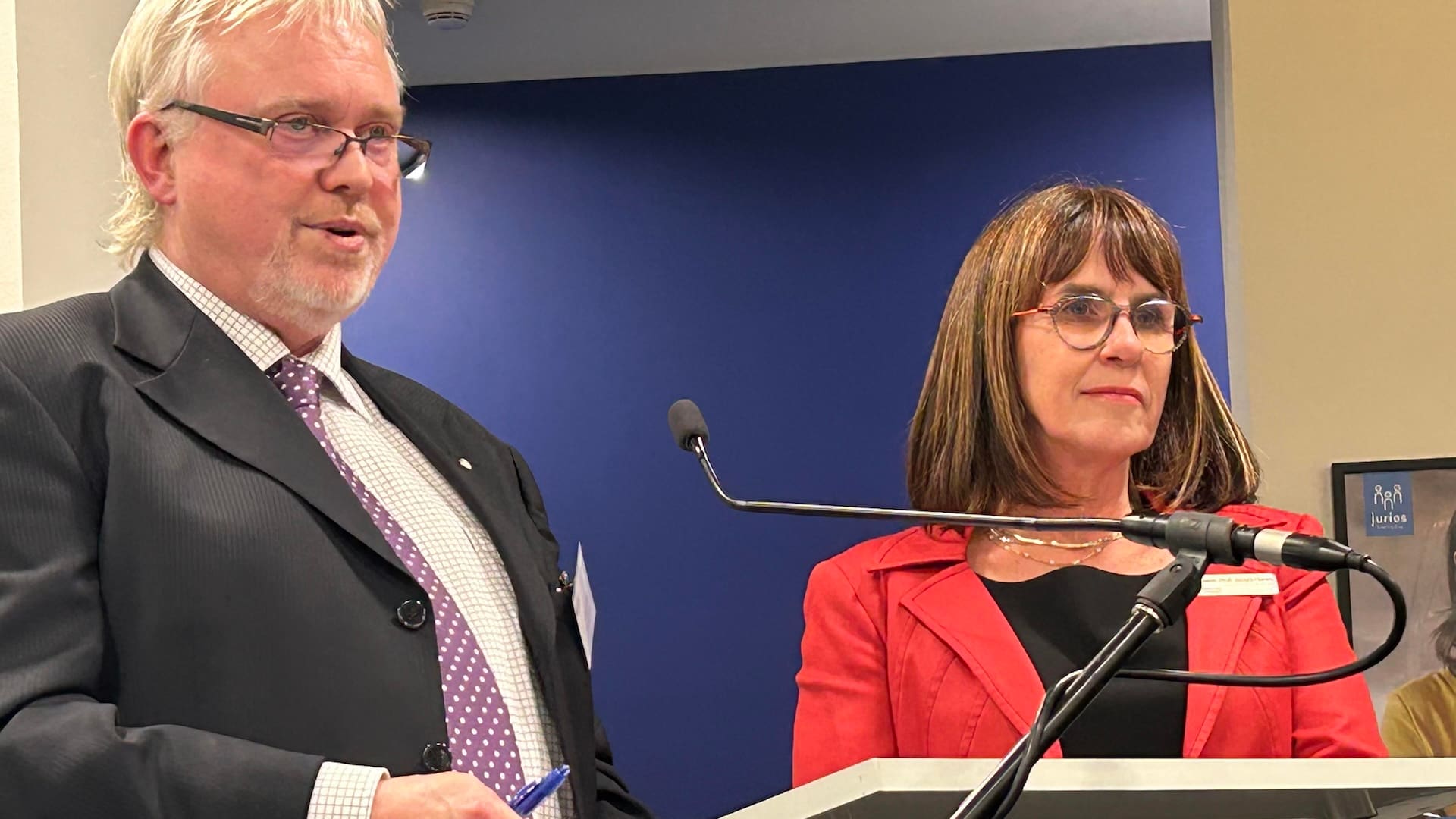
In a powerful evening of reflection and reform, Monash Law celebrated the launch of two groundbreaking books - Sexual Assault Trials: Challenges and Innovations and Making Jury Trials Fair at the County Court of Victoria. The event brought together judges, academics, legal professionals, and researchers to explore the evolving landscape of jury trials and sexual assault proceedings. The launch highlighted the impact of legal research by Monash Law.
Sexual Assault Trials: Challenges and Innovations is the result of a conference exploring Sexual Assault trials, hosted by Monash Law in 2023. So successful was the conference that speakers at the conference were asked to provide a book chapter to share their learnings in written form. The resulting book is co-edited by Associate Professor Jacqui Horan and Dr Greg Byrne PSM.
Making Jury Trials Fair is based on Byrne’s PhD which was completed in 2022 under the supervision of Professor Jonathan Clough and Associate Professor Jacqui Horan . Dr Byrne was awarded the Mollie Holman medal for excellence in research for his thesis in 2022.
A fitting venue for a vital conversation about juries
Held in the Jury Pool Room of Victoria’s principal trial court, the launch was described by Chief Judge Amanda Chambers as 'very appropriate' given the subject matter of both books.
Chambers acknowledged the traditional owners of the land and welcomed attendees, including members of the judiciary, legal profession, and academia. She emphasised the importance of public confidence in the jury system.
"It goes without saying that public confidence in our system of trial by jury is essential in upholding the rule of law in our democracy".

Sexual Assault Trials: Challenges and Innovations
Co-edited by Associate Professor Jacqui Horan and Dr Greg Byrne PSM, with a chapter contribution from Associate Professor Becky Batagol, Sexual Assault Trials: Challenges and Innovations draws together research from Australia, Aotearoa New Zealand, and Argentina.
The book examines the persistent challenges in sexual assault trials and proposes innovative solutions.
Chambers praised the book as, “a remarkable collection of work that is meticulously researched and covers a broad spectrum of topics.”.
Topics include critiques of affirmative consent laws, the role of expert witnesses, jury directions, and the issue of jurors acting as detectives.
"The authors draw on a vast array of literature and other research combined with a very real understanding of the challenges we face in dealing with these difficult trials."
Innovative legal research and practical legal solutions
Associate Professor Horan shared the origins of the book, which stemmed from a successful jury conference in Melbourne.
"We thought we'd try something different. We actually involved some victims in the discussion that was carefully handled, but it was a magnificent success. ".
The conference inspired contributors to develop chapters based on their presentations, resulting in a rich and diverse compilation.
Dr Byrne highlighted several chapters, including a case study on trauma-informed police training and an analysis of Victoria’s 2023 affirmative consent laws.
" We examined the deeming provision exceptions to it and how it interacts with jury directions in Victoria, and we concluded that the reforms risk introducing a new set of problems and are unlikely to achieve the objective of shifting scrutiny from the actions of the victim survivor to the accused," he explained.

Her Honour Judge Felicity Pia Hampel.
Making Jury Trials Fair: A Jury-Centric Approach
The second book launched, Making Jury Trials Fair, is based on Dr Byrne’s PhD research, which earned him the Mollie Holman Medal for excellence in research. Chambers described the book as, "Essential reading for anyone interested in jury reform” and commended Byrne’s call for a jury-centric approach.
Byrne’s book challenges the assumption that jurors understand and apply judicial directions.
" Our court system operates on the pragmatic assumption that jurors understand directions, and it's pragmatic because we don't actually get into the jury room. We have jury confidentiality and the so-called exclusionary rule. The question is, what if that assumption is flawed?".
He proposes a five-step jury-centric framework and the establishment of a Jury Advisory Council to guide reform.
Voices from the Judiciary suggest next steps
Deputy Chief Judge Meryl Sexton, who wrote the foreword for Sexual Assault Trials, emphasised the book’s balanced approach.
"This is not an anti-accused book. A fair trial is a fair trial to all involved".
She highlighted the practical innovations in its chapters, including written jury guides and expert panels.
" To hopefully further wet your appetites to read this book, I advise that there are a few things that I may well be using in my next sexual assault trial, for example, to avoid the juror detectives getting to work as described in chapter nine.".
The Honorable Felicity Hampel, who wrote the foreword for Making Jury Trials Fair, echoed the importance of understanding juror perspectives.
" A trial's not fair if those who are responsible for deciding whether an accused is guilty of charges aren't able to understand what they need to do to make their decision."
She praised Byrne’s work for lifting the veil of assumption and encouraging a fresh lens on trial processes.