
Professor Paula Gerber launches Sex, Gender & Identity: Trans Rights in Australia
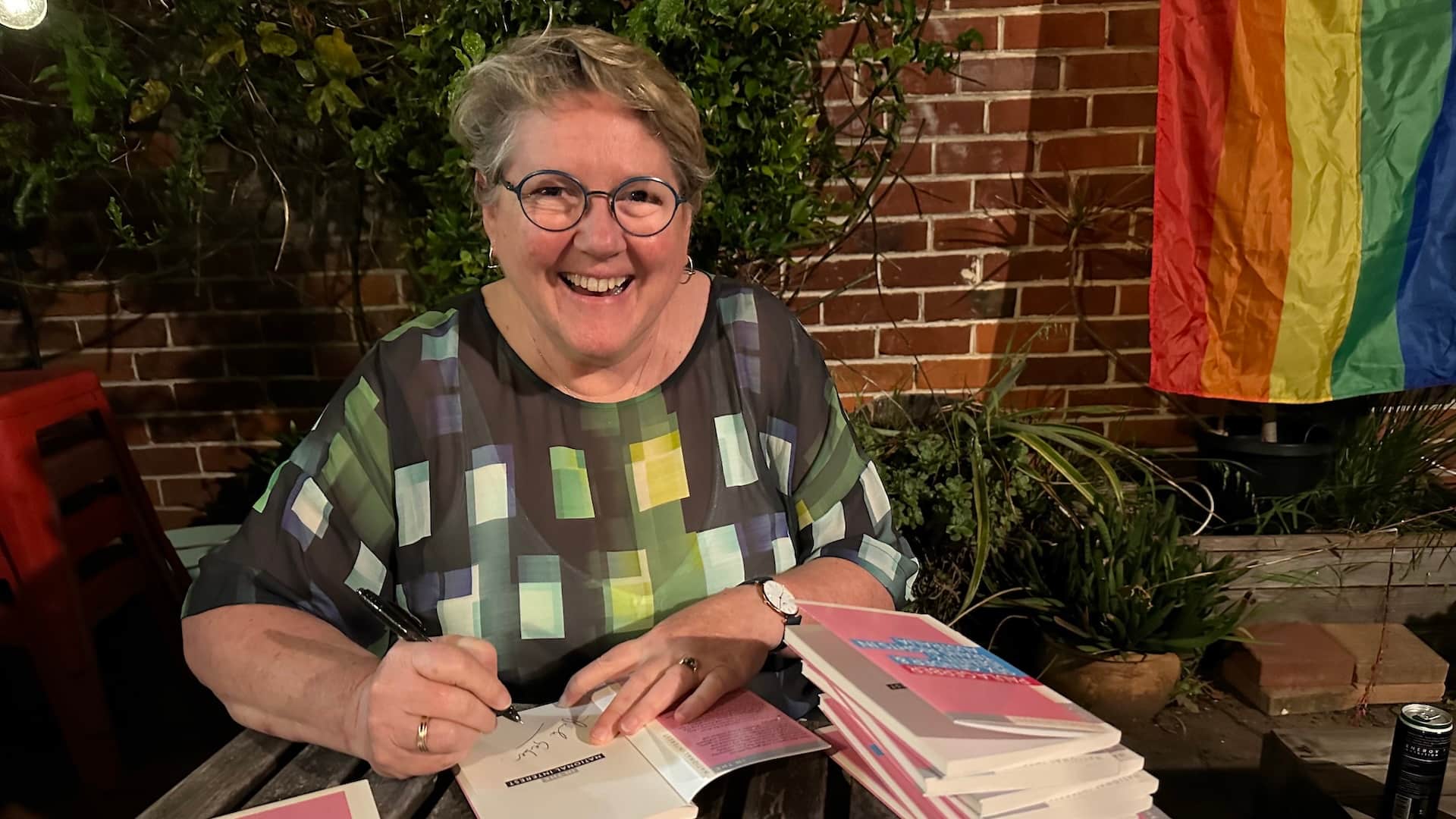
Professor Paula Gerber’s new book blends rigorous legal scholarship with an enduring belief in justice and dignity for all. To launch Sex, Gender & Identity: Trans Rights in Australia, the Monash Law academic has travelled the length and breadth of the country to speak personally and passionately to a number of enthusiastic audiences.
At the Australian National University’s Meet the Author event, Professor Paula Gerber reflected on a lifetime dedicated to advancing human rights. Speaking with Professor Kim Rubenstein before an audience of scholars, students and advocates, she shared her origin story as a human rights advocate.
“I think it was always inevitable that I was going to be a human rights lawyer and an academic,” Gerber said.
“I have seen firsthand a number of human rights violations. I’m the child of a refugee, a Holocaust survivor, and I’ve seen discrimination because of that background. I’m a lesbian, and I’ve experienced firsthand the discrimination that the LGBTIQ community faces”.
Find out more about Trans Awareness Week 13th - 19th November
From lived experience to research leadership
Gerber’s conversation traced her journey from personal experience to public scholarship.
“In my lifetime I’ve seen a lot of advances in the human rights of the LGBTIQ community - laws like marriage equality, the banning of conversion practices, and expungement of convictions for those wrongly criminalised for being gay,” she said.
“But that increasing respect for the rainbow community has not been experienced by everyone to the same degree. At the moment, trans and gender diverse people are being particularly targeted with hate and discrimination. This book is my contribution to trying to progress us a bit closer to a society where everyone enjoys respect, dignity and equality”.
Her commitment is both academic and deeply personal. As a Deputy Director of the Castan Centre for Human Rights Law, Gerber spent years researching international and domestic frameworks that protect, and too often fail to protect, LGBTIQ+ communities. Her work, she explained, aims to make complex legal issues accessible to the public while maintaining a focus on humanity and inclusion.

Paula Gerber at Avid Reader bookshop in Brisbane with a queue of signature seekers.
Understanding sex, gender and identity
One of the highlights of her conversation with Rubenstein unpacked how language and understanding have an influence on equality.
“Language has been weaponised against trans and non-binary people,” Gerber said.
“And I don’t think it’s all malicious. I think there's a lot of ignorance about what terminology is correct and what is offensive”.
She illustrated this inadvertent weaponisation through an encounter with a journalist who confused ‘sex’ and ‘gender’ .
“They said people were travelling to the US to engage in fertility treatment where they can ‘choose the gender of their baby’. I told them, ‘They’re not choosing the gender of their baby, they're choosing the sex of their baby. Nobody knows what the gender of that child will be.’ I said, if nothing else, please use the correct terminology. And the next day, the headline still said ‘gender’. So we’ve got work to do”.
In the book, Gerber explains that sex is multidimensional, shaped by chromosomes, hormones, anatomy and biology.
“Sex is more than just chromosomes, and it can be changed. The law recognises that,” she said. “Gender, Is a social construct. Gender is what a society from time to time, from place to place, thinks should be the roles that are performed and the behaviors and the looks and the attributes of someone, based on their sex.”
Her explanation reframes a debate often distorted in public discourse.
“ For a long time we’ve thought of sex as a binary. A helpful analogy is that we don't just describe people as old or young - we recognise that age is on a spectrum. We don't describe people as tall or short - height is on a spectrum. We need to start thinking of sex and gender in the same way; as being on a spectrum rather than a binary.”.
History, identity and resilience
While the focus of the book is explained in the title Sex, Gender & Identity: Trans Rights in Australia, Gerber also situates her research in a historical and cultural context.
“A lot of trans and non-binary people today, especially young people, can feel very isolated and very alone,” she said.
“ I found it incredibly distressing last year, when I read a Victorian coroner's report into the suicide of five young trans women. We cannot stand by and let that happen.”
“There's lots of things we can do to better support trans and non-binary people. I think it helps to know the history, to know that even though trans people might feel alone, for as long as humans have roamed the earth, there have been gender diverse people. That’s what my research really exposed.”
She pointed to examples from history, such as the Roman Emperor Elagabalus, who sought gender-affirming surgery in 221 CE, and the rediscovery of ancient graves that suggest the existence of gender-diverse people throughout human civilisation.
Closer to home, Gerber spoke of Indigenous understandings of gender diversity.
“It’s wonderful to see where we are now, and horrible to see what happened to trans First Nations Peoples when colonisers arrived and stamped out anything that they perceived as sexual or gender non-conforming,” she said.
“For a long time First Nations trans people have not felt comfortable embracing their cultural identity as well as their gender identity. That is changing and they're reclaiming the language of sister girls and brother boys and their cultural and gender identities.”.

Paula Gerber in conversation with Anna Cody at Gleebooks in Sydney.
Law and human rights: progress through persistence
Turning to law, Gerber described how legislative change can both reflect and drive societal progress.
“The law is my catnip - we're back in my comfort zone talking about legal recognition,” she said with a smile.
“Australia has been at the forefront of reform, particularly through the 2013 amendments to the Sex Discrimination Act, which removed the binary concept of sex and prohibited discrimination on the basis of gender identity”.
She recounted the 2024 landmark Australian case, Tickle v Giggle, where a trans woman successfully argued that exclusion from a women-only app constituted discrimination.
“It’s the first time that the prohibition on discrimination on the basis of gender identity had been tested in court,” Gerber explained.
“ It's now been appealed. The arguments have been made and we are awaiting the judgment, which will probably be delivered early next year.
The conversation also highlighted how global frameworks reinforce domestic rights.
“After the Holocaust, the international community said, ‘We cannot allow this to happen again,’” Gerber said.
“The world said there must be minimum standards we all agree to live by”.
She outlined cases where individuals have used UN human rights mechanisms to challenge domestic laws, demonstrating how international advocacy can lead to local change.

Paula Gerber at Readings bookshop in Melbourne.
Global perspectives on trans rights
Gerber’s book surveys global trends, identifying countries that are regressing and others that are leading reform.
“ It's very easy for everyone just to point to the US and Trump, and to point to the UK and the For Women Scotland decision and say it's all doom and gloom. I think we need to broaden our look, our gaze beyond Western countries,” she said.
“ So in the end, I chose seven countries and four of them are countries where things are going backwards for trans and non-binary people. And three of them are where advances are being made.”
One of those is Pakistan, which dramatically improved its ranking in the Trans Rights Indicator Project (TRIP) which evaluated the legal situation for trans people in 174 countries.
“When the project began in 2000, Pakistan scored 7.69%. After reforms and court victories, it’s now over 84.62% - the biggest improvement of any country,” she said.
Germany also features as a case study in progress.
“ We know that a very large proportion of the trans community in Germany were wiped out in the Holocaust. But now Germany is one of the leading countries in terms of facilitating changing your sex on your identity documents to conform with your gender identity,” Gerber explained.
By contrast, she described the United Kingdom’s For Women Scotland case as “fundamentally flawed, distressing and a bit scary.” Gerber warned that the court’s interpretation of “sex” as “biological sex” under the Equality Act, risks entrenching discrimination. The Supreme Court
“The UK Human Rights Act 1998 incorporates the European Convention on Human Rights (ECHR) into domestic British law. It requires all public bodies - including courts - to respect human rights in their decisions. You cannot find human rights being considered anywhere in the judgment of For Women Scotland,” she said.
“ Now, it is up to the British government to step up and say, ‘oops, our bad, we need to amend this outdated Equality Act to make it fit for purpose in 2025 and beyond. Because the intent of the Act is actually to promote equality, not to reduce it ”.

Richard Fidler and Paula Gerber after her interview for ABC Radio on Conversations.
Changing attitudes through education
Throughout the conversation, Gerber returned to a theme that threads through all her work: education.
“I used to think law was the answer to everything,” she said.
“ I came to realise that the law is only one very small part of the picture. Societal attitudes are vital.”
She cited South Africa as a country where progressive laws coexist with persistent prejudice.
“ South Africa was the first country in the world to prohibit discrimination on the basis of sexual orientation, in a constitution, Nelson Mandela said, ‘I know what it's like to be discriminated against because of an innate attribute. I don't want anyone to experience that.’ Unfortunately, Nelson Mandela didn't have the foresight to also include gender identity,”
“There's been some wonderful decisions out of the South African Constitutional Court, including marriage quality. South Africa is the only country in the African continent where same-sex couples can marry. But societal attitudes have not kept up. It is still one of the most dangerous places to be gay, and she said.
For Gerber, education is the bridge to societal attitude adjustment.
“There’s no point winning cases in court if people don’t know about them, or support them,” she said. “We need more resources devoted to education and awareness-raising so that societal attitudes and the law are in sync.”
Celebrating scholarship and advocacy
As the discussion drew to a close, Rubenstein reflected on the importance of Gerber’s contribution. The event, part of ANU’s Meet the Author series, underscored how legal scholarship can inspire public conversation about rights, respect and equality.
Gerber’s commitment, Rubenstein noted, mirrors the mission of universities themselves, which is to bring ideas into the public domain and challenge inequity through knowledge.
“I think this book assists others in resisting discrimination,” Rubenstein said during the conversation, praising its clarity and accessibility .
In Sex, Gender & Identity: Trans Rights in Australia, Gerber brings together law, history and lived experience to create a resource for understanding and empathy. Her message, grounded in scholarship but driven by compassion, resonates beyond the academy.