
A dagger at the heart of society
The ‘death cult' attack on Australian police during WW1

By Dr Stephen Gray
In late 1916, just over one hundred years ago, three men were accused of shooting dead an unarmed police officer in the New South Wales town of Tottenham, four hundred miles from Sydney.
Two of the men, Roland Kennedy and Frank Franz, were members of the radical anti-war Industrial Workers of the World, or IWW, otherwise known as the ‘Wobblies’.
Their IWW membership, as much as their crime, set them on a collision course with powerful political forces during a turbulent yet forgotten time in Australia's past.
The question of ‘right’ and ‘wrong’ does not concern us
The IWW first formed in Chicago in June 1905. They were a fighting organisation, born out of the struggles of American copper miners at Colorado’s Cripple Creek. They rejected voting for parliament and the Labor Party, and believed only ‘direct action’ would lead to the proletarian revolution, preceded by an apocalyptic general strike.
In their own words, they aimed
To use any and all tactics that will get the results sought with the least expenditure of time and energy… The question of ‘right’ and ‘wrong’ does not concern us."
Tottenham was a mining town with a strong ‘Wobbly’ element, and a reputation for ‘disorderly conduct’ in the eyes of the police.
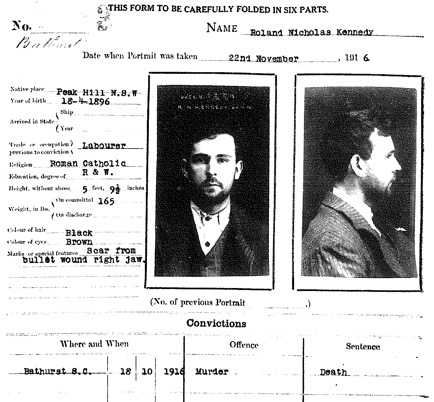
Among the most prominent was Roland Kennedy. He was a Tottenham local whose IWW agitation had cost him his job at Mount Royal, the local mine. A friend of part-German origin, Frank Franz, also joined the Wobblies in late 1915.
Together with other members, they distributed Wobbly pamphlets at street meetings, and went kangaroo-shooting when out of work. Possibly they also organised sabotage at local mines that employed scab labour, or sacked workers who were IWW men.
A ‘turbulent element’ takes hold
By mid-1916 local authorities had become so worried about a ‘turbulent element’ that they requested police protection for the town.
In late September, it arrived in the form of Constable George Duncan. Duncan was a policeman of fearsome reputation, on a mission to ‘clean up’ the town.
On 25 September 1916, his second day on the job, Duncan arrested an IWW member, a German named George Wann for offensive language. Wann violently resisted the arrest, which happened publicly in the street, in front of a crowd, which ‘hooted’ the policeman.
Amongst that crowd was Roland Kennedy.
Kennedy exchanged strong words with Duncan. Duncan asked him for his name. Kennedy said "I’ll write it down for you", suggesting the constable was too illiterate to write it himself. On another version of the conversation, it was Duncan who told Kennedy he was too ignorant to write his name.
The next day was very wet, the wettest spring in twenty five years. In such weather Duncan rode eighteen miles with the man he had arrested, George Wann, to the nearest police jail at Dandaloo. When he returned, he was soaked, and probably in a bad mood.
He went to the hotel pub to try to find Kennedy and summons him for offensive behaviour and indecent language to him the day before. Kennedy was not there, but he heard what had happened.
Late that evening, at about nine o'clock on 26 September 1916, Duncan was sitting at a typewriter at the police station, working on a report about diseased cattle, when he was struck and killed through the window by two .32 calibre bullets. The first two bullets were fired at the same time. About three seconds later a third bullet, a .38, was also fired, but this bullet missed Duncan.
Swift response to the murder
That night and the next day, officers arrived from all the nearby towns, by mail coach, goods train and horse. A doctor struggled in by motor car, getting bogged in the mud on the way.
Conditions at the Tottenham police lock-up were primitive. Suspects had to be held in two wooden cells in the back yard of the station. Another was held under guard in the office. They could overhear the police talking, and the police could hear them.
Even worse, police had to share their office with Duncan’s corpse. It was so wet that when they tried to bury Duncan, a couple of days later, his grave kept filling with water. Eventually he was buried in the Presbyterian cemetery in Parkes.
Two CIB detectives rushed from Sydney to investigate. Within a couple of days they picked up Kennedy and Franz. Both Kennedy and Franz made statements in which they denied involvement.
However, on 30 September, Franz confessed to the murder.
According to the police, he confessed because he had been unable to sleep, and had to clear his conscience. Franz blamed Roland Kennedy, along with Kennedy’s older brother Herb. He said he had been pressured into it, and only fired the later shot, without aiming, and nowhere near the victim.
However, there was another reason for his ‘confession.’ As Franz later said, "It was stated to him that, if he made a confession and gave evidence for the crown, his life would be spared and he or his family would probably receive the reward", of some £200.
Franz’s confession was put to Roland Kennedy. Initially he said "it is all lies", however he then "turned very white, beads of perspiration came out on his forehead, he was trembling all over" and said "give me a drink of water." Roland Kennedy also confessed.
A few days later on 2 October, they were asked to re-enact the murder. Franz placed three pegs on the ground outside the police station window to show where the shots had been fired from.
Roland Kennedy placed a peg for himself and another for Franz, but refused to place a third peg as he said his brother Herb had no involvement.
There was a coronial inquest a few days later. The coroner, James Patterson, investigated and returned a "verdict of murder, feloniously and maliciously committed by Roland Kennedy, Frank Franz and Herbert Kennedy." They were then committed for trial.
The trial begins
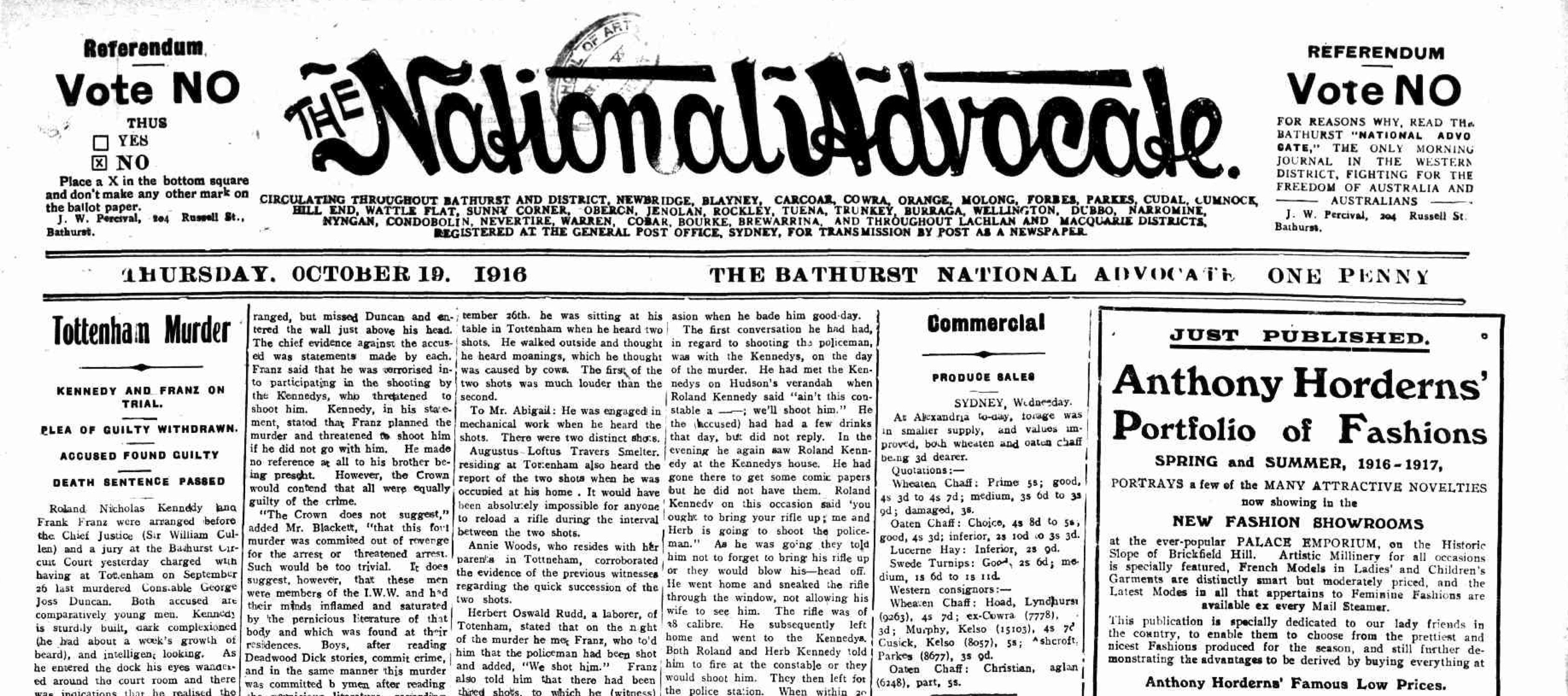
The trial began in Bathurst on 16 October 1916.
Roland Kennedy pleaded guilty. However, he had failed to understand the trial process. He changed the plea after the judge pointed out that he would only have the chance to explain his actions if he pleaded not guilty.
Kennedy said he and Franz alone went to the station, with Franz leading the way. Franz said "Count three!" and they fired simultaneously at Duncan through the window. He said if not for Franz he would not have taken any part in the shooting.
Franz said he, Roland and Herb went to the station. Roland and Herb fired at Duncan. The brothers had threatened him that they would shoot him dead if he did not fire. He then fired a shot, several seconds later, but could not see Duncan as he fired.
Effectively, Franz had already confessed. He could only hope his deal with the prosecution and the State would save his life.
The prosecution blamed the IWW. They failed to mention drunkenness or the desire for revenge, instead saying the men "had their minds inflamed and saturated by the pernicious literature of that body, which was found at their residences."
The jury took only an hour to find Roland Kennedy and Franz guilty of murder. The judge, NSW Chief Justice Sir William Cullen, duly sentenced both men to death.
Roland’s older brother Herb was tried separately, a month later. Unlike Roland, Herb had not confessed, and the only evidence against him was that of Frank Franz. Besides, Herb was a family man. The prosecution did not press the case, and the judge directed an acquittal.
Mercy meets politics
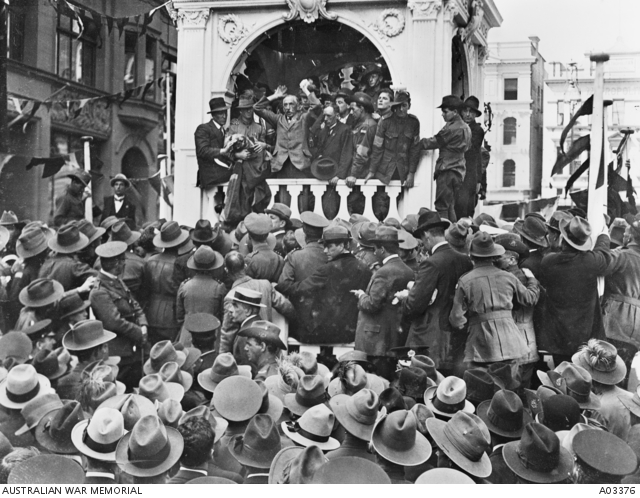
The IWW mounted a public campaign to have the men’s life spared. The prospects for success seemed reasonable.
The NSW Premier, Holman, had always opposed capital punishment, and there had been no executions in the state for years. Holman was a former Labor man, and had in fact been Attorney-General when Cabinet commuted a death sentence imposed on a young man for murder about five years before.
And for Franz, at least, there was also the question of the prosecution deal.
However, this took place in the shadow of the conscription campaign.
In August 1916, Prime Minister Billy Hughes announced a referendum on conscription. Hughes was a strong supporter of the British Empire, and at the end of 1915, had promised the British an extra 50,000 Australian troops.
As PM in January 1916, Hughes launched a stinging attack on the IWW. He denounced them as "foul parasites who have attached themselves to the vitals of Labour."
It is no use treating these people like a tame cat," he snarled. "They must be attacked with the ferocity of a Bengal tiger."
The Wobblies returned fire. They called him "the dwarfish popinjay who is Labor Prime Minister of Australia, and whose sole claim to eminence and notoriety is the ‘gift of the gab’."
But Hughes had the War Precautions Act at his disposal.
In early 1916, ‘Wobbly’ leader Tom Barker was jailed for printing a cartoon "of a gigantic field-gun with a soldier crucified on it and top hatted persons collecting his dripping blood in bowls." He was convicted for prejudicing recruiting under regulation 28 of the Act.
A Counter-Espionage Bureau was established, and became "specially engaged in unravelling the schemes of the IWW."
In September, it arrested the ‘IWW Twelve’ – men charged with treason and tried for sedition and conspiracy following several factory fires in Sydney.
To the prosecution, the IWW was an octopus of German sympathisers and fifth-columnists, a "gigantic conspiracy" to "levy war against the King within the State of New South Wales".
To the scaffold
The men’s appeals to the Executive Council and the Court of Criminal Appeal were swiftly rejected.
Franz and Kennedy were executed at Bathurst jail on 20 December 1916, less than three months after their crime.
Franz was executed in breach of a deal, and as a police witness who had turned ‘King’s Evidence’. This was unique in Australian and probably British history, as the working-class weekly Truth pointed out.
To the prosecution and the conservative press, IWW propaganda was squarely to blame for the shooting. Legislative Council member J D Fitzgerald summed it up - it was a case in which:
Weak minded Australians were drawn into nets cast by foreign intriguers."
This view perfectly suited both the New South Wales and the federal governments, which were intent on clamping down on the IWW.
Just a few days before the executions, on 18 December 1916, the federal government passed its Unlawful Associations Act.
Effectively this made the IWW illegal. In introducing the Act, politicians referred repeatedly to the shooting of the policeman – in the words of a Tasmanian senator, "policemen [have been] shot down at their desks."
Prime Minister Billy Hughes himself said:
This organisation holds a dagger at the heart of society, and we should be recreant to the social order if we did not accept the challenge it holds out to us. As it seeks to destroy us, we must in self-defence destroy it."
"Good-bye, boys."
Roland Kennedy, at least, seems to have welcomed death. He never showed remorse or attempted to justify himself.
‘Good-bye, boys’, were his only words on the scaffold.
His brother Kevin wrote to his mother on learning of his brother’s fate:
Well Mother I can assure you there is no necessity to worry, as I know that as a Revolutionist that it came to Rolly as a great relief to know that he was executed not because of what he had done, but because of his accepting a Revolutionary philosophy and dared to expound it to the workers that they may enjoy life…
Only a youth as intense as he could feel as deeply as he did the flight of time.
Life was very short, child that he was he had never had a childhood.
He had early seen struggle and forced to struggle.
He thought himself hard, stern and uncompromising.
Of course he was not; it is only that he had a few illusions, and that the sensitive nature of childhood and youth had suffered at what he beheld in the Industrial Penitentiarys or slave shops."
As far as the ‘Wobblies’ were concerned, there was no doubt that the sentences were politically motived.
On 21 December 1916, the day after the executions, the Sunday Times printed a cartoon showing the ghost of Ned Kelly, in full armour, standing, arms folded, behind an IWW man holding a rifle and a firestick. "If they hanged me, what should be done with him?", the caption read.
Troubling questions remain
Troubling questions remain about this episode.
Why did the police go straight to arrest Kennedy and Franz? There were no eye-witnesses, and it was at night. Presumably suspicion fell on them because they were IWW men.
Their confessions are suspect. Franz was offered a reward. Kennedy only confessed when told of Franz’s statement. Confession by threat is illegal. So is confession by inducement – and the police did not even stick to their part of the deal.
According to ballistics evidence, there were three men. If so, why were the charges dropped against Herb? Some said it because he was a family man; or perhaps he was less involved with the IWW. If it wasn’t Herb, who was it?
The episode is almost forgotten now in Australian history. Nevertheless it is an extraordinary one. All this took place against the backdrop of the Somme and Gallipoli, and the referendum on conscription.
The IWW, the small protest group was important enough to merit the government’s closest attention: a case of attacking the Sab-Cat with "the ferocity of a Bengal tiger", to adopt the argot of the times – or using the sledgehammer of the State to crack a nut.
Radicals in our midst
A historian, Rowan Day, has compared the IWW men to the Russian radical Nechaev, as portrayed in Dostoyevsky’s Devils.
In J M Coetzee’s The Master of Petersburg, when a fictional Dostoyevsky goes to the police to ask for his dead son’s effects, they tell him his son was an associate of Nechaev himself.
“How deeply,” says the police officer, “he had fallen under the influence of the Nechaevites, who have led astray heaven knows how many of our more impressionable and volatile young people… Explain to me again: why are dreamers, poets, intelligent young men like your stepson, drawn to bandits like Nechaev?”
“I do not know,” responds Dostoyevsky. “Perhaps because in young people there is something that has not yet gone to sleep, to which the spirit in Nechaev calls. Perhaps it is in all of us: something we think has been dead for centuries but has only been sleeping.”
So did the IWW men also respond to something ‘we think has been dead for centuries but has only been sleeping’?
Could some members of the ‘Islamic death cult’ - as some Australian politicians have termed it in recent times - have more in common with the anarchists and Nechaevites than we might realise?
If we understood these similarities in our history, deradicalisation campaigns might stand a better chance.
After all, one hundred years ago, public reactions to perceived radical threats were not so different to today.
Hear Dr Stephen Gray discuss the Tottenham murders on Just Cases, a podcast from Monash Law School that explores the back story to some big legal cases that have flown under the radar.
An earlier version of this article was first published as 'Death Cults’, Murdering a Police Officer, and the First World War in the Alternative Law Journal Vol 41, Issue 4, 2016. (Login required)