
Finger-prick test could screen for early Alzheimer’s
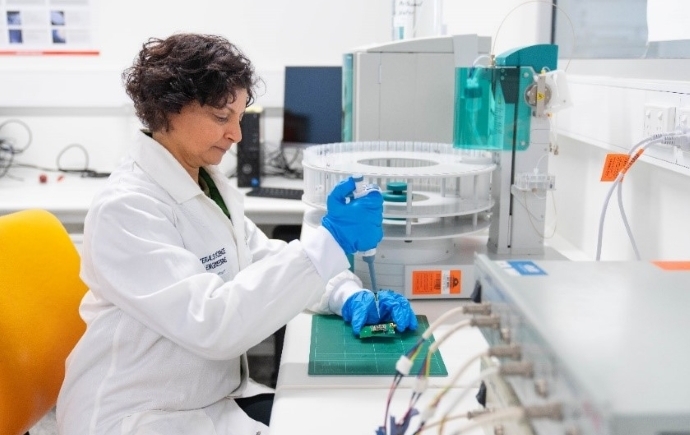
GPs could soon be able to screen their patients for Alzheimer’s Disease (AD) using a simple handheld device, thanks to Monash Institute of Medical Engineering (MIME) project grant support.
Currently, there are no accessible tools for early diagnosis of AD, the leading cause of dementia.
Monash University engineers have developed the first-of-a-kind finger-prick blood test with ‘needle-in-a hay-stack’ precision to detect the hallmark (protein) biomarkers in early AD before symptoms progress.
Lead researcher, Associate Professor Sudha Mokkapati has been working on the device for four years.
The size of a credit card, it uses world-first patented sensor technology which can detect ultra-low concentrations of disease markers in blood in minutes.
With the number of Australians diagnosed with dementia set to double by 2054, the quick blood test could become a vital tool to streamline diagnoses by giving GPs unprecedented access to non-invasive diagnostics.
Associate Professor Sudha Mokkapati from Monash Materials Science and Engineering, developed the proof-of-concept electronic sensor for point-of-care testing, removing the need for laboratory-based pathology tests, and making the process to diagnosis faster and more cost-effective.
“It’s simple to use, low-cost and portable so it could be made widely accessible to GPs to screen patients right at the point-of-care. Detecting very early disease in large populations could dramatically change the trajectory of this burdening disease for many patients, shave millions off associated healthcare costs and reduce the load on the healthcare system and its employees,” said Associate Professor Mokkapati.
This project was one of six awarded Monash Institute of Medial Engineering (MIME) Invent Research Support grant support in late 2024. Associate Professor Mokkapati was also involved in the MIME MedTech Commercialisation Advancement Program (MCAP) in 2024.
“MIME Invent Research Support helped us to gather initial results to put forward a strong case for external funding to further our research and product development,” said Associate Professor Mokkapati.
“The MIME MCAP supported the project team with aspects of business strategy, IP development, regulatory and product development. We also received directional guidance on the immediate next steps for translating our technology from lab to the market. It equipped us with language and tools to better portray our story to potential investors/funders,” said Associate Professor Mokkapati.
Next steps for the project are to undertake the clinical validation needed to bring this a step closer to enabling reality and in turn deliver a better disease management and treatment protocol for AD.
Watch this space for further developments.
For more information on MIME Invent Research Support grant support visit: https://www.monash.edu/mime/programs/invent-research-support