
Meet Monash University’s latest Women in STEMM Student Leaders – Lane Carrandi
PhD Candidate – School of Public Health and Preventive Medicine
Research focus: Health economics and implementation science
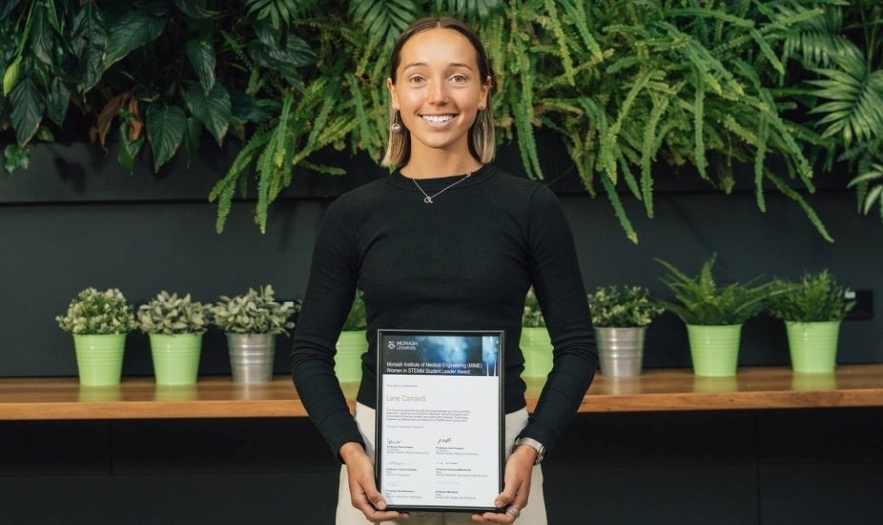
Lane Carrandi is a recipient of a 2024 Women in STEMM Student Leader Award. These awards aim to recognise, celebrate and support women students at Monash University who are contributing to innovation in healthcare and medical technologies. MIME spoke to Lane upon accepting this award.
What is your chosen degree and what inspired you to pursue this path?
I am currently pursuing a PhD in Health Economics and Implementation Science. Originally, I am from the USA, where I completed my Bachelor of Science in Health Promotion and Behavior. Since moving to Australia five years ago, I have also completed a Master of Public Health. Through my work in healthcare and industry organisations and academic institutions internationally, I have identified that one of the main barriers to implementing innovations in healthcare is resources—both money and time. I am passionate about building health economic capacity, with a particular focus on global clinical trial research, developing methods for practical implementation, and driving global healthcare innovation.
What is your favourite aspect about this STEMM field?
My favourite aspect about this field is the people I get to work with. I feel so lucky to be a part of the team at the Australian and New Zealand Intensive Care Research Centre (ANZIC-RC). Being in a clinical trials centre, I get to interface with a diversity of experts, including clinicians, statisticians, project managers, methodologists, and clinical trialists. Everyone brings something to the table, and we are all working towards a shared goal. This collaborative approach makes learning fun!
Can you elaborate on your contribution to innovation in healthcare and medical technologies?
My work focuses on addressing the pressing challenge of implementing innovations in resource-constrained settings. The aim of my PhD is to develop an economic implementation toolkit in collaboration with end users. This toolkit is designed to guide clinical trialists, service providers, and healthcare funders through the complex process of implementing innovations.
I have first-authored peer-reviewed publications in health economics, implementation science, and health services research. I have also actively contributed to industry and government evaluation reports, as well as research translation activities to support knowledge dissemination.
Can you tell us a little of your leadership experience?
Throughout my career, I have strived to be a positive role model and mentor for individuals aspiring to build careers in STEMM. I actively engage with students and early-career researchers, sharing my experiences and insights. For example, this year, I led a three-day international workshop in the United Kingdom which brought together 30 implementation scientists, health economists, patient contributors, and patient and public involvement and engagement researchers from Australia and the United Kingdom. I helped to secure grant funding to support early-career researchers and patient contributors to attend. The feedback from attendees was overwhelmingly positive and has led to ongoing international collaborations.
The MIME Women in STEMM Student Leader Awards recognise student leadership. What does receiving this award mean to you?
This award recognises my commitment to improving the representation of diverse perspectives in leadership and ensuring these voices have a seat at the table when decisions are being made. Receiving this award also reminds me of those who have inspired me in my career and offered me a seat at their table.
Lisa Higgins, Helen Skouteris, Amy Grove, Carol Hodgson, and Emily Callander – thank you for your mentorship and endless support. Al Meredith and Bill Wiggins – thank you for being there every step of the way.
What will the $1,000 cash prize to support your studies go towards?
The cash prize will support me to attend conferences and present my research. Networking with colleagues and disseminating my research in the final year of my PhD will be extremely valuable to my career.
What are you most looking forward to in regard to the MIME networking opportunities afforded to you due to receiving this award?
The MIME community comprises researchers, engineers, and information technology specialists across academia and industry. I am looking forward to the opportunity to expand my networks and link with those who share my passion for healthcare innovation.
Why do you think awards like this are important for Women in STEMM?
Initiatives that recognise minority communities exist because they have largely been left behind. My hope is that one day everyone will be afforded the opportunity to realise their potential. A key mechanism for change is celebrating and dedicating funding for those communities, which is what MIME has done for Women in STEMM.
What is your advice for women in STEMM or those thinking about a career in STEMM?
Relationships are your greatest asset. When I moved to Australia, I did not know anyone. At times, I felt disheartened when trying to build a career. Building and fostering relationships was what catapulted my career growth. Invite people to get a coffee with you, ask them how they got to where they are, and ask them to keep you in mind if any opportunities arise.