
Sperm syringe offers new hope to infertile couples
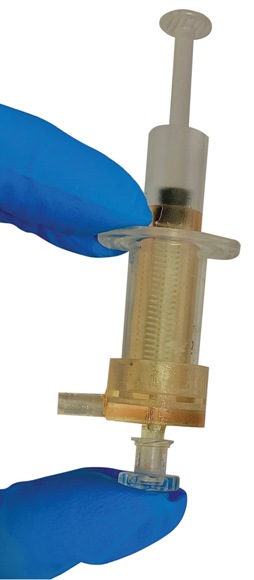
The Sperm Syringe
A syringe that is able to detect viable sperm is bringing new hope to infertile couples.
The world-first syringe can isolate quality sperm in less than 15 minutes, a novel innovation in sperm selection technology in 30 years.
The breakthrough harnesses simple plastic syringe technology, which can be readily mass produced, bringing hope and cheaper treatment solutions to 180 million people affected by infertility worldwide.
Current clinical sperm selection methods are outdated, labour-intensive, and can damage sperm DNA, contributing to miscarriage and low fertilisation rates.
The innovative ‘Sperm Syringe’ device addresses this gap by providing a faster, safer, and more effective way to select motile and high-quality sperm, significantly improving reproductive outcomes.
The syringe works by drawing 1 millilitres of semen into a chamber that then passes through a network of over 500 parallel microchannels. The quality sperm swim through the microchannels into the selection chamber, where they can be extracted, leaving the poor-quality sperm behind. This process takes less than 15 minutes and is able to retrieve more than 41 per cent of healthy sperm from the sample.
Using this method, researchers can improve the quality of sperm selection by up to 90 per cent. This dramatically reduces the need for complex and invasive intracytoplasmic sperm injection procedures (injecting a single sperm into an egg), in favour of artificial insemination directly into the uterus.
Recent funding from the Monash Institute of Medical Engineering (MIME) and AEA Ignite is supporting the Sperm Syringe to transition from 3D printing to scalable manufacturing using plastic injection molding and conducting necessary safety and efficacy studies for regulatory approval.
Lead researcher, Dr Reza Nosrati of Monash’s Department of Mechanical and Aerospace Engineering said the innovation would streamline sperm selection in fertility clinics, ultimately resulting in higher success rates for couples seeking fertility treatment, at lower cost.
“Sperm selection is a crucial part of infertility treatment, but the conventional clinical methods for sperm selection haven’t changed over the past 30 years,” Dr Nosrati said.
“Due to this lack of technological developments, the success rate of treatment methods has stagnated at ~35 per cent per cycle,” said Dr Nosrati.
“Using the sperm syringe we can select sperm with up to 90 per cent improvement in DNA integrity and morphology (make-up), and since DNA quality is directly linked with fertilisation success, we expect to improve assisted reproductive technology outcomes. This technology can help to standardise and streamline the sperm selection process in fertility clinics.”
This project was one of six awarded Monash Institute of Medial Engineering (MIME) Invent Research Support grant support in late 2024.
“MIME support is crucial in advancing the Sperm Syringe towards clinical translation and commercialisation. It allows us to transition to mass manufacturing and complete performance validation for obtaining regulatory approvals, and establish commercial partnerships to bring this life-changing technology to market,” said Dr Nosrati.
“Receiving a MIME Invent Support grant has been instrumental in not only advancing the technical aspects of our project but also in helping us build a strong collaborative structure with Monash IVF, one of the leading IVF providers worldwide, around this project. This alignment will not only accelerate regulatory approvals and commercialisation efforts but also facilitate faster market acceptance and product uptake, ensuring the successful adoption of the Sperm Syringe in both domestic and international fertility markets.”
Watch this space for further developments.
Acknowledgements
- Monash IVF for their support and expertise.

- Professor Mark Green, Professor Deirdre Zander-Fox and Professor Rob McLachlan for their clinical insights and guidance in helping design the Sperm Syringe to be a simple, robust and clinically effective technology.
- MIME and AEA Ignite for their funding which has been instrumental in driving this project forward.
For more information on MIME Invent Research Support grant support visit: https://www.monash.edu/mime/programs/invent-research-support