
AI platform aims to transform aged care by embedding research evidence into everyday practice
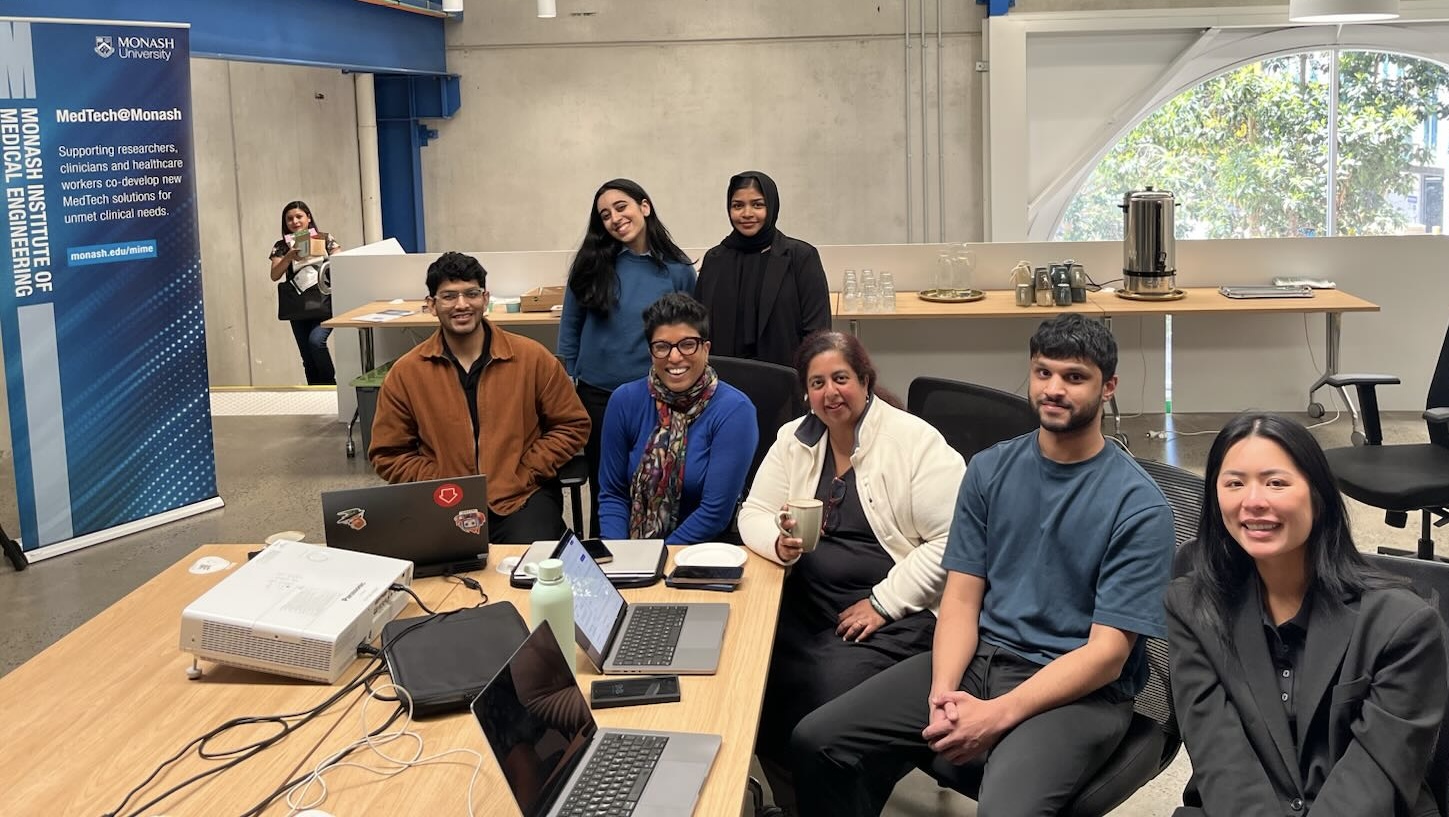
The Evidencea project team
An innovative AI-enabled platform designed to embed research evidence directly into aged care decision-making is being developed with support from a Monash Institute of Medical Engineering (MIME) Invent Support grant.
The project, Evidencea: Harnessing AI to embed evidence and improve outcomes in aged care, brings together fragmented data from multiple aged care systems nationally and links it with high-quality research evidence to help providers proactively identify and respond to risks under the new Aged Care Act.
Led by Associate Professor Darshini Ayton from Monash University’s Faculty of Medicine, Nursing and Health Sciences, the project focuses on government-defined quality indicators such as falls and pressure injuries; with hospitalisations and weight loss to come later—areas that significantly impact the safety, independence and quality of life of older Australians.
“With the new Aged Care Act, providers are being asked to do more than report on quality indicators—they’re being asked to embed contemporary evidence into continuous improvement,” Associate Professor Ayton said.
“But accessing and applying research evidence in real-world care settings is not straightforward. This project is about closing that gap and making evidence actionable at the point of care.”
From reactive reporting to proactive care
Many aged care providers currently rely on dozens of disconnected digital systems that do not communicate with one another. As a result, extracting data for regulatory reporting and quality improvement is often a manual, time-intensive process—leaving little time to focus on prevention and care optimisation.
Evidencea addresses this challenge by integrating data across systems through an API-driven platform, generating meaningful analytics through evidence-based risk prediction and linking identified risks with evidence-based interventions. This enables care teams to understand patterns, predict adverse events and act earlier to prevent harm.
“We don’t want quality of care to be reduced to a compliance exercise,” Associate Professor Ayton said.
“This platform helps providers understand what is happening, what might happen next, and—critically—what research evidence says they can do to prevent poor outcomes.”
Improving safety and quality of life for older Australians
Falls remain one of the most prevalent and serious risks in residential aged care, often leading to hospitalisation and accelerated physical decline. Evidencea’s initial development has focused on falls prevention, with pressure injuries, hospitalisations and weight loss now being incorporated.
By enabling proactive, evidence-informed interventions, the platform has the potential to reduce avoidable harm, maintain independence and improve day-to-day quality of life for residents—while also easing the emotional and operational burden on care staff and families.
Powered by cross-disciplinary collaboration
The project brings together expertise from across Monash University, including Professor Shonali Krishnaswamy from the Faculty of Information Technology and Dr Julie Dao from the Faculty of Engineering, alongside partners in aged care practice.
Support from MIME has been critical in advancing the project from concept to prototype. Early support enabled MIME Invent Student Internship students to work on the project to develop initial wireframes, followed by grant funding which allowed a working prototype that is now being expanded across multiple quality indicators.
“The support from MIME has been truly wraparound,” Associate Professor Ayton said.
“It’s not just grant support—it’s access to students, technical expertise, regulatory insight and commercialisation support. That combination has allowed us to demonstrate proof of concept and build strong partnerships with aged care providers.”
What’s next
The team is now working closely with aged care partners nationally including residential aged care and in-home care to test the platform using real-world data, refine usability and assess feasibility at scale. The next phase will look at expanding to include the quality indicators of hospitalisations and weight loss while also focusing on larger grant opportunities and potential commercialisation or spin-out pathways.
“Our vision is for Evidencea to be an enabling platform for the entire aged care sector,” Associate Professor Ayton said.
“One that not only improves care on the ground, but also provides the data and evidence needed to advocate for the workforce, resources and systems required to deliver high-quality aged care.”
For more information on MIME Invent Research Support grant support, visit:
https://www.monash.edu/mime/programs/invent-research-support
The Evidencea project team consists of:
Associate Professor Darshini Ayton, Professor Shonali Krishnawamy, Professor Sophia Zoungas, Rhiannon Tate, Dr Emma Xu, Dr Julia Dao and Dr Alison Greenway.
The project team acknowledges the support of the Monash Institute of Medical Engineering (MIME), collaborators across Monash University and aged care partners and who have contributed to this research.