
From early support to national impact: How collaboration is driving the future of artificial heart technology
Breakthrough medical technologies rarely emerge from a single laboratory, discipline or institution. Instead, they are built through years of collaboration, shared expertise and strategic support.
The Artificial Heart Frontiers Program (AHFP) is a powerful example of what can be achieved when clinicians, engineers, researchers and industry partners unite around a common goal: transforming treatment options for people living with advanced heart failure.
Today, the Monash University-led program is supported by a landmark $50 million Medical Research Future Fund (MRFF) grant and brings together partners from across Australia to develop next-generation implantable heart devices that have the potential to save and improve countless lives.
Behind this national effort lies more than a decade of collaboration and innovation, including early support from the Monash Institute of Medical Engineering (MIME), which helped bring together engineering, clinical and research expertise that would ultimately contribute to the broader artificial heart program.
According to Dr Jason Coonan, General Manager of the Artificial Heart Frontiers Program, collaboration remains the foundation of the program's success.
"Developing artificial heart technologies isn't something that can be achieved by one person, one discipline or even one organisation. It takes engineers, clinicians, researchers and industry partners all working towards a common goal, and that's exactly what makes this program so powerful."
A shared mission
Heart failure affects hundreds of thousands of Australians and millions of people worldwide. Many patients with advanced forms of the disease have limited treatment options, particularly when donor hearts are unavailable.
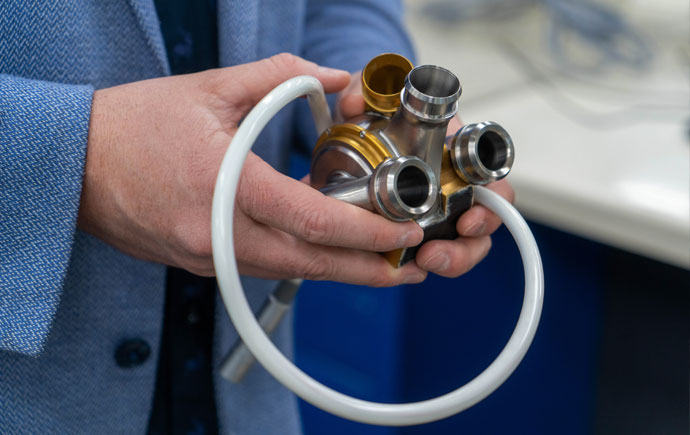
To address this challenge, the AHFP is developing a suite of technologies designed to support patients with different forms of heart failure. These include the BiVACOR Total Artificial Heart for patients with severe biventricular heart failure and the MiniPump, a novel device being developed for patients with heart failure with preserved ejection fraction (HFpEF), a condition that currently has few effective device-based treatment options.
That collaborative approach is essential given the complexity of the technologies being developed.
"When you think about these implants being developed with the support of the AHFP, there really isn't another way to do it outside of a multidisciplinary approach," Dr Coonan said.
"These devices sit at the intersection of engineering, biology and medicine. They require world-class engineering to design and build them, researchers who understand how the body responds to them, and clinicians who can help translate them into patient care. Developing a new implantable medical device is incredibly complex, and success depends on bringing all those disciplines together behind a shared goal."
The AHFP includes research organisations, healthcare partners and industry collaborators across Victoria, New South Wales and Queensland, bringing together expertise in engineering, cardiovascular medicine, translational research, clinical trials and commercialisation.
Building momentum through early support
Long before the AHFP secured national funding, Australian researchers were working to advance new solutions for patients with advanced heart failure. In particular, Professor Shaun Gregory and Professor David Kaye, now Co-Directors of the AHFP, were at the helm of world-leading MCS research and platforms at Monash and Alfred Health.
MIME was an early supporter of Professors Gregory and Kaye, recognising the potential of their pioneering research in artificial heart technologies to address significant unmet clinical needs.
This aid helped strengthen the collaboration between engineering and clinical research, supporting the translational work required to progress promising technologies towards real-world application.
The success of the AHFP today highlights the importance of early-stage support in ambitious medical engineering projects, particularly those that bring together researchers and clinicians to tackle complex healthcare challenges.
From research to real-world impact
While developing implantable heart devices is an ambitious undertaking, recent milestones demonstrate the progress being made.
In 2025, Australia's first implant of the BiVACOR Total Artificial Heart was announced as a clinical success, with the patient becoming the first person in the world to be discharged from hospital while supported by the device before later receiving a donor heart transplant. The procedure formed part of the broader Artificial Heart Frontiers Program and marked a significant milestone in the journey towards new treatment options for patients with advanced heart failure.
For Dr Coonan, achievements like these reflect the dedication and resilience of the multidisciplinary teams working behind the scenes.
"Innovation is incredibly hard. There are failed experiments, regulatory hurdles and constant challenges along the way. What continually amazes me is the resilience of our researchers and engineers. When something doesn't work, they simply move on to the next solution. That persistence is what ultimately drives breakthroughs."
Looking ahead
With the AHFP running through to 2028, the next phase will focus on advancing both the BiVACOR Total Artificial Heart and the Mini Pump through further stages of development and clinical testing.
For MIME, the program demonstrates the value of supporting multidisciplinary collaboration from the earliest stages of innovation.
By bringing together clinicians, engineers, researchers and industry partners, the Artificial Heart Frontiers Program is not only advancing world-leading heart technologies – it is creating a model for how collaboration can accelerate the translation of research into life-changing healthcare solutions.
While the program is focused on advancing world-leading technology, Dr Coonan says the real measure of success is much simpler: improving the lives of patients and their families.
"For patients who have exhausted every other option, these technologies represent hope. If we can give someone more time with their family, more time to live a productive and fulfilling life, then that's what success looks like. It's not just about extending life – it's about extending life in a way that can truly be lived."
Read more about the Artificial Heart Frontiers Program