
From the emergency department to MedTech innovation: Dr Andrew Backay’s sabbatical with MIME
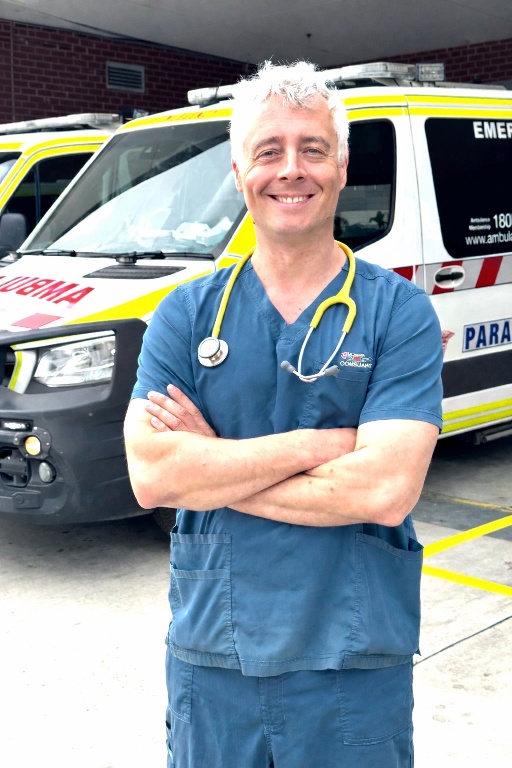
For Dr Andrew Backay, an emergency physician at Monash Health, the fast-paced environment of the emergency department has long shaped the way he thinks about healthcare and technology.
“The emergency department is a very complex environment,” he explains. “It’s busy, noisy and often overcrowded, so there’s a lot of sensory and cognitive overload. Because of that, I value reliability and simplicity in technology above all else.”
That frontline experience gave Dr Backay a unique perspective when he undertook a six-month sabbatical with the Monash Institute of Medical Engineering (MIME) in late 2025, immersing himself in the world of MedTech innovation.
A long-standing interest in engineering
Dr Backay’s interest in engineering and medical devices began long before his sabbatical.
“I’ve always been a bit of a shed tinkerer by nature,” he says. “Over the years that naturally evolved into an interest in MedTech.”
Conversations with colleagues first introduced him to MIME and its work at the intersection of engineering, clinical practice and commercialisation. Curious to learn more, he reached out to the team and the opportunity for a sabbatical soon followed.
Making the sabbatical happen
While the idea was appealing, turning it into reality required careful planning.
Medical specialists working full time in the public system are typically eligible for a six-month sabbatical every seven years. At Monash Health, these opportunities are often used to undertake formal university study.
“This was something a bit different,” Dr Backay explains. “When a hospital supports a sabbatical, it’s important that the work is meaningful and that you’ll bring something valuable back to the organisation.”
“My sabbatical was focused on learning how to innovate,” he adds. “And that’s an area Monash Health is very keen to support.”
Learning the process of innovation
Working within MIME gave Dr Backay exposure to the structured processes that underpin MedTech innovation; something he had often wished for in clinical practice.
“On the clinical ‘shop floor’, you encounter problems all the time – what we might call clinical needs,” he says. “But the ideas you have in the moment often disappear because there isn’t always a structured way to capture and develop them.”
“One of my goals in undertaking this sabbatical was to learn how to view those ideas through a structured MedTech lens.”
Unlike a university course, the sabbatical provided real-world insight into how the MedTech ecosystem works, from early concept development through to clinical validation and commercial considerations.
Contributing across the MIME program
During the six-month placement, Dr Backay was embedded as a core member of the MIME team and contributed across several initiatives.
“I was fortunate to be involved broadly across the program,” he says. “In particular, I worked on several MedTech Commercialisation Advancement Program (MCAP) projects, joined the review board for the Invent Support Grants, and was embedded within a number of specific projects that aligned with my clinical expertise.”
The experience offered a rare opportunity to see how clinicians, engineers and commercial specialists collaborate to develop new technologies.
The critical role of clinicians in innovation
One of the biggest insights Dr Backay gained during the sabbatical was the importance, and the challenge, of involving clinicians in MedTech development.
“Medicine is such a complex environment that it can be difficult for engineers or commercial teams to fully understand it,” he says. “Clinician input is incredibly important.”
At the same time, engaging clinicians can be challenging given the demands of clinical practice.
“It’s difficult for clinicians to find the time, but it’s equally difficult for clinicians to gain a deep understanding of the engineering or commercial side. MIME helps to bridge that gap.”
Encouraging other clinicians to get involved
Reflecting on the experience, Dr Backay strongly encourages other clinicians with an interest in innovation to consider engaging with MIME.
“If you have an interest in MedTech, then do it,” he says. “The team at MIME is incredibly supportive, and you get real-world insight into the MedTech world that you simply don’t get from a textbook or a university course.”
His sabbatical highlights the value of bringing clinicians into the innovation process, ensuring that new technologies are grounded in the realities of patient care.
As healthcare systems continue to evolve, experiences like Dr Backay’s demonstrate how clinician-engineer/digital/design collaboration can help transform frontline insights into meaningful health innovations.