
Meet Monash University’s latest Women in STEMM Student Leaders – Izabella Mancewicz
Undergraduate, Faculty of Medicine, Nursing and Health Sciences
Research focus: Bridging clinical practice and AI to build ethical, clinician-led healthcare innovation
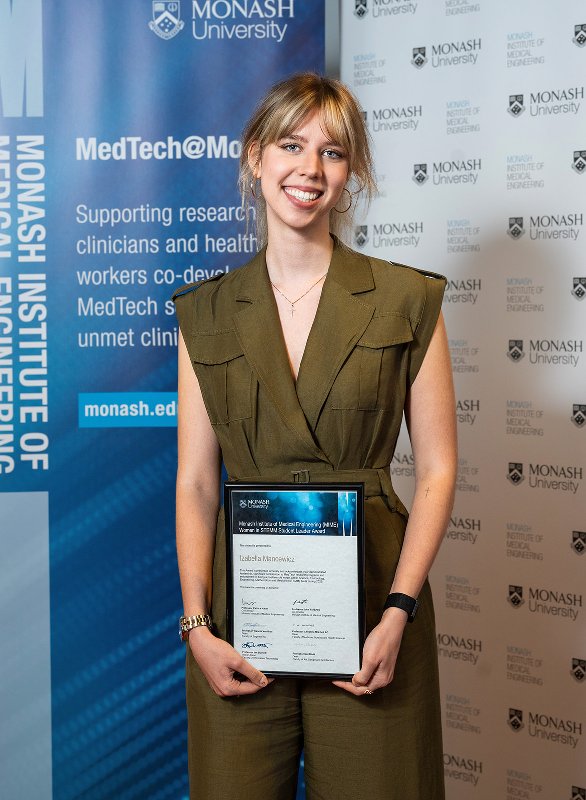
Izabella Mancewicz is a recipient of a 2025 Women in STEMM Student Leader Award. These awards aim to recognise, celebrate and support women students at Monash University who are contributing to innovation in healthcare and medical technologies. MIME spoke to Izabella upon accepting this award.
What is your chosen degree and what inspired you to pursue this path?
I'm studying a Bachelor of Medical Science and Doctor of Medicine at Monash. I only began considering this path from Year 10 after picking up my first biology elective. The wonders of nature and the human body, combined with my love for critical thinking, reasoning, problem-solving and building authentic relationships with people, made me believe this is where I can make the most impact in my life.
What is your favourite aspect about this STEMM field?
The vulnerability and authenticity. Medicine is special because you often see both ends of the coin - it's such a privilege to help people in their most vulnerable moments and have a direct impact on someone's life, while also learning about the incredible complexity of the human body. As someone who thinks philosophically, it's made me reflect deeply on my place in the world, who we truly are, and what path I want to pursue.
Can you elaborate on your contribution to innovation in healthcare and medical technologies?
My work sits at the intersection of medicine, AI, and innovation. At the Cao Lab for Medical Artificial General Intelligence (AGI)/ Artificial Superintelligence (ASI), I'm researching how clinicians use AI in real-world practice, have analysed physician usage of Large Language Models (LLMs), cross specialties, also on simulated AI doctor-patient environments to assess model behaviour and decision-making. I'm also tracking medical AI adoption in healthcare across Australia and hope to contribute on policy commentaries on AI regulation.
Beyond research, I co-founded and lead Nexus, a community making MedTech and AI accessible to students, innovators and clinicians. We've run programming bootcamps where I mentored 20 medical students from zero coding to building working projects, hosted Women in MedTech events connecting clinicians with investors and researchers, launched a youth stream introducing high schoolers to healthcare coding, and organised the Global Medical AI Challenge, a two-week program for over 150 medical students from 19 countries to learn, build, and present their own AI projects.
I'm also a Berkeley AI Safety Policy Fellow, where my passion lies in the ethical and policy dimensions of AI – specifically ensuring that healthcare AI is built responsibly, with clinical perspectives at the centre of governance frameworks. The goal is to train bilingual leaders who understand both medicine and technology, so we can build AI tools that are not only powerful, but ethical, safe and truly supportive of healthcare.
Can you tell us a little of your leadership experience?
I've always been drawn to leadership – in high school as Campus Captain and College Captain, and now at university where I founded and lead Nexus. But what leadership means to me has evolved. It's not just about organising events or holding a title, it's about building a team of people who are as passionate as you are and empowering them to take ownership.
With Nexus, I've focused on creating a culture where everyone has agency, where people can decide what they want to run, whether that's workshops, our online presence, or sponsor relationships.
Leadership is also about advocating for what we believe in: that MedTech and AI should be accessible to everyone, not just people with technical backgrounds, and that the future of healthcare – policy, technology, and innovation, should be shaped by polymaths, not single-discipline experts. The events and projects we've run reflect this vision, and I'm committed to continuing down this path.
Seeing my team members grow into their own leadership roles and watching students realise they can build the future too – that's exactly why I built Nexus. I hope to keep inspiring and bringing more clinicians and innovators into this space.
The MIME Women in STEMM Student Leader Award recognises student leadership. What does receiving this award mean to you?
It means a lot. I've always been an advocate for putting yourself out there, having ambition, and doing the work, especially when that's not always the norm. There have been tougher times as well as better ones. My joy comes from the work itself, but it's meaningful to be recognised in this way, and I hope it inspires others around me to pursue their own ambitious paths.
What will the $1,000 cash prize to support your studies go towards?
The $1,000 will help me sustain myself while I continue the work I'm passionate about. Between med school, running Nexus, and research at the Cao Lab, I'm juggling a lot without external funding. This prize will allow me to keep contributing at my fullest capacity and put even more energy into what I truly love doing.
What are you most looking forward to in regard to the MIME networking opportunities afforded to you due to receiving this award?
I'm incredibly excited to meet others who are in pursuit of greatness. I'm a strong believer that the people you surround yourself with subconsciously shape you and open doors to opportunities and experiences that align with your path. This is a chance to connect with people who share that drive.
Why do you think awards like this are important for Women in STEMM?
They're incredibly important because women are often under-recognized due to differences in how we present our skills and traits compared to men – even though we're equally, if not more, competent and capable. Recognition like this helps level the playing field and validates the work women are doing to push boundaries in STEMM.
What is your advice for women in STEMM or those thinking about a career in STEMM?
We're so often told at a young age to restrain the traits that actually help us succeed – being ambitious, outspoken, opinionated, confident. These are exactly the traits that help you reach out, land opportunities you wouldn't have otherwise, and connect with people who can open doors. My advice? Go against the norm. You'll never feel completely ready. You'll often feel out of your depth, and as women, we might feel more out of place than others. Don't let it stop you. Click yes and apply for that next opportunity. Luck isn't just chance – it's when preparation meets opportunity. So, start preparing, throw yourself out there, and talk to interesting people. You'll meet incredible people along the way who share your drive. Don't wait for permission - just start and keep going.