
Meet Monash University’s latest Women in STEMM Student Leaders – Viktoriia Ignateva
Master of Artificial Intelligence – Human-centred computing, Faculty of Information Technology
Research focus: Developing health technology solutions and AI applications for social impact
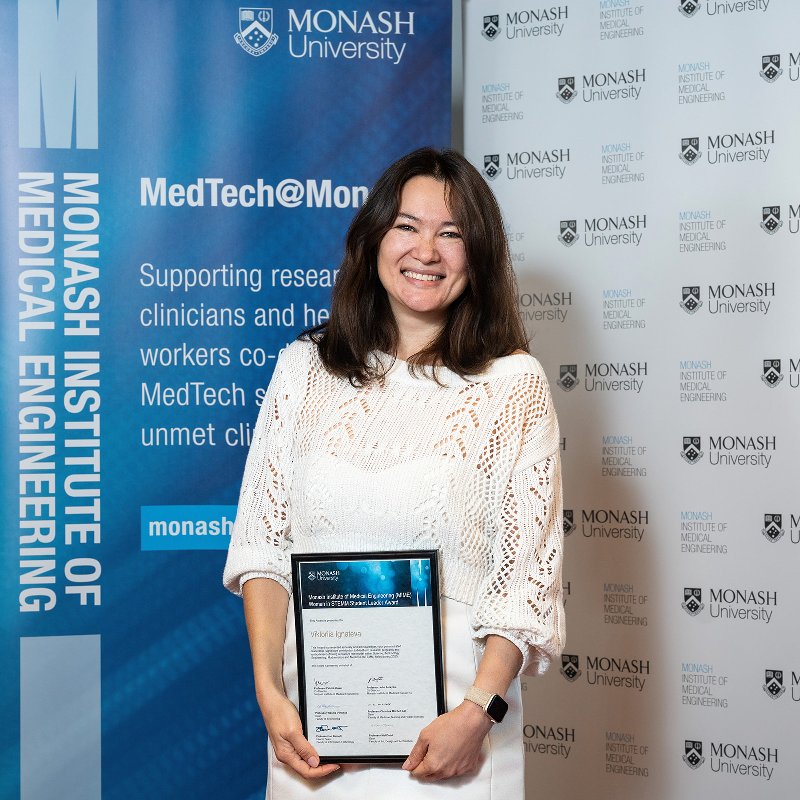
Viktoriia Ignateva is a recipient of a 2025 Women in STEMM Student Leader Award, which aims to recognise, celebrate and support women students at Monash University who are contributing to innovation in healthcare and medical technologies. MIME spoke to Viktoriia upon accepting this award.
What is your chosen degree, and what inspired you to pursue this path?
I’m currently pursuing a Master of Artificial Intelligence after completing a Graduate Diploma in Psychology. My journey has been unconventional. I arrived at Monash unable to speak English and came from a psychology background, which some might consider a disadvantage in a technical field. However, this unique combination of psychology and AI fascinates me because I understand both biological processes in humans that shape who we are and the technical capabilities of emerging technologies. I’m passionate about creating AI and digital health solutions that genuinely serve people’s needs. My psychology background taught me to think about the human first, and AI gives me the tools to create meaningful solutions.
What is your favourite aspect about this STEMM field?
I love that AI and human-centred computing allow me to work at the intersection of technology, health, and social impact. Every project I work on has the potential to genuinely improve someone’s life, whether it’s a parent struggling with their child’s developmental regression, a family caring for someone with dementia, or communities worldwide fighting disinformation. The fact that I can combine technical innovation with real human empathy makes this field incredibly fulfilling.
Can you elaborate on your contribution to innovation in healthcare and medical technologies?
As a Research Assistant at Action Lab, I contributed to health technology projects that address critical challenges. Through the Child Development Regression project, I helped to develop an evidence-based platform that empowers parents and carers to navigate developmental challenges while supporting their own mental health, recognising that effective health technology must serve entire family systems, not just individual patients.
With the Sleep 2 Care project, I worked on digital interventions that improve the quality of life for people living with mild dementia and their caregivers by addressing sleep disturbances, developing digital applications of evidence-based solutions, and demonstrating genuine empathy. These projects have taught me that health technology innovation requires both technical and organisational excellence and a deep understanding of human needs.
Beyond direct health tech, as CEO of a student team, Monash Students for AI with Communities (MOSAIC), I’m leading a collaboration with the International Federation of Red Cross to develop a multilingual AI-powered platform combating global disinformation. This includes a comprehensive web platform, data analytics dashboard, and gamified learning experiences, demonstrating how emerging technologies can serve humanitarian and public health goals.
Can you tell us a little about your leadership experience?
My leadership journey has been shaped by my own challenges as a student who arrived without English proficiency just before the COVID lockdowns. This lived experience drives my advocacy and empathy across multiple leadership roles.
As former President and now Vice-President of the Monash Data & AI Society, I create inclusive spaces where students, particularly women and international students, feel genuinely empowered to explore STEMM careers. I actively mentor emerging leaders, understanding my responsibility extends beyond organising events to cultivating the diverse STEMM leaders our field desperately needs. Since I became part of the society, the number of women joining us and becoming leaders has increased significantly, e.g. we are now a mostly women-led society of AI and Data Science postgraduate students at Monash University.
During my time as Graduate Student Representative on the University Education Committee, I successfully advocated for improved access to the research stream and enhanced support for international students. I also serve as a Student Representative at Academic Progress Committee hearings, supporting students through challenging moments and helping them to find ways to continue their studies successfully and stay enrolled in their courses.
As a Teaching Associate, I bridge the gap between students and faculty, translating complex concepts into accessible language and providing teaching teams with insights into student challenges. My own learning journey informs this work daily.
Through my “Chat AI” podcast, I convene researchers, teaching staff, and industry experts to discuss critical questions facing IT students, demonstrating that women can lead important conversations at the intersection of AI, ethics, and innovation.
The MIME Women in STEMM Student Leader Awards recognise student leadership. What does receiving this award mean to you?
This award is incredibly meaningful to me because it recognises that leadership isn’t about where you start, it’s about where you go and who you bring with you. When I started at Monash without speaking English, I couldn’t have imagined leading student teams, conducting research, or advocating for policy changes. This award validates that my non-linear path and lived experiences as a student who wasn’t born and raised in Australia aren’t barriers; they’re strengths that enable me to lead with empathy and authenticity. It motivates me to continue showing other students, especially women and international students, that they too can overcome any barrier and make meaningful contributions to STEMM.
What will the $1,000 cash prize to support your studies go towards?
The prize will support my continued professional development, partially funding conference attendance that I dreamed about, it will enhance my capabilities in health technology innovation and AI applications for social good.
What are you most looking forward to in regard to the MIME networking opportunities afforded to you due to receiving this award?
I’m most excited about connecting with inspiring STEMM women leaders and mentors who share my passion for using technology to create social impact. The MIME network could open doors to collaborations between health technology, ethics, and humanitarian applications, exactly the interdisciplinary work I’m passionate about. I’m also looking forward to learning from other women’s leadership journeys and finding new ways to support the next generation of diverse STEMM leaders.
Why do you think awards like this are important for Women in STEMM?
Awards like this are crucial because they spotlight women who are redefining what STEMM leadership looks like. Not all of us followed traditional paths, some of us came from non-cognate backgrounds, learned new languages, faced systemic barriers, or navigated significant personal challenges. By celebrating diverse women leaders, these awards send a powerful message to students who might not see themselves fitting the “typical” STEMM profile: you belong here, your unique perspective is valuable, and your contributions matter. Representation and recognition inspire the next generation to persist when the journey gets difficult.
What is your advice for women in STEMM or those thinking about a career in STEMM?
Your non-traditional path isn’t a disadvantage, it’s your superpower: “Everything that doesn’t kill us makes us stronger.” Whether you’re switching fields, learning in a second language, or balancing multiple responsibilities, these experiences give you perspectives that many people lack. In fields like AI and health technology, we desperately need people who understand human complexity, cultural diversity, and real-world challenges. Don’t let imposter syndrome convince you that you don’t belong. Find your community, seek mentors who believe in you, and remember that vulnerability and leadership can coexist. Share your struggles, you never know who you’re inspiring by simply showing up authentically and persistently. The STEMM field needs exactly who you are.