
Leading change and driving research excellence
Leading change and driving research excellence
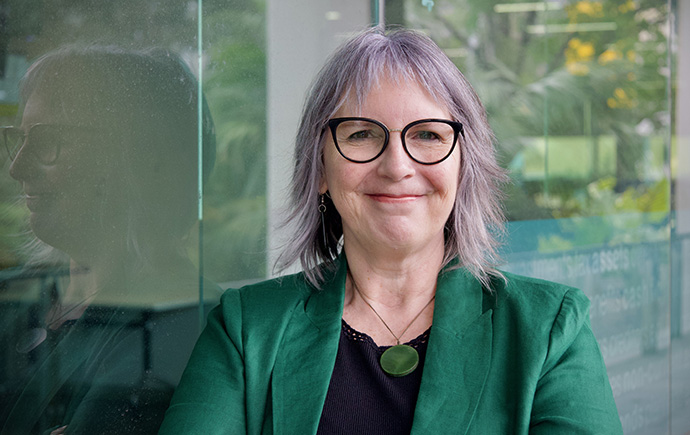
Behind every world-class breakthrough is a strong support system - and Monash Business School’s Helen Matich is at the heart of it. As Research Services Senior Manager, she leads strategic projects and fosters collaboration between professional and academic staff to drive research success.
Research may happen in offices and labs - but ensuring it runs smoothly takes strategy, coordination, and vision at all levels of the organisation. That’s where Helen Matich comes in.
As Research Services Senior Manager, she leads a dedicated professional team and coordinates major change projects to deliver Monash Business School’s strategic goals. It’s a fast-paced role that she relishes.
“One of the things I love about this job is that the research portfolio is so dynamic. No two days are the same - you never quite know what’s going to come across your desk,” Helen said.
“Working closely with academics and the research they care so deeply about is fantastic.”
Her work centres on making sure research services are a partner to academic success.
“There’s a lot of administrative complexity in the research space,” she said. “We’re here to facilitate the research effort. We can’t always cut down the red tape, but my highly experienced team helps researchers navigate the system efficiently.”
Being part of a university that values research so highly is inspiring, she said. “There’s a real sense of purpose. Research changes lives and transforms society. It’s fundamental to who we are as a business school, and I find that incredibly motivating.”
Shaping a globally competitive doctoral program
One of Helen’s most significant recent achievements has been enabling the transformation of Monash Business School’s PhD program to compete with the world’s best.
It was the culmination of a strategy more than a decade in the making.
“The objective was to offer a longer program to match the UK’s five- to seven-year model, but at Monash, a stipend-supported PhD is limited to three and a half years,” she said.
“Our job was to deliver this at scale and transition the majority of our PhD cohort to an Integrated Masters-plus-PhD model from 2025.”
Under the highly structured model, eligible students undertake a Master of Commerce of either one or two years, and provided they maintain a WAM of above 83, they then transition to PhD studies of up to three and a half years.
In this and other major projects, problem-solving is a key skill, Helen said.
“In the PhD project, there were many challenges: How can we build a globally competitive doctoral program within non-negotiable structural constraints? How do we make the process seamless, positioning the ‘Integrated PhD’ as a high-quality doctoral package?”
Having a clear goal in sight was important. “We all understood that in time, the Integrated PhD program would strengthen Monash Business School’s reputation for research training and help us build a pipeline of future academic leaders,” she said.
Her contribution to the year-long project helped earn Helen this year’s Vice-Chancellor’s Award for Research Professional of the Year.
“It might be my name on the award, but really it’s a reflection of my whole team, and all the other teams we worked with in the process of making change happen,” she said.
“Knowing that your work is recognised and valued, that you’re making a meaningful contribution - that’s what drives me.”
‘Our greatest resource is our people’
A key pillar of Helen’s leadership is building a culture of collaboration.
“It’s really important to me that the people I work with understand their contribution to the bigger picture and have the skills they need to do their best work,” she said.
This philosophy informs how she empowers her team. “Our greatest resource is our people,” she said.
“There’s a challenge in directing and advising without taking away ownership - creating a space where people feel supported to experiment, learn, and grow.”
Inspired by strong mentors throughout her career, she is passionate about supporting others to reach their full potential. “I’ve participated in the formal Monash mentoring programs for many years, both as a mentee and a mentor,” she said.
“Both roles are enormously valuable and are an opportunity to learn from others, inspire and be inspired, even if their role is very different from your own.”
Her advice for women starting out in university administration is to step outside their comfort zone. “Don’t be afraid to take opportunities, even if they feel outside your skill set,” she said.
“I’m a big believer in transferable skills.”