
Can we trust the data? The researcher making uncertainty visible
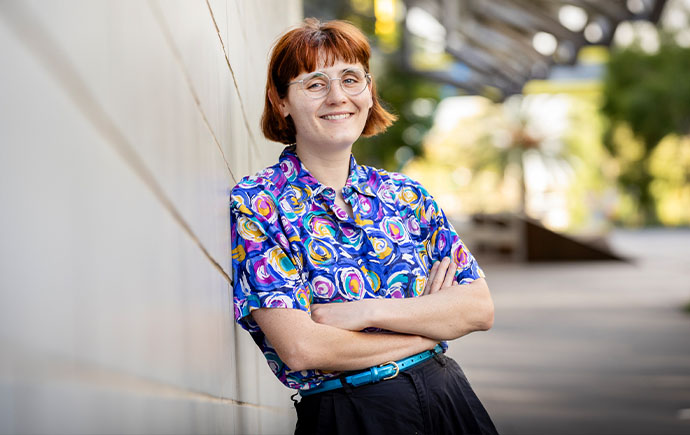
Monash Business School PhD candidate Harriet Mason.
April 7 2025
Numbers don’t lie—but they don’t always tell the whole story. Zema Scholarship recipient Harriet Mason is investigating how data visuals shape our understanding and why seeing uncertainty is important.
Graphs, charts and visual data are everywhere, from news reports to financial forecasts. But are we really seeing the whole picture?
Monash Business School PhD candidate Harriet Mason is tackling a critical blind spot in data science: making statistical uncertainty easier to understand.
As a researcher in visual statistics, she studies how uncertainty is represented in graphs, charts, and models —and the real-world consequences when it isn’t.
“How we think doesn’t naturally align with how statistics work,” Ms Mason said.
“Graphs help bridge this gap by translating data into a format that makes sense to us. Seeing information visually is key to truly understanding it.”
However, not all graphs are created equal.
Take economic forecasts, for example. A line graph showing GDP growth might seem like a hard fact. But forecasts are never 100% certain.
“Graphics usually present averages, and while we treat them as indisputable numbers, there is always some level of uncertainty,” she said.
“My research focuses on identifying which graphics communicate this uncertainty well, which don’t, and why.”
The science of seeing uncertainty
Ms Mason’s research focuses on ‘uncertainty visualisation’ – the science of making statistical uncertainty easier to understand.
Her work is unfolding in three phases.
First, she reviewed existing uncertainty visualisation methods to understand why they fail.
She is currently in stage two, developing software to help non-experts create clearer, more accurate visualisations.
The final stage will test how different visualisation methods impact public understanding.
“Graphics are designed for an audience, so we need to evaluate when they work—and when they don’t,” she said.
Renewable energy: A high-stakes example
As a Zema Energy Studies Scholarship recipient, Ms Mason’s work will have major implications for renewable energy forecasting.
As Australia shifts to clean energy, the Australian Energy Market Operator (AEMO) must predict how much power will be available from wind and solar at any given time.
But unlike coal or gas, renewable sources are less predictable, harder to store, and weather-dependent.
Ms Mason’s supervisor, Professor Diane Cook, said current methods based on a single statistic, such as average demand, failed to account for the inherent volatility of renewable resources.
“This could lead to backup power stations being deployed needlessly, or not deployed at all, resulting in power outages," Prof Cook said.
“Including volatility alongside the mean will enable more reliable decision-making.”
Ms Mason said finding reliable ways to manage energy demand and supply was vital for the future.
“Regardless of your personal beliefs about climate change, we are still going to run out of gas and coal,” she said.
“It’s really important to develop solutions to mitigate these challenges.”
‘I could spend my whole career on this topic’
With her PhD nearing completion, Ms Mason isn’t finished with the problem of uncertainty—far from it.
“This is just the beginning. I could spend my whole career on this topic,” she said.
She credits Monash University for supporting her research and allowing her to shape her academic journey around her passions.
“One of the main reasons I chose Monash was its flexibility—it let me tailor my undergraduate degree to my interests,” she said.
“The staff here are incredibly supportive and passionate. If they see that you genuinely care about your field, they’ll help you, whether that’s securing a job or continuing in academia.”
The Zema Scholarship PhD program is designed to support the next generation of leaders to meet Australia’s energy sector challenges.
The scholarship provides a $52,352 per annum stipend plus the opportunity for a paid internship with the Australian Energy Market Operator, and supports successful applicants for the approved duration of their PhD candidature, to a maximum of three-and-a-half years.
This year’s application deadlines are 31 May 2025 (for Semester 2/2025 commencement) and 31 October 2025 (for Semester 1/2026 commencement).
Learn more about the Zema Scholarship.