
Cellulose nanofibres and nanofibre materials
From wood and agriculture residues, we are developing a series of nanocellulose materials: micro fibrillated cellulose (MFC), nano fibrillated cellulose (NFC) and nanocellulose crystals (NCC). These three types of nanocellulose can be combined with nanoparticles to develop recyclable composites that are very strong and flexible or provide gas and water vapour barriers. Applications are in food preservation and lighter packaging, low cost/disposable reverse osmosis membranes for water and food processing purification and industrial air filters. We are also exploring new technology and concepts to improve the production of cellulose nanofibers.
Our current projects focused on:
- New barrier materials from cellulose nanofibers
- New methods to rapidly make sheets from cellulose nanofibers for filter applications
- New sources of cellulose for nanofiber production to reduce energy consumption
- Methods to quantify cellulose nanofiber quality development
The development of nanocellulose based antimicrobial materials using bis(phosphinato) bismuth complex has also been explored. Morphological studies of the sheets revealed the overall distribution of the complex throughout the nanocellulose matrix. The composite sheets were able to inhibit the growth of bacteria and fungi, including strains of multi-drug resistant bacteria.

Figure 1A. SEM images of the Bi-MFC composite using secondary electron imaging

Figure 1B. SEM images of the Bi-MFC composite using EDX mapping of the selected area
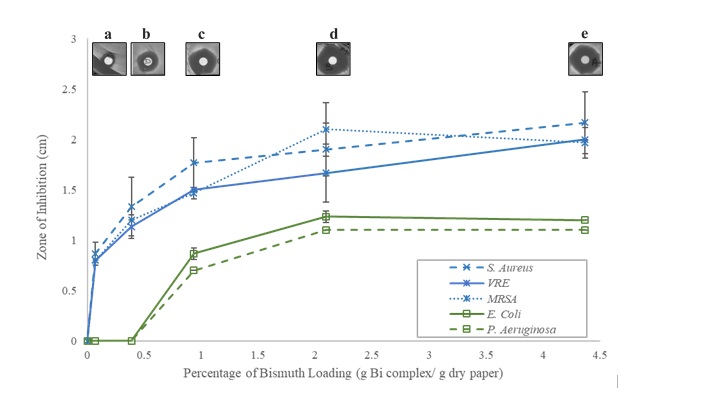
Figure 2. Effect of bismuth complex loading on zone of inhibition with different bacteria from disk diffusion assay and the top images show their picture representation against S. aureus
Selected Publications
Dehghani, M., Naseri, M., Nadeem, H., Banaszak Holl, M. M. and Batchelor, W. (2022). Photocatalytic Degradation of 1,4-Dioxane and Malachite Green over Zinc Oxide/Cellulose Nanofiber Using UVA/B from Direct Sunlight and a Continuous Flow Reactor. ACS EST Water 2022. https://doi.org/10.1021/acsestwater.1c00484
Naseri, M., Maliha, M., Dehghani, M., Simon, G. P., Batchelor, W. (2022). Rapid Detection of Gram-Positive and -Negative Bacteria in Water Samples Using Mannan-Binding Lectin-Based Visual Biosensor. ACS Sensors. https://doi.org/10.1021/acssensors.1c01748
Maliha, M., Brammananth, R., Coppel, R. L., Werrett, M. V., Andrews, P. C., Batchelor, W. (2022). The effect of pulp type on the performance of microfibrillar lignocellulosic bismuth-based active packaging material. Cellulose. https://doi.org/10.1007/s10570-022-04562-1
Nadeem, H., Dehghani, M., Garnier, G., Batchelor, W. (2022). Life cycle assessment of cellulose nanofibril films via spray deposition and vacuum filtration pathways for small scale production. Journal of Cleaner Production 342, 130890. https://doi.org/10.1016/j.jclepro.2022.130890
Kargupta, W., Browne, C., Verdugo, L., Hunt, I., Stack, K., Batchelor, W. and Tanner, J. (2021). Flotation as a separation technology for recovering pulp fines and sustainable nanocellulose production. Separation and Purification Technology 270, 118810. https://doi.org/10.1016/j.seppur.2021.118810
Naseri, M., Ziora, Z. M., Simon, G. P. and Batchelor, W. (2021). ASSURED-compliant point-of-care diagnostics for the detection of human viral infections. Reviews in Medical Virology. https://doi.org/10.1002/rmv.2263
Nadeem, H., Naseri, M., Kirubanandan, S., Dehghani, M., Browne, C., Miri, S., Batchelor, W. (2020). An energy efficient production of high moisture barrier nanocellulose/carboxymethyl cellulose films via spray-deposition technique. Carbohydrate Polymers 250. 116911. https://doi.org/10.1016/j.carbpol.2020.116911
Naseri, M., Simon, G. P., Batchelor, W. (2020). Development of a Paper-Based Microfluidic System for a Continuous High-Flow-Rate Fluid Manipulation. Analytical Chemistry 92(10), 7307-7316. https://doi.org/10.1021/acs.analchem.0c01003
Miri, S., Raghuwanshi, V, S,, Andrews, P. C., Batchelor, W. (2020). Composites of mesoporous silica precipitated on nanofibrillated cellulose and microfibrillated cellulose: Effect of fibre diameter and reaction conditions on particle size and mesopore diameter, Microporous and Mesoporous Materials 311. 110701. https://doi.org/10.1016/j.micromeso.2020.110701
Dehghani, M., Nadeem, H., Raghuwanshi, V. S., Mahdavi, H., Banaszak Holl, M. M., Batchelor, W. (2020). ZnO/Cellulose Nanofiber Composites for Sustainable Sunlight-Driven Dye Degradation. ACS Applied Nano Materials 3(10), 10284-10295. https://doi.org/10.1021/acsanm.0c02199
Maliha, M., Herdman, M., Brammananth, R., McDonald, M., Coppel, R., Werrett, M., Andrews, P., & Batchelor, W. (2020). Bismuth phosphinate incorporated nanocellulose sheets with antimicrobial and barrier properties for packaging applications. Journal of Cleaner Production, 246, [119016]. https://doi.org/10.1016/j.jclepro.2019.119016
Ang, S., Haritos, V., & Batchelor, W. (2020). Cellulose nanofibers from recycled and virgin wood pulp: a comparative study of fiber development. Carbohydrate Polymers, 234, [115900]. https://doi.org/10.1016/j.carbpol.2020.115900
Shanmugam, K., Nadeem, H., Browne, C., Garnier, G., & Batchelor, W. (2020). Engineering surface roughness of nanocellulose film via spraying to produce smooth substrates. Colloids and Surfaces A: Physicochemical and Engineering Aspects, 589, [124396]. https://doi.org/10.1016/j.colsurfa.2019.124396
Onur, A., Shanmugam, K., Ng, A., Garnier, G., & Batchelor, W. (2019). Cellulose fibre- perlite depth filters with cellulose nanofibre top coating for improved filtration performance. Colloids and Surfaces A: Physicochemical and Engineering Aspects, 583, [123997]. https://doi.org/10.1016/j.colsurfa.2019.123997
Mendoza, L., Hossain, L., Downey, E., Scales, C., Batchelor, W., & Garnier, G. (2019). Carboxylated nanocellulose foams as superabsorbents. Journal of Colloid and Interface Science, 538, 433-439. https://doi.org/10.1016/j.jcis.2018.11.112
Onur, A., Ng, A., Garnier, G., & Batchelor, W. (2019). The use of cellulose nanofibres to reduce the wet strength polymer quantity for development of cleaner filters. Journal of Cleaner Production, 215, 226-231. https://doi.org/10.1016/j.jclepro.2019.01.017
Varanasi, S., Garusinghe, U., Simon, G. P., Garnier, G., & Batchelor, W. (2018). Novel In-situ Precipitation Process to Engineer Low Permeability Porous Composite. Scientific Reports, 8(1), [10747]. https://doi.org/10.1038/s41598-018-28786-z
Garusinghe, U. M., Raghuwanshi, V. S., Garvey, C. J., Varanasi, S., Hutchinson, C. R., Batchelor, W., & Garnier, G. (2017). Assembly of nanoparticles-polyelectrolyte complexes in nanofiber cellulose structures. Colloids and Surfaces A: Physicochemical and Engineering Aspects, 513, 373-379. https://doi.org/10.1016/j.colsurfa.2016.10.068
Shanmugam, K., Varanasi, S., Garnier, G., & Batchelor, W. (2017). Rapid preparation of smooth nanocellulose films using spray coating. Cellulose, 24(7), 2669-2676. https://doi.org/10.1007/s10570-017-1328-4
Raj, P., Mayahi, A., Gunawardhana, W. D. T. L., Varanasi, S., Garnier, G., Patti, A. F., Martin, D., & Batchelor, W. J. (2016). Development of cellulose nanofibre quality with mechanical energy: Effect of starting chemical composition. In Progress in Paper Physics Seminar 2016: Conference Proceedings (pp. 27-29). Technische Universitat Darmstadt. http://tuprints.ulb.tu-darmstadt.de/5636/.