
GIXRD Case Study: Characterising the crystalline structures on the surface of a Mg-Li alloy
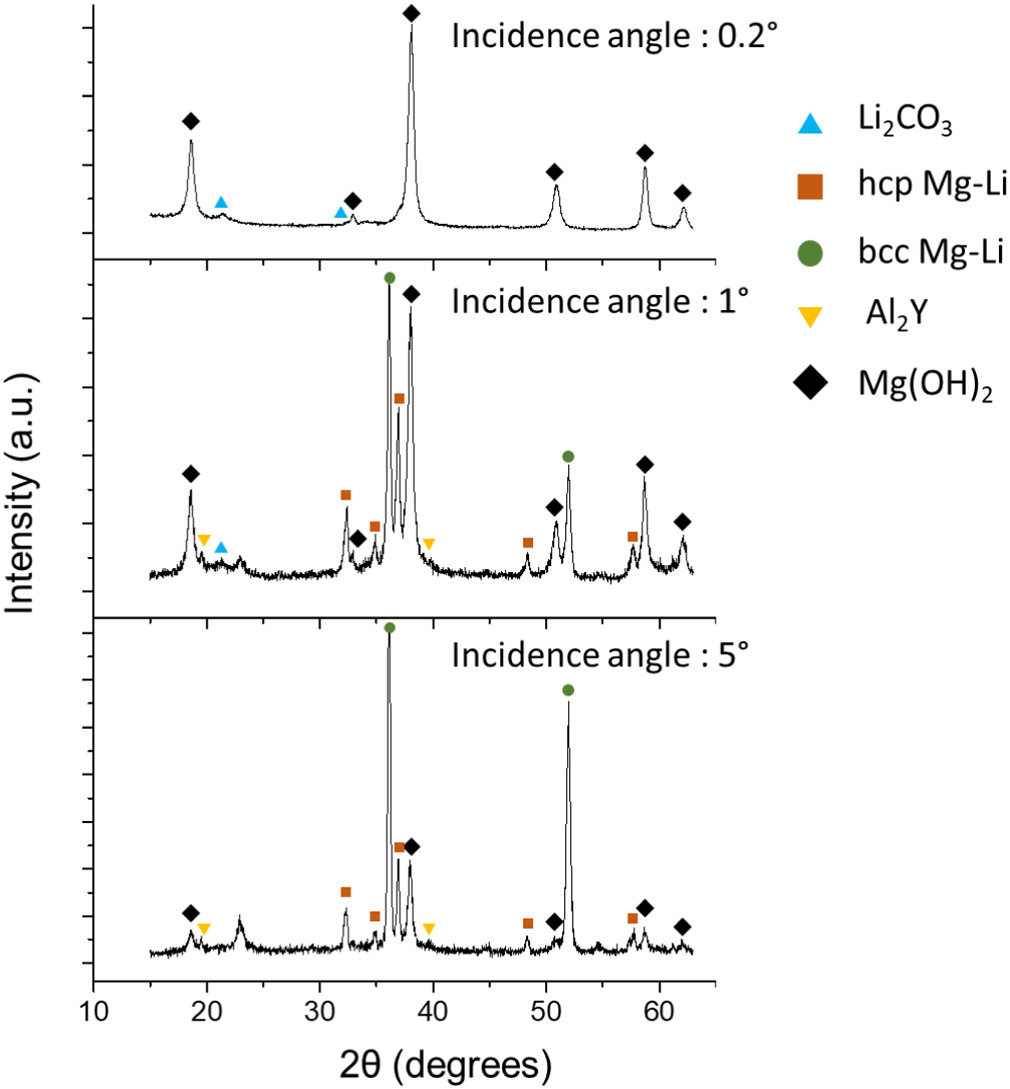
Figure 1. GIXRD revealing different phases at varying depths in a corrosion surface film
It has been demonstrated that bcc Mg-Li alloys (where Li > 10.3 wt%) have superior corrosion resistance to Mg-Li alloys with lower Li concentration. This has been attributed to the combined effect of the formation of a uniform bcc matrix which eliminates galvanic coupling between the hcp α-Mg and bcc β-Li phases, and more critically, the formation of a protective Li2CO3 surface film upon bcc Mg-Li. The formation of Li2CO3 (or Li2O) containing surface films upon Mg-Li alloys, the formation of corrosion favourable hcp phase and anti-corrosion bcc phase structures and distributions throughout thickness of the corrosion thin film can be characterised by GIXRD.
The Monash X-ray Platform’s Bruker D8 Discover diffractometer is a multi-purpose machine, equipped with a high speed position sensitive detectors with energy discrimination capabilities, a Centric Eulerian cradle for precise specimen alignment, parallel focusing Gobel mirror and a 0.2° Equatorial Soller slit for GIXRD data collection with good resolution for thin film samples. Our GIXRD setup is able to characterise films down to 10 nm.
In this work, the GIXRD results demonstrated the existence of protective layer of Li2CO3 and major Mg(OH)2 phase at the top surface of the corrosion thin film. GIXRD also revealed the existence of hcp phase caused by selective dissolution of Li near the top surface of the thin film and the major anti-corrosion bcc phase of the base matrix.
Data and image courtesy of Yan, Y, Qiu, Y, Gharbi, O, Birbilis, N & Nakashima, PNH 2019, 'Characterisation of Li in the surface film of a corrosion resistant Mg-Li(-Al-Y-Zr) alloy', Applied Surface Science, vol. 494, pp. 1066-1071. https://doi.org/10.1016/j.apsusc.2019.07.167