
Danish Sheikh: Griffin Award finalist for new play on love, law and belonging

Danish Sheikh, Senior Lecturer at Monash Law and co-lead of the Law and Performance Lab, has been named a finalist for the 2026 Griffin Theatre Award for his new play Bureaucracy: A Love Story.
The Griffin Award, one of Australia’s most significant platforms for new playwriting, has helped launch some of the country’s most influential works. Among them is Monash alumna Suzie Miller’s Prima Facie, recognised in 2018 before going on to major international stages.
For Sheikh, the Griffin Award recognition is both a personal milestone and a reflection of a broader practice that sits at the intersection of law, theatre and lived experience.
“I feel ferociously lucky to get to make this work, and even luckier to have it recognised as work worth making,” Sheikh said.
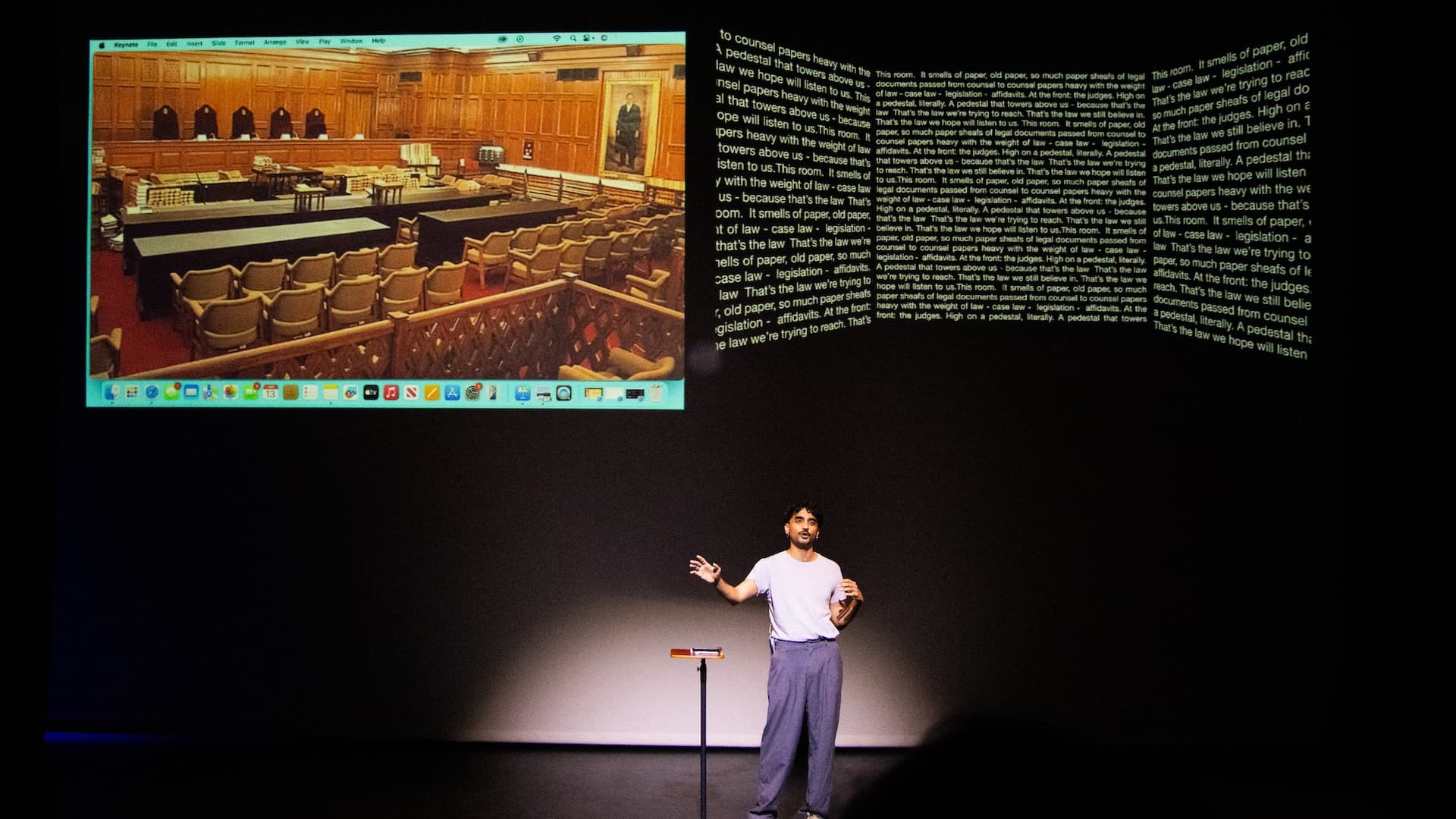
Danish Sheikh performing his lecture performance Much to do with law/ But more to do with love.
A romantic comedy shaped by law and lived experience
Bureaucracy: A Love Story is, on the surface, a romantic comedy. At its core, it is an inquiry into what happens when systems of law meet the complexity of human relationships.
“It’s a two-hander romantic comedy. It’s a story about a queer Indian PhD student and an Indian-Australian bureaucrat who fall in love,” Sheikh explained.
The relationship comes under strain when bureaucracy enters the frame in a deeply personal way.
“The complication is that the bureaucrat is also someone who assesses partner visa applications for a living. Their relationship reaches the point where they might need to apply for one.”
As the couple’s relationship develops, the professional logic of migration law begins to seep into their private life.
“All the questions that the bureaucrat has spent his career asking strangers start surfacing in his own relationship.”
For Sheikh, this tension reveals something fundamental about how law shapes identity and intimacy.
“I was very interested in what happens to love when you’re required to perform it for an audience. And how bureaucracy reshapes how we think about ourselves.”
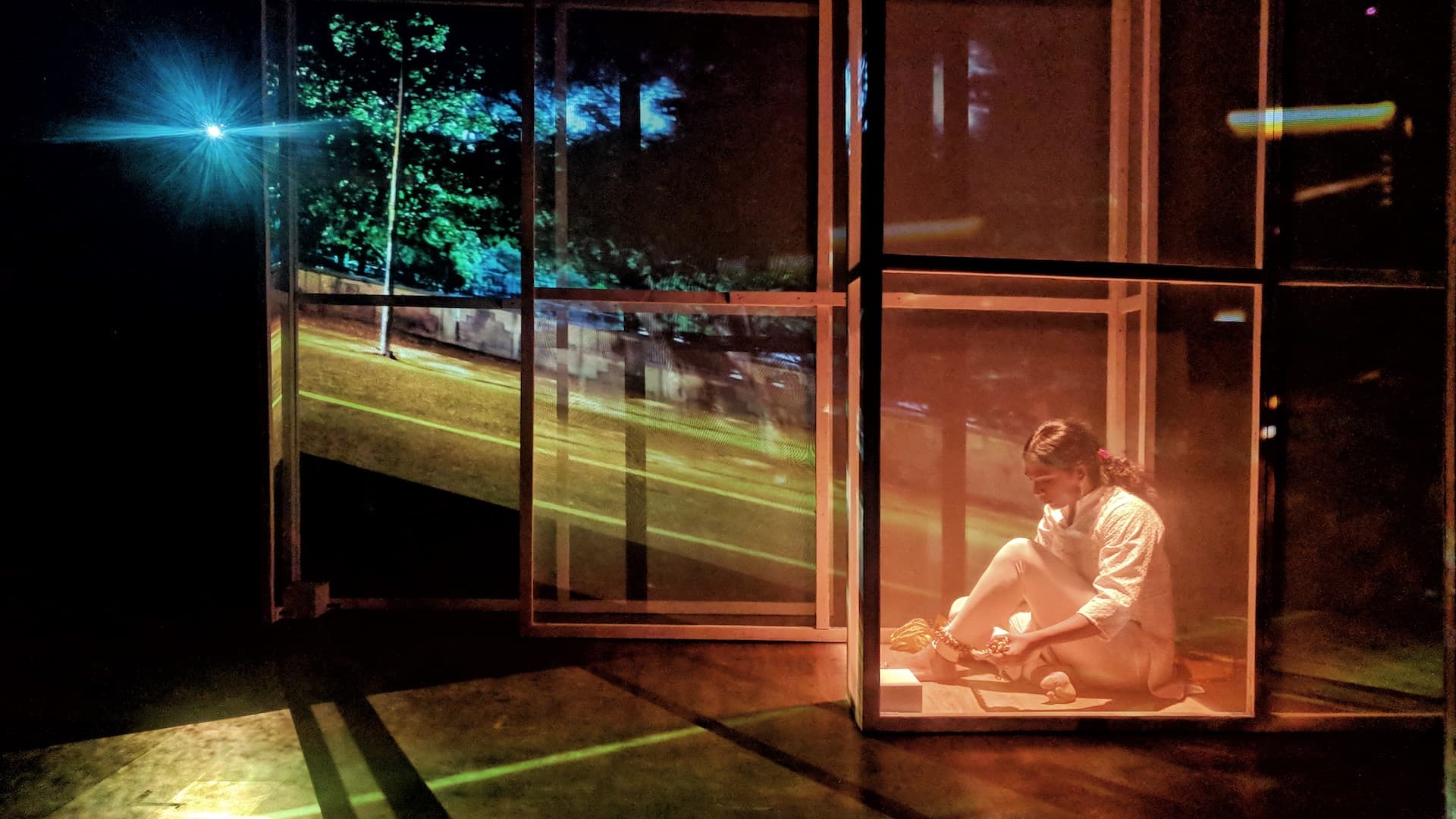
Abhina on stage in Danish Sheikh’s first play Contempt, which explores the 2012 hearings in the Supreme Court of India on the constitutionality of Section 377 of the Indian Penal Code.
A career from the courtroom to the stage
Sheikh’s creative practice is deeply informed by his background as a human rights lawyer in India, where he worked on litigation to decriminalise homosexuality.
“The very first play that I wrote came out of the 2013 Indian Supreme Court decision which initially upheld the validity of the sodomy law,” Sheikh said.
“ It was a really emotionally difficult decision. It described queer Indians as a minuscule minority, and it said that our so-called rights didn't justify decriminalisation.”
“I found that conventional legal analysis couldn’t quite capture what the decision had done. There was something both heartbreaking but also baffling, that we couldn’t write about.”
Theatre offered another way of understanding. Building on his knowledge of the law and the conventional legal analysis, Sheikh used the creative process to view the problem from different angles.
“It had to go into the space of theatre. We had to restage those hearings, and through restaging, figure out what went wrong”.
This approach continues to shape his work, both on the stage and in the classroom. Sheikh applied these principles to create Much to Do With Law/ But More to Do With Love at Midsumma earlier this year and also his new play Bureaucracy: A Love Story.
“I keep returning to moments where the law collides with lived experience. To moments where the law asks people to make something about themselves legible to a process that wasn’t really designed with human lives in mind.”
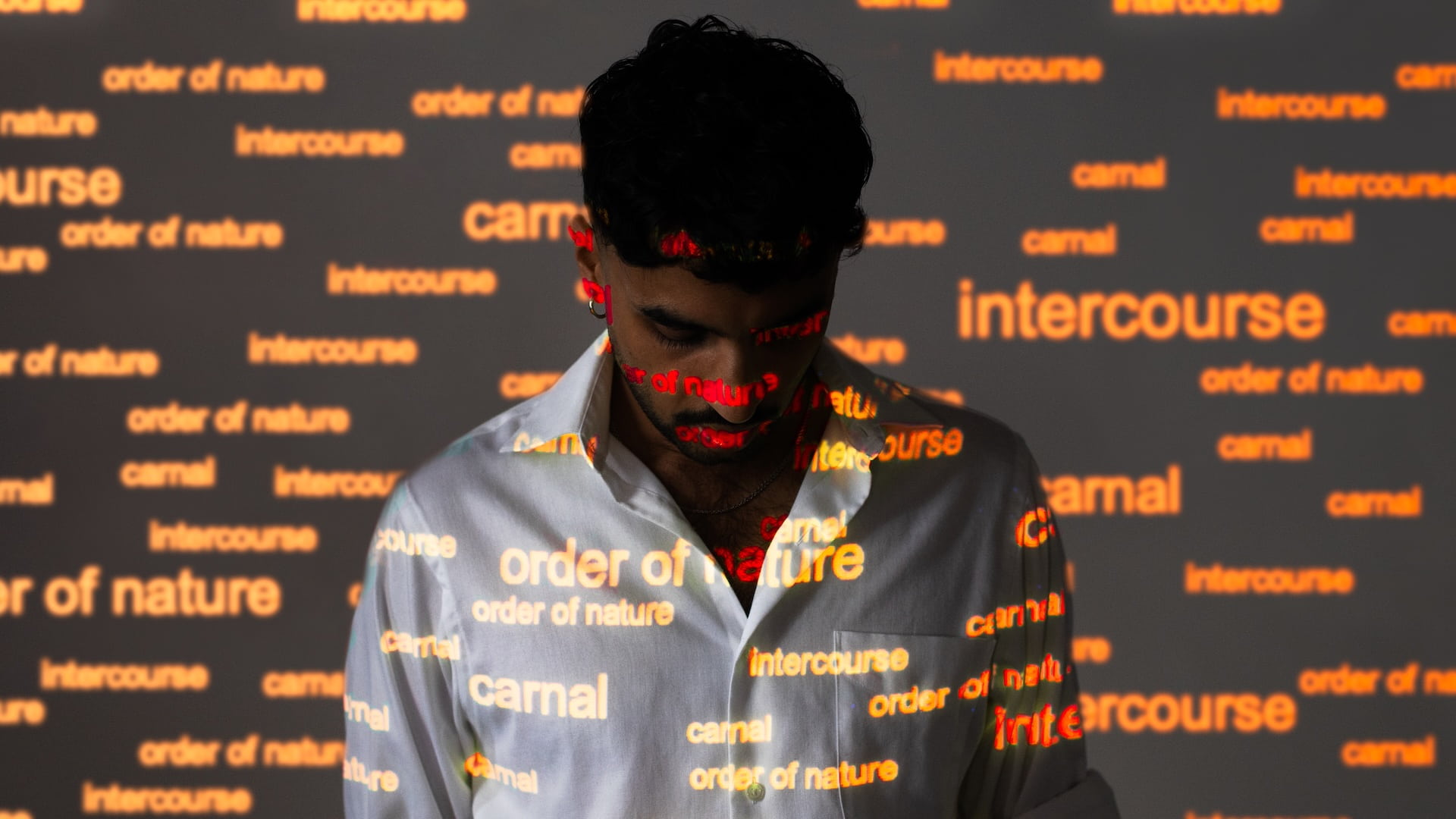
Danish Sheikh in a promotional image for his lecture performance Much to do with law/ But more to do with love at Midsumma in 2026.
Migration, queerness and the performance of love
At the centre of Sheikh’s new play is the experience of migration and the bureaucratic processes that define belonging.
The partner visa system becomes a powerful lens through which to explore this.
“It’s a fascinating correlation – where you’re finding a different way of having to render your love legible before the state” Sheikh said.
The play engages explicitly with queer identity and migrant experience, drawing on Sheikh’s long-standing interest in how legal systems interact with communities that sit at the margins.
Sheikh had the extraordinary, uncomfortable and dangerous experience of growing up in a context where being queer was criminalised.
“I grew up in the Indian context. I grew up in a space where it was criminal to be queer. Then I went to law school and realised that this thing that I’m studying is also a thing that considers me a criminal.”
Despite the challenges that this realisation presented, Sheikh ultimately found legal education to be transformational. In addition to learning the limitations of the law, he witnessed how communities creatively navigated these constraints.
“ I came into contact with all these activists from these different queer communities who were very hopeful about the promises of the law, who were very open to what the law could do.”
“People were always finding ways to think with the law even when the law doesn’t care for them. They were finding these little gaps – really creative ways of doing things.”
That spirit of resistance through creativity inspired Sheikh’s move into the theatre and continues to inform his research and teaching in law.

Danish Sheikh at the Queer Playwriting Award Showcase in January 2025.
Developing the play through collaboration
Sheikh’s journey to the Griffin Award shortlist has been a collaborative and iterative creative process.
In 2025, he was selected for Malthouse Theatre’s year-long artist development program, which he describes as a lovely process.
“ There were three of us who were writers, with a dramaturg, director, and a number of other creatives in conversation with Malthouse's in-house dramaturgs and creative producers.”
“We spent the year thinking through this work from scratch. That was quite fascinating, trying to draw out the broad themes that I was interested in and then slowly sifting out an idea that could be translated effectively to the stage in a room with incredible theatremakers like Jessica Arthur and Keziah Warner whose work I admire deeply.”
The artist development program culminated in a workshop and public reading at Malthouse, allowing the work to take shape in front of audiences.
It also coincided with Sheikh joining Monash Law and continuing to develop the project within the Law and Performance Lab.
“I’m very grateful for the institutional support from Monash through the Law and Performance Lab.”
“That support allows for these experiments - and considers these experiments as important legal research.”
With a throughline from Malthouse to Law Faculty to Research Lab, the next natural step was for the play to be submitted for the Griffin Award. This unique legal research project now sits alongside some of Australia’s most promising new theatrical works.

Danish Sheikh with Sheridan Harbridge at the Griffin Award 2026.
Creative legal practice at Monash Law
Sheikh’s recognition in the theatre world is closely tied to his academic work in creative legal practice, an area that brings artistic methods into legal scholarship and education.
“It comes from what you might call an impulse to repair,” Sheikh said.
He explained that critique through regular law writing might talk about the fact that historically the law had contempt for queer lives, which would be factual, but not necessarily revealing or providing a deeper understanding. Rather than critique alone, creative practice offers new possibilities to dig deeper.
“ Creative legal practice can do something else. It can find hope, and it can find different possibilities. It can allow us to imagine how the law can be otherwise. I find that quite powerful as an idea.”
At Monash Law, this approach is embedded in both research and teaching. Sheikh co-leads the Monash Law and Performance Lab with Associate Professor Marc Trabsky, where the approach takes concrete form across several projects: among them Embodied Legal Pedagogy, an initiative exploring how performance methods can reshape the way law is taught. The project will culminate in a major two-day workshop this November, which Sheikh is co-organising with Associate Professors Cristy Clark and Brad Jessup and colleagues from the Faculty of Art, Design and Architecture’s WonderLab.
"None of this is a solo practice," Sheikh said.
"The most exciting thing about the Lab is watching colleagues from law, performance and design discover they've been circling the same questions from different directions."
He sees theatre as a way to deepen how students engage with legal education.
“ We often train our students to think about where the law can go wrong. That's obviously good and effective legal training and they need to understand that. But I think they also need to understand that we're also trying to craft citizens who can think justice.”
“They need to be able to feel its possibilities, to feel the idea that it can allow for different lives and different futures to happen. That's the creative element for me.”
Already, the response that Sheikh has received from students has been inspiring.
“One student in the lead up to my Law and Literature unit wrote… ‘My soul had been starving, and all of a sudden I realised why. It was missing creativity’.”
Theatre as a counterbalance to AI in legal education
In addition to deepening understanding, Sheikh also sees theatrical practice as playing a critical role in how legal education evolves, particularly in this moment of AI ascendency.
“AI tends to smooth out friction while accelerating our everyday lives. It lets us delegate work away from the body. And that's genuinely valuable.”
“But the very thing that makes AI feel valuable is exactly the thing we have to be careful about. Frictionlessness is wonderful until you realise that friction is where a lot of learning happens, the slow, effortful, sometimes uncomfortable work of turning an idea over in your body.”
“Theatre puts bodies back in a room together. It restores the productive friction. It makes you feel an idea in your chest before you've analysed it. Legal education is going to need both: the speed of the machine and the slowness of the rehearsal room.”
This emphasis on embodiment, feeling and presence is central to Sheikh’s practice and to his work being recognised by the Griffin Award.
A national stage for new Australian writing
The Griffin Award includes public readings of each finalist play, offering writers the opportunity to present their work to new audiences and industry professionals.
For Sheikh, this is part of what makes the recognition so meaningful. Having performed his work in Melbourne and developed this new play at the Malthouse, the finalist reading brought the play before a Sydney audience for the first time.
“ I think one of the reasons that I find theatre such a great forum is it allows you to translate your work before a wider array of audiences.”
There was a full-circle quality to the evening itself: the ceremony's keynote was delivered by Sheridan Harbridge — the performer who originated Prima Facie on the Australian stage, and writer of the hit musical My Brilliant Career.
"I think even just being in contention is remarkable. It gives you an enormous amount of exposure.”
As Bureaucracy: A Love Story moves onto a national stage, it carries with it a conviction that creativity and embodiment belong at the heart of legal research and education."
Monash Law congratulates Danish Sheikh on this remarkable achievement and we look forward to more students and researchers exploring the possibilities of creative legal practice.
So who won the Griffin Award 2026?
The Griffin Award 2026 was announced on Monday 13 July at Griffin’s annual Griffin Award & Keynote event, held at Belvoir’s Downstairs Theatre in Sydney.
Congratulations to playwright and novelist Vernon Pua who has won the 2026 Griffin Award for outstanding new Australian playwriting for his play 8 Hot Tips On Sharing Your Bed.
And congratulations to the other 2026 Griffin Award Finalist - Amarantha for her play They Came for Cane.