
Professor Elen Stokes explores hope in environmental law
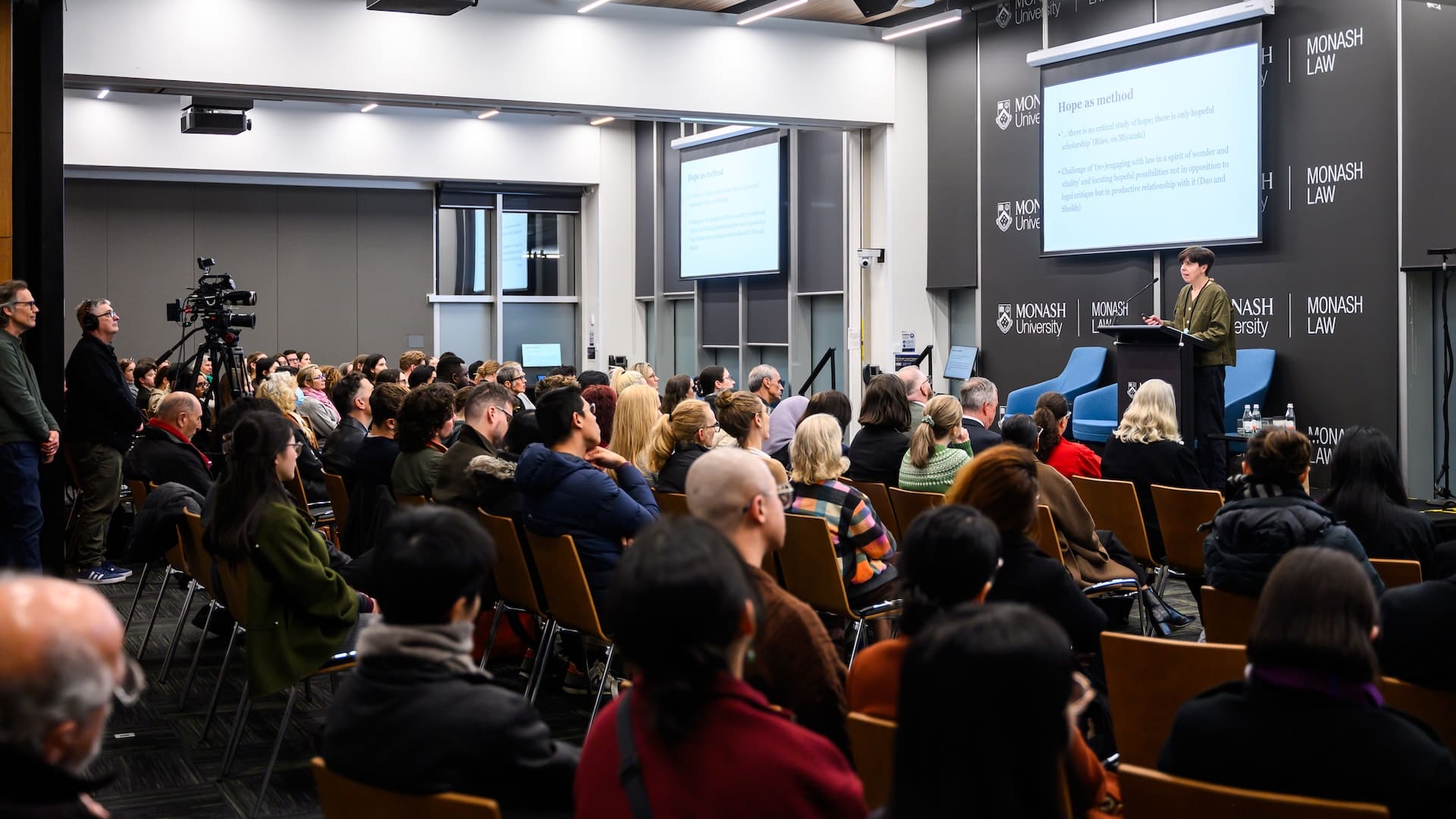
Can law help sustain hope in the face of climate change, biodiversity loss and environmental decline?
That was the question at the heart of a public lecture delivered by Elen Stokes from Bristol Law School. Monash Law students, academics, practitioners and members of the judiciary gathered to reflect on the future of environmental law and the possibilities it offers in a time often defined by crisis.
Introducing the lecture Professor Steven Vaughan, Dean of Monash Law, described Professor Stokes as one of the United Kingdom’s leading environmental law scholars. Her research spans environmental governance, technological innovation, uncertainty, futures and, more recently, hope itself.
Professor Stokes challenged familiar assumptions about environmental law as a discipline focused primarily on failure, shortcomings and unmet ambitions. Instead, she invited the audience to consider the ways law can create, sustain and organise hope, even when facing some of humanity’s most pressing environmental challenges.
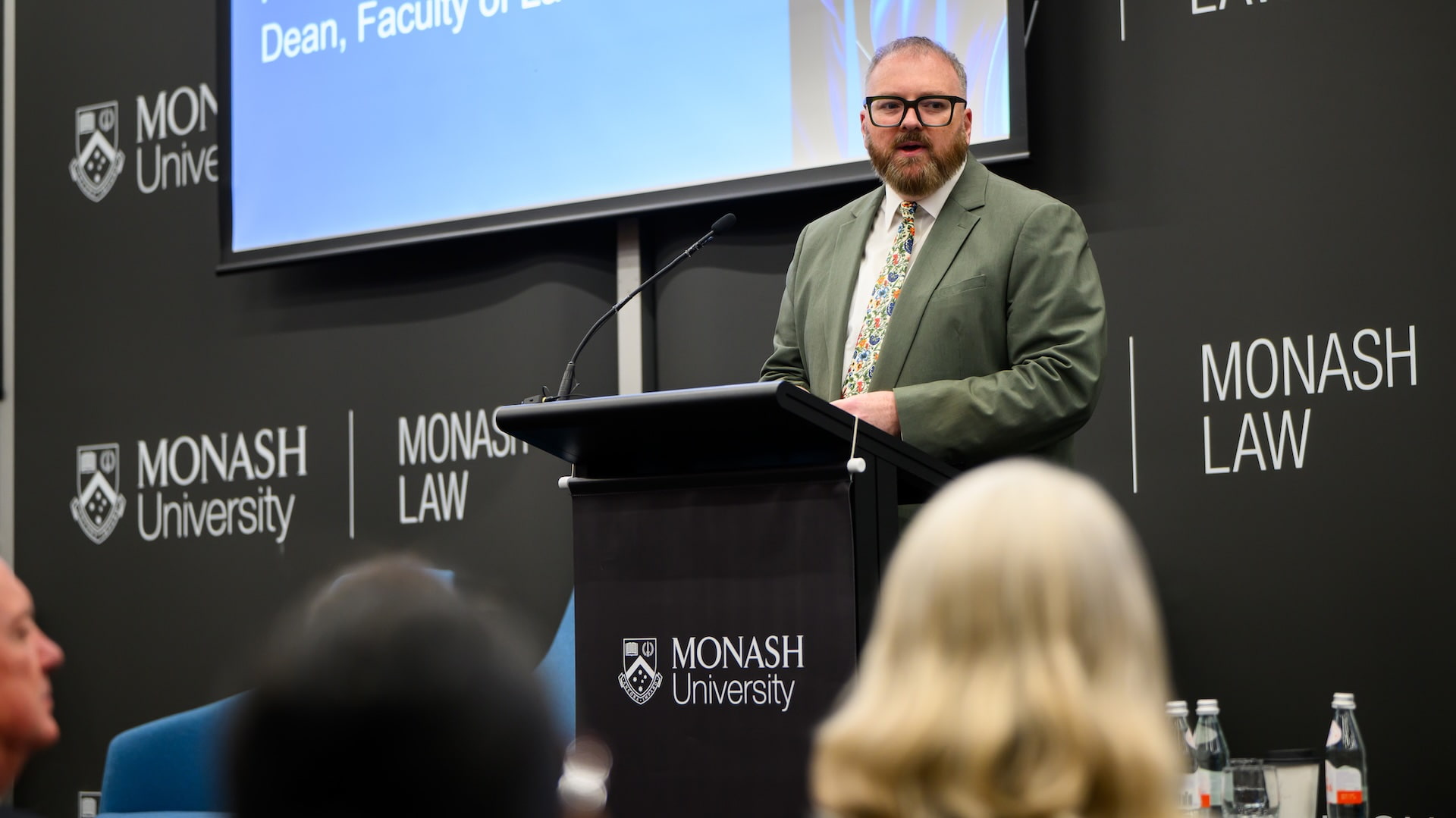
Professor Steven Vaughan, Dean of the Faculty of Law, introducing Professor Elen Stokes.
Looking for the good news in environmental law
Professor Stokes began with a personal reflection, explaining that her exploration of hope emerged from an attempt to write about environmental law’s “good news stories”.
“ I had personal reasons to want to think about the good news in this subject. I had recently had a child and I'd also been given reason to reflect on what I'd written in my career. It dawned on me that I had written nothing positive about environmental law in the decades that I'd been working in it,” Stokes said.
“So off I set, to look for the positive, but that proved to be a challenge too far. Because the positive, it turns out, can be quite hard to find in this field.”
Environmental law today operates against a backdrop of what Professor Stokes described as a “triple planetary crisis” of climate change, pollution and biodiversity loss. In the United Kingdom, these challenges have been accompanied by political upheaval following Brexit and broader concerns about environmental protections. At the same time, universities have faced funding pressures and uncertainty about their future roles.
These overlapping pressures led her to ask a deceptively simple question: could environmental law itself be understood as a site of hope?
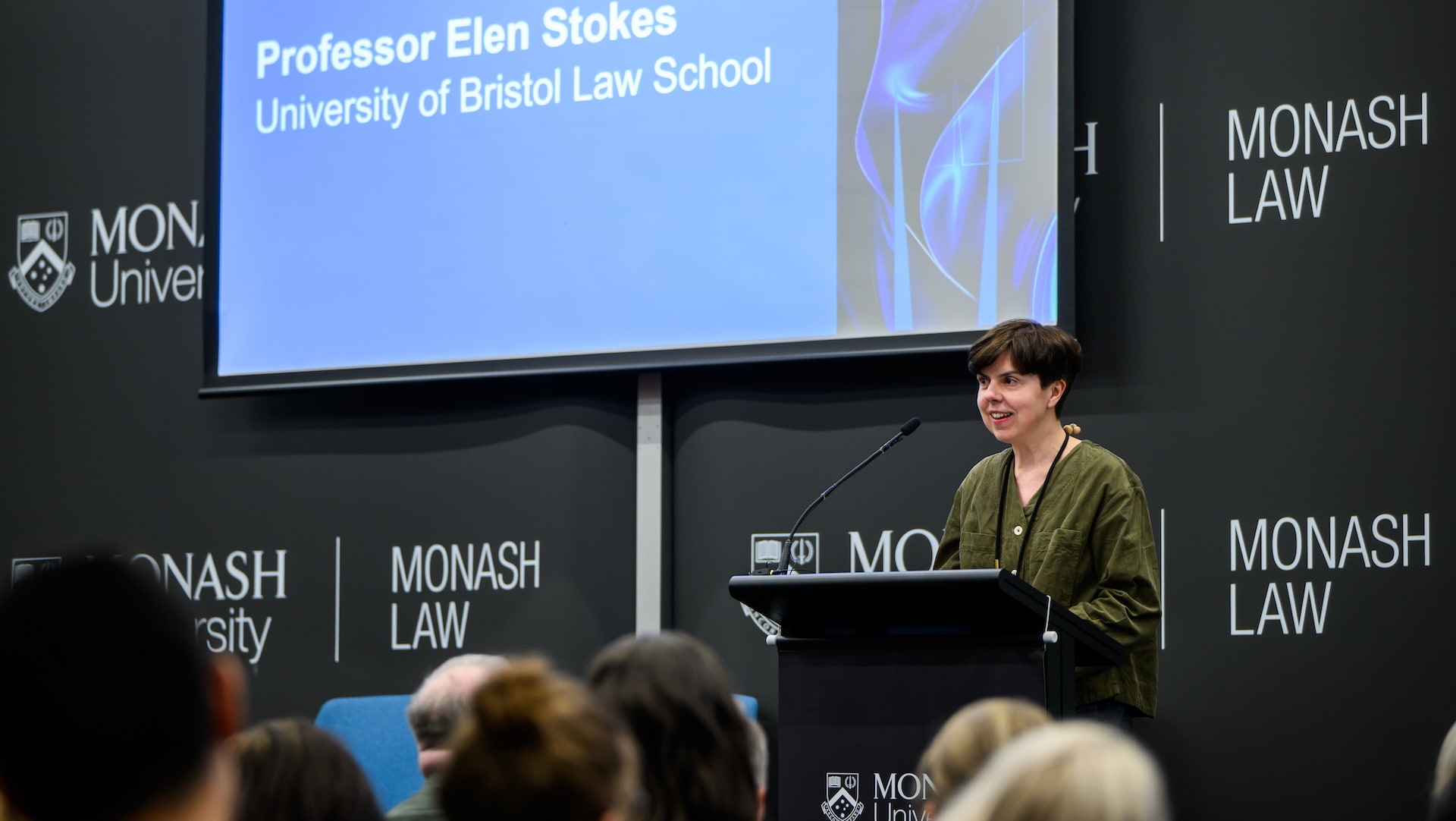
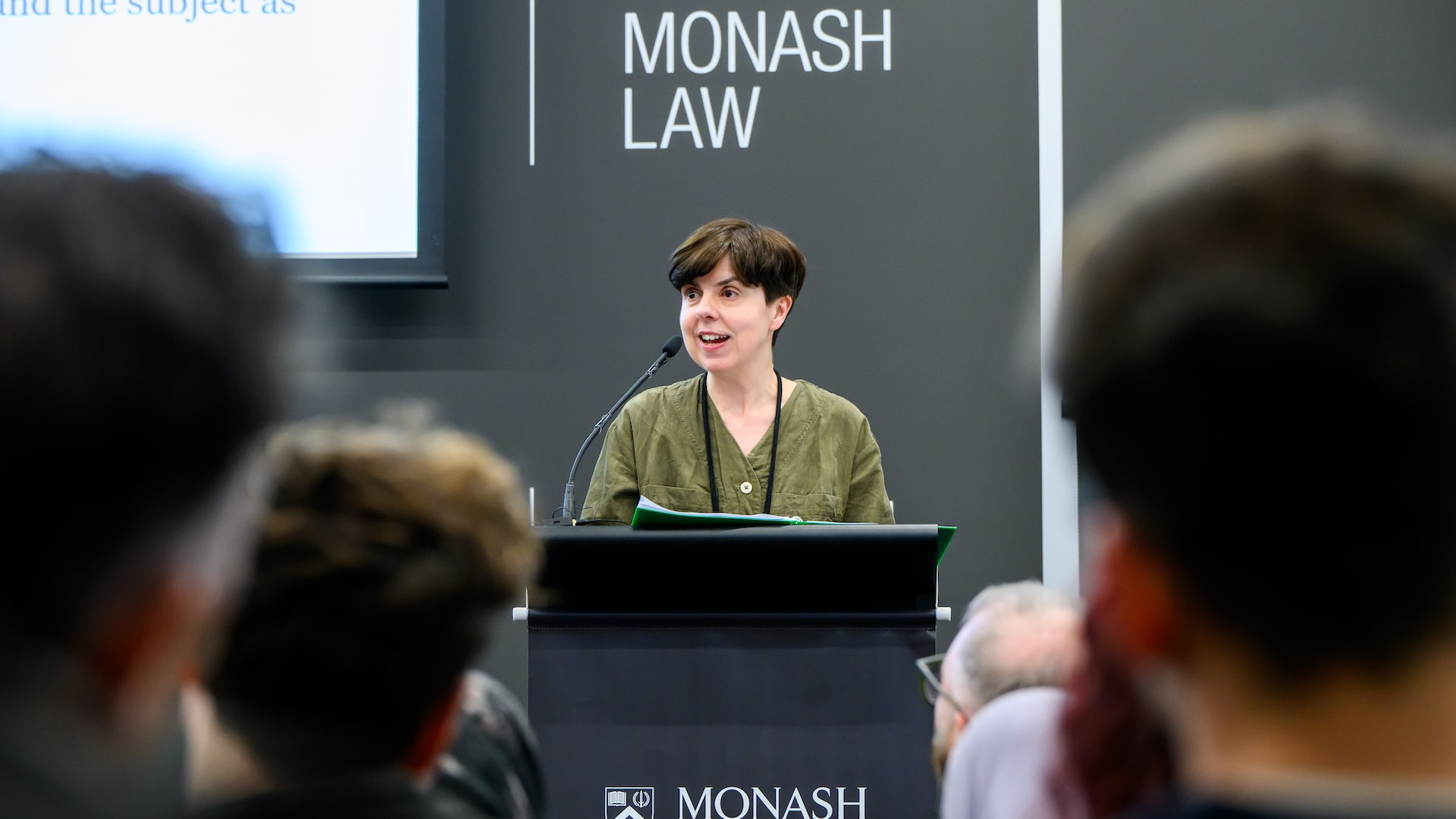
Professor Elen Stokes presents a public lecture at Monash Law.
What hope means and what it doesn't
A central theme of the lecture was the distinction between hope and optimism.
Drawing on scholarship from philosophy, sociology and legal studies, Professor Stokes argued that hope should not be confused with blind confidence that things will work out for the best. Rather, hope exists in the space between possibility and certainty. It requires reasons, evidence and commitment, while recognising that success is never guaranteed.
”Optimism, as Terry Eagleton points out, is ‘simply a quirk of temperament’, a belief that things usually work out well even when ‘the facts do not support it’. Hope, by contrast, ‘needs to be underpinned by reasons’,” Stokes said.
“Even so, hope offers no guarantee of fulfilment. It is by definition ‘disappointable’. The hoped-for outcome must nevertheless remain possible even if it is not probable.”
This understanding matters deeply for environmental law, where many of the challenges confronting societies appear daunting in scale and complexity. For Professor Stokes, hope is not an alternative to recognising a crisis. Instead, it emerges from confronting difficult realities directly.
“ Importantly, I'm not suggesting here a turn away from despair, but instead recognising despair as a condition from which hope arises. As Eagleton goes on to note, ‘the most authentic kind of hope is whatever can be salvaged, stripped of guarantees from a general dissolution’,” Stokes said.
Continuing to quote Eagleton, hope “represents an irreducible residue that refuses to give way, plucking its resilience from an openness to the possibility of unmitigated disaster”. And it is this demanding conception of hope, Stokes reflected, that might direct our attention to parts of environmental law in or through which hope may be generated and sustained.
Two ways law can create hope
Professor Stokes introduced a clear framework for understanding how hope operates within environmental law.
The first form, which she described as “eventful hope”, emerges through significant legal moments. These may include landmark court decisions, major legislative reforms or public declarations that capture widespread attention and create new possibilities for action.
Climate litigation offers one example. International court decisions and advisory opinions have increasingly become moments around which communities, advocates and governments invest considerable hope. These events help focus public attention and can create renewed belief that meaningful change remains possible.
The second form, “institutionalised hope”, is less dramatic but potentially more enduring. It is embedded in laws, policies and governance structures that establish long-term goals and pathways for progress. Examples include emissions reduction targets, environmental benchmarks and legislative frameworks aimed at sustainable development.
Among the examples discussed was Wales's Well-being of Future Generations Act 2015, legislation that seeks to embed sustainable development across public decision-making. While often criticised for lacking strong enforcement mechanisms, Professor Stokes argued that its significance may lie elsewhere: in changing cultures, expectations and ways of governing over time.
In this sense, hope becomes an ongoing practice rather than a single moment of success.
Rethinking the role of legal scholarship
Beyond examining hope within environmental law, Professor Stokes also challenged scholars to consider how hope shapes their own work.
She distinguished between “thinking towards hope”, which treats hope as a subject for analysis, and “thinking from hope”, which uses hope as a starting point for research, teaching and professional practice.
This approach raises broader questions about the purpose of legal scholarship itself.
Too often, Stokes suggested, academic work excels at identifying failures and shortcomings. While critique remains essential, legal scholarship also has a responsibility to consider alternatives, imagine better futures and explore what remains possible.
By examining overlooked forms of legal action, alternative judgments and imaginative approaches to environmental governance, scholars can help reveal possibilities that might otherwise be obscured.
”In environmental law, these include wild law judgments, earth law judgments, and Anthropocene judgments. By revisiting judgments of the past or anticipating judging practices of the future, these projects are designed to prize open alternative futures or pasts,” Stokes said.
“They sit within wide-ranging initiatives to reimagine familiar narratives in environmental law, to reconfigure its underlying structures, and even to prefigure the conditions that shape what follows. Efforts such as these might not save us from climate change, but as Chiara Armeni notes, they remind us of the need for a constant reflection on who tells the story.”
“And I would argue they bring with them a hope-oriented mode of engaging rather than a mode anchored in the fatalism of inevitability. Hopeful environmental law scholarship may also involve a renewed focus on or a renewed appreciation of failure.”
What hope means for students and practitioners
What role do law schools, academics and teachers play in finding hope in environmental law? Some of the lecture's most compelling reflections focused on students entering environmental law for the first time.
Each year, Professor Stokes asks new cohorts why they chose to study the subject. Again and again, she encounters a belief that the law can help tackle environmental harm and create a better future.
That optimism can be challenging for educators, who also understand the limitations and frustrations of legal systems. However, Professor Stokes argued that extinguishing hope should never be considered a successful educational outcome.
“ Our students at the start of the environmental law course are not accepting of the status quo, and they often see hope in what the law might do to change it,” Stokes said.
“If on completing the module, all hope were lost, that would not just be a cause for regret, it would signal a failure in our teaching and also in their learning. For that reason, I think it is important not just for teaching, but also for research, to take seriously this more nebulous character of what it means to engage with environmental law.”
These observations resonated well beyond the classroom, offering a message relevant to practitioners, policymakers, activists and judges grappling with environmental issues in their own work.
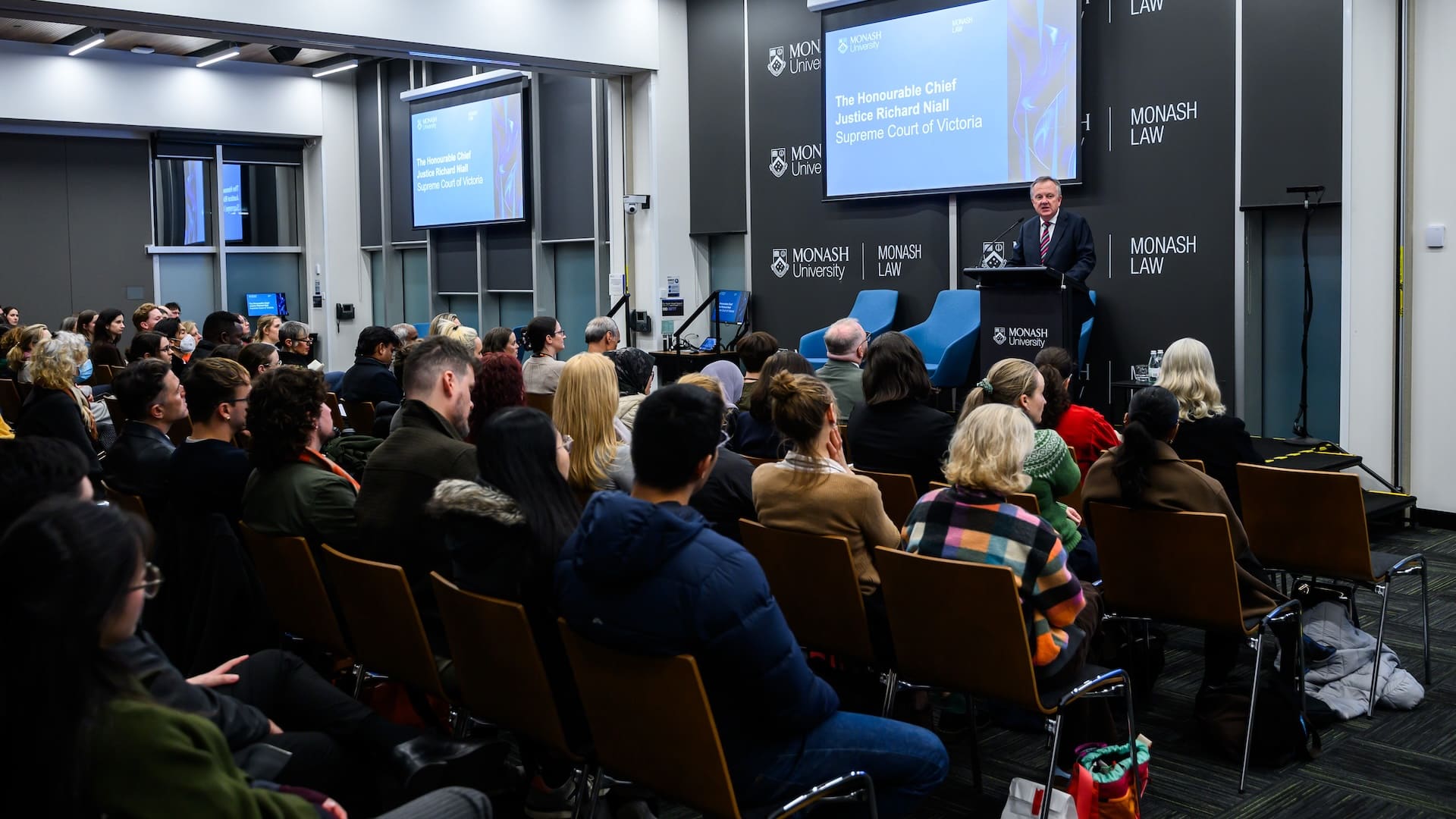
The Honourable Chief Justice Richard Niall responds to Professor Elen Stokes’ lecture.
A response from the Chief Justice
Responding to the lecture, the Honourable Chief Justice Richard Niall reflected on the opportunities and challenges facing environmental law within Australia's common law tradition.
He noted that environmental issues often sit uneasily within legal frameworks historically focused on individual rights, responsibilities and remedies.
Against that backdrop, he welcomed Professor Stokes's call for a more hopeful mode of legal inquiry.
“ It's important that our work not be fateful, and it's important that academic writing, like judicial writing, have an emotional register,” Niall said.
“The paper that we've been favoured with tonight is a very important and interesting addition to legal scholarship. It causes us to reflect on how we write, how we communicate, and that the law, faced with challenges such as the environment, needs to adapt, but that adaptation can only be undertaken from a position of hope rather than pessimism.”
He also emphasised the important relationship between courts and legal scholarship, suggesting that academic work has a crucial role in helping legal systems respond to emerging social challenges.

Professor Elen Stokes, Professor Steven Vaughan and the Honourable Chief Justice Richard Niall.
Holding the line between here and hope
Closing her lecture, Professor Stokes returned to an image from novelist Ali Smith, who describes hope as a tightrope stretched across a ravine between where we are and where we hope to be.
For environmental law, that tightrope is rarely comfortable. It requires confronting difficult truths while remaining open to the possibility of meaningful change.
At a time when public debate about environmental issues can be marked by anxiety, frustration or despair, this lecture offered a different perspective. It posited that hope is neither naïve nor passive. Rather, it is something law can cultivate through institutions, decisions, scholarship and practice.
Even in the face of climate change and biodiversity loss, hope remains an essential part of environmental law’s work and perhaps one of its most important responsibilities.