
Monash researchers earn Planning Institute of Australia commendation for ground-breaking circular economy planning study
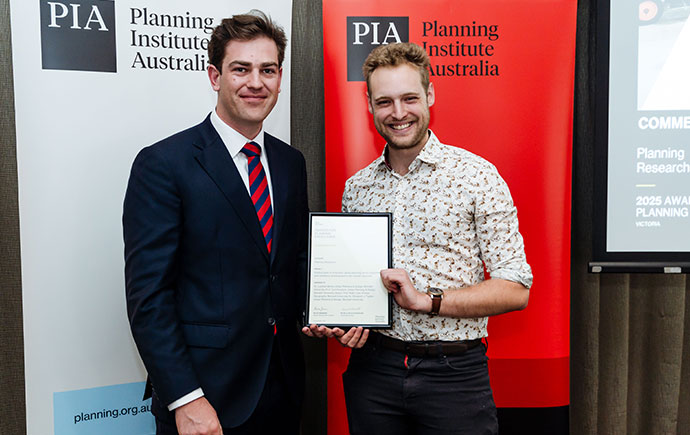
Monash University’s Urban Planning and Design researchers have been recognised with a prestigious commendation from the Victorian Chapter of the Planning Institute of Australia (PIA), celebrating their innovative contribution to understanding how cities can better support inclusive, circular economies.
“Reuse organisations (like op shops and “waste-to-wages” circular enterprises like Green Collect, Outlook and Good Sammy) are doing essential work in our cities, yet they often operate in planning blind spots,” said Monash Urban Planning and Design (UPD) alum Dr Lachlan Burke, lead researcher on the award-winning PhD project.
“Our study shows how better planning support, like well-connected industrial lands, can strengthen their impact on jobs, inclusion and sustainability.”
The project, Circling Back to Inclusivity: Urban planning, reuse organisations and workforce development in the circular economy received a PIA Victorian Chapter Commendation in the Planning Research category and was part of the broader "Measuring the benefits of reuse in the circular economy" ARC linkage project led by Associate Professor Ruth Lane in Human Geography. The team includes Dr Burke, Professor Carl Grodach and Dr Elizabeth (Liz) Taylor from Urban Planning and Design, together with Associate Professor Lane.
The judging panel praised the study for advancing planning knowledge in a rapidly evolving sector. The citation highlighted the research’s demonstration of “relational processes of change in the circular economy and its socioeconomic configurations,” noting that it situates circular activity within real urban places and broader economic frameworks. As Australia moves away from linear models of production and waste, the panel stressed the importance of planning policy that keeps pace with shifting employment patterns, industry structures and material flows.
Professor Grodach said the commendation reflects the growing importance of planning research that links economic development and social inclusion.
“Circular economy discussions often focus on technology or waste systems, but our research highlights the important roles of social enterprises and workforce development,” he said. “Reuse organisations and circular enterprises don’t just divert materials; they create local jobs, community connections, and new forms of economic activity. Planners need to understand these networks if cities are going to support more inclusive and sustainable economies.”
The project drew on extensive fieldwork, with reuse organisations (Green Collect, Melbourne and Good Sammy, Perth), examining how they operate, the communities they support and the spatial, regulatory and economic barriers they encounter. By documenting real-world practices, the researchers were able to identify gaps in planning systems that inadvertently hinder circular enterprises, such as zoning restrictions or infrastructure designed around traditional industrial models. Further, they identified other ways that local governments could support them, like contracting social enterprises directly to recirculate goods into the local economy, rather than just relying on flat fee waste management operation structures.
Associate Professor Lane said the findings highlight the need to rethink long-held planning categories as the boundaries between employment, industry, retail and community activity increasingly overlap.
“Reuse organisations don’t fit neatly into existing planning boxes,” she said. “They might be part workshop, part shopfront, part training provider, part community hub. Lachlan's work shows that for these activities to thrive, and for people to benefit as the economy changes, planning frameworks need to be more flexible and more attuned to how these organisations actually function on the ground.”
The researchers argue that progressing the circular economy requires more than policy commitments. It demands a re-examination of how cities allocate land, support emerging industries and enable new forms of work. Their report offers planners and governments a roadmap for recognising and sustaining circular activities that build economic resilience and social inclusion.
Dr Burke said the team is honoured to receive recognition by Victoria’s peak planning body at a pivotal moment for Australian cities.
“This award underscores that planning research has a vital role in shaping fairer, more sustainable urban futures,” he said. “We’re excited to continue working with communities, organisations and policymakers to help make that transition possible.”