
CRISPR-Cas9
CRISPR-Cas9 is a natural defense system in bacteria that helps them recognise and cut the DNA of invading viruses. Scientists have adapted this system as a precise and powerful tool for gene editing, allowing them to modify DNA to study genes, treat genetic disorders, and develop new medical therapies. This was discovered by Jennifer Doudna and Emmanuel Charpentier from the University of California, Berkeley in 2012.
Use this page to revise the following concepts of CRISPR-Cas9:
CRISPR-Cas9 in Bacteria
Bacteria use the CRISPR-Cas9 system as a defense mechanism against viruses, specifically bacteriophages (viruses that infect bacteria).
When a virus infects a bacterium, it injects its DNA into the bacterial cell.
If the bacteria survives, it stores a small piece of the virus's DNA in a part of its genome called CRISPR (Clustered Regularly Interspaced Short Palindromic Repeats).
Bacteria use the stored viral DNA to make guide RNA. This RNA helps bacteria recognise the virus if it attacks again.
Bacteria produce the Cas9 enzyme, which acts like molecular scissors. If the same virus attacks again, the guide RNA directs the Cas9 enzyme to the matching DNA in the virus. The Cas9 enzyme cuts the viral DNA, disabling the virus and protecting the bacteria.
CRISPR-Cas9 is like a memory and defense system that helps bacteria identify and destroy viruses they’ve encountered before. Scientists have adapted this system as a powerful tool for editing DNA in research, medicine, and biotechnology.
CRIPSR-Cas9 Use in Gene Editing
CRISPR-Cas9 is like a pair of molecular scissors that scientists can program to cut DNA at a specific spot.
Scientists create a small piece of RNA, called single-guide RNA (sgRNA) that matches the exact DNA sequence they want to edit, known as the target sequence. The single guide RNA is attached to the Cas9 protein, which acts as the scissors.
Just adjacent to the sequence targeted by the sgRNA, there must be a Protospacer Adjacent Motif (PAM), a short conserved DNA sequence of 2-6 base pairs that may be recognised by the Cas9 enzyme. Cas enzymes can only edit DNA where the PAM sequences occur.
Then:
- The single guide RNA binds to the complementary DNA strand at the target sequence.
- Cas9 recognizes the nearby PAM site (e.g., "NGG", where "N" is any base).
- Once bound, Cas9 makes a precise double-stranded cut in the DNA 3 base pairs upstream of the PAM site.
This specificity ensures the DNA is cut only at the intended location. When designing CRISPR experiments, scientists must choose target DNA sequences next to a valid PAM. The diagram below shows the CRISPR-Cas9 and sgRNA binding to the complementary target DNA and making a double stranded cut.

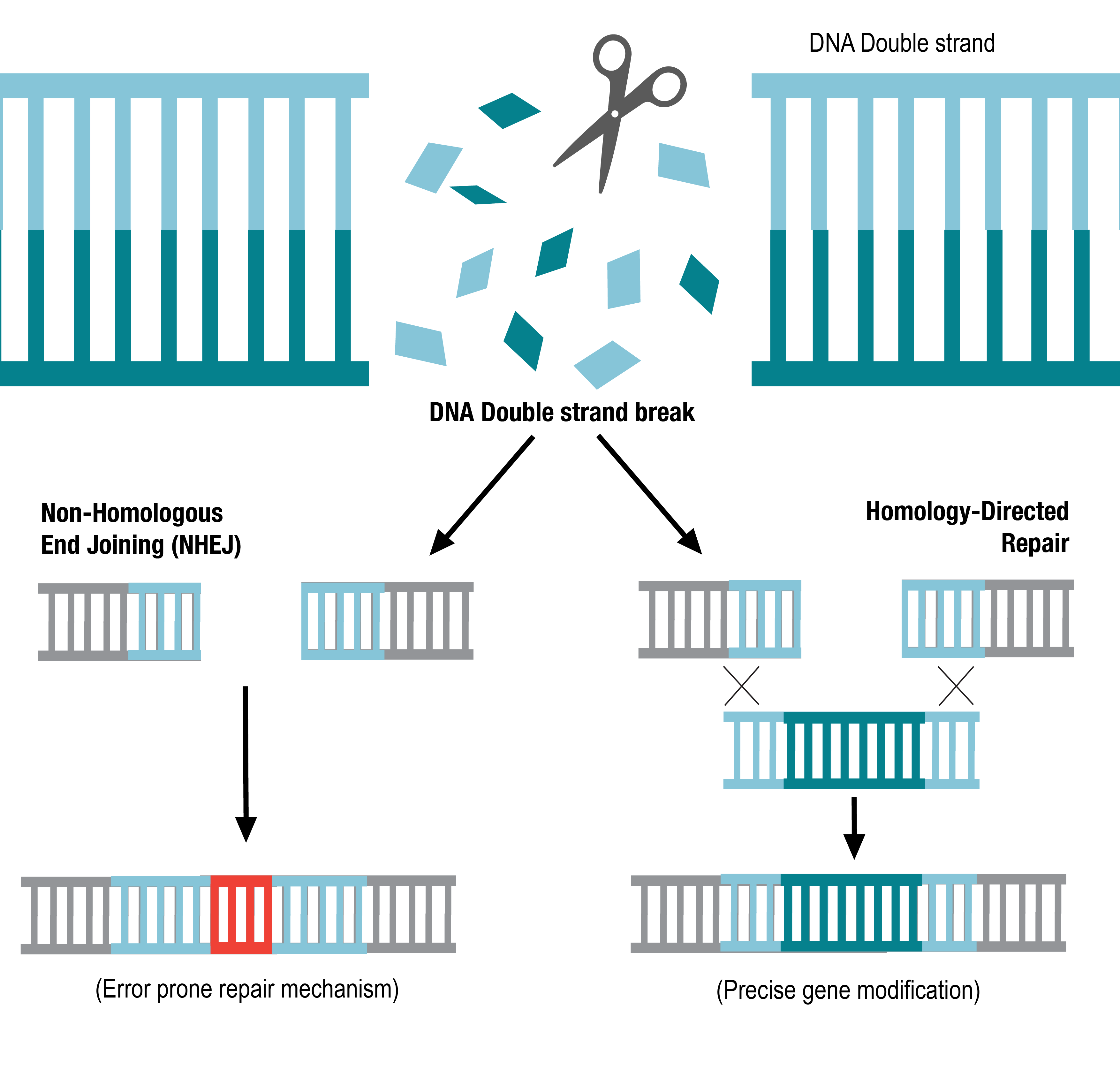
Once the DNA has been cut, the cell tries to repair it. It can be repaired in one of two ways:
- Non-homologous end joining
- Homologous directed repair
Each method is explained below:
- Non-homologous end joining: The cell quickly joins the broken DNA ends back together without using a template. This process is often imprecise and can lead to small errors like insertions or deletions of DNA bases at the repair site.
This method is used by scientists to disrupt or "knock out" a gene by causing these small changes, which can deactivate the gene. This method may be used to determine the function of the gene, by examining the impact of its deactivation. - Homology directed repair: The cell uses a DNA template to guide the repair, ensuring the DNA is fixed accurately. The template can be the cell’s own DNA or a new piece of DNA provided by scientists. This allows for precise edits, such as fixing a mutation or inserting a new gene.
Scientists use this method when they want to make specific changes, like correcting a faulty gene or adding new genetic information.
The diagram below shows the two repair mechanisms.
Examples of Uses of CRISPR-Cas9
CRISPR-Cas9 is a versatile tool with a wide range of applications, from improving crops and treating genetic disorders to advancing scientific research. By enabling precise edits to DNA, it has transformed fields like medicine, agriculture, and biotechnology.
CRISPR-Cas9 is a relatively new technology and has not been widely used in humans due to the possibility of off-target cuts. In off-target cuts the DNA is cut at unintended locations in the genome, in addition to the intended target of the engineers. This could have dire consequences if it cuts a functional gene in humans. However, there is currently extensive investigation into the use of CRISPR-Cas9 to edit human genes for the treatment of disease, and new small scale successes are being published often.
There are also many examples of where genetic engineers have successfully used gene editing to increase agricultural production, including:
Example 1 - Tomatoes
CRISPR has been used to delay ripening and extend the shelf life of tomatoes.
The gene associated with fruit ripening, the SlMlo1 gene, was disrupted using CRISPR. By knocking out this gene, the ripening process was slowed, reducing spoilage and waste during transport and storage.
Example 2 - Improving crop resistance to pesticides in rice
Scientists use CRISPR-Cas9 to modify plant genes to make crops more resistant to pests, diseases, or harsh weather. In rice, CRISPR-Cas9 has been used to edit genes that make the plant more resistant to a common and destructive disease known as bacterial blight. This reduces the need for chemical pesticides and helps ensure stable crop production.
