
Homo sapiens Neanderthals and Denisovans
Neanderthals (Homo neanderthalensis), Denisovans, and modern humans (Homo sapiens) share a complex evolutionary relationship, supported by fossil evidence and genetic data. Neanderthals lived in Europe and parts of western Asia from around 400,000 to 40,000 years ago. They were closely related to modern humans but had distinct physical characteristics, such as a robust body and large brow ridges. Denisovans are an even more recently discovered group, identified primarily through DNA extracted from a few bone fragments and teeth found in the Denisova Cave in Siberia. They lived around the same time as Neanderthals, primarily in Asia. The image below is a reconstruction of a Neanderthal male by artist John Gueche based on Shanidar 1 fossil (right).

Image source: Copyright NMNH, Smithsonian Institution
Genetic studies, particularly DNA analysis, have revealed that Neanderthals and Denisovans interbred with early Homo sapiens. Modern humans of non-African descent carry traces of Neanderthal DNA (1-2%) in their genomes. This interbreeding occurred around 60,000 years ago as Homo sapiens migrated out of Africa and encountered Neanderthals and Denisovans. Mitochondrial DNA (which is inherited only through the mother) suggests that modern humans have a distinct lineage from both Neanderthals and Denisovans, reinforcing the idea that Homo sapiens originated in Africa. The image below shows one theory of when gene flow occurred between these species.
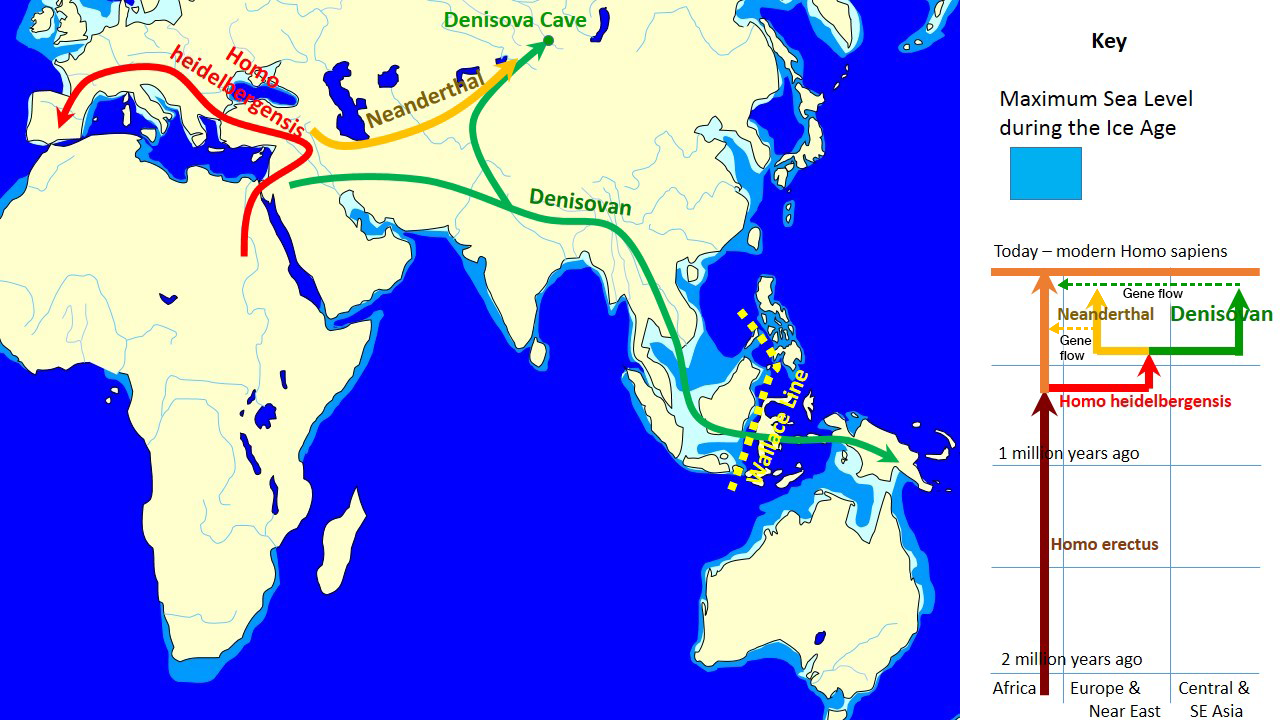
Image source: John D. Croft, CC BY-SA 3.0
The discovery of Denisovan DNA has added another layer of complexity. Some modern humans, particularly those of East Asian and Oceanian descent, have inherited significant portions of Denisovan DNA, indicating interbreeding in Asia. These findings highlight how closely interconnected these hominin species were and how our genetic history includes contributions from multiple ancestors, rather than a linear progression of one species evolving into the next.