
Trends in Human Evolution
There are several key trends in human evolution that can be observed in the fossil record. The most prominent and well-established of these trends include the increase in cranial capacity (brain size) from early to later hominins, as well as significant structural changes in the limbs and skeletal system that are associated with the development of bipedalism.
Use this page to revise the following concepts within the trends in human evolution:
Brain Size
Brain size has tended to increase over human evolution. Early hominins like the Australopithecines had small brains (400-500 cm3), only a little larger than the size of a chimpanzee's (350-400 cm3). As evolution progressed, brain size increased, particularly in the genus Homo. This is observed within the fossil record through investigating the cranial capacity of fossilised skulls.
While brain enlargement is linked to more advanced cognitive abilities—such as problem-solving, social interaction, and culture—it is important to note that brain organization and structure also play key roles.
The development of larger brains enabled hominins to create more sophisticated tools, communicate more effectively, and adapt to new environments, with social behaviors and cooperation likely contributing to further cognitive development.

Arm to Leg Length Ratio
In the course of human evolution, there has been a significant change in the arm to leg length ratio, with legs becoming longer relative to arm length. Early hominins, such as those of genus Australopithecus, had relatively long arms compared to their legs, which was likely useful for climbing. However, as bipedalism evolved, the ratio shifted, and modern humans developed longer legs and shorter arms. This change is closely tied to the adaptation for efficient upright walking, as longer legs provide greater stride length and energy efficiency during bipedal locomotion.

Position of the Foramen Magnum
The position of the foramen magnum, the opening at the base of the skull through which the spinal cord passes, underwent a critical shift in hominin evolution to a more central position. In early primates , the foramen magnum is located toward the back of the skull, indicating a more horizontal posture. As hominins began to walk upright, the foramen magnum gradually shifted to a more central position beneath the skull, allowing for a vertical alignment of the head and neck. This change is a key adaptation for bipedalism, facilitating an upright posture and efficient walking. Note that in the image below, although all the hominin species have a relatively central foramen magnum, it becomes more central in the latter species of the genus homo.

Bicondylar Angle
The bicondylar angle refers to the angle formed by the femur as it angles inward toward the knee. In early hominins, this angle was less pronounced, but as bipedalism developed, the femur became more angled to help maintain balance during walking. Modern humans have a more distinct bicondylar angle, which aligns the knees and allows for a more stable and efficient gait when walking on two legs. This adaptation is crucial for maintaining balance and proper weight distribution during upright locomotion. The image below shows the difference between .

Other Trends
Dental
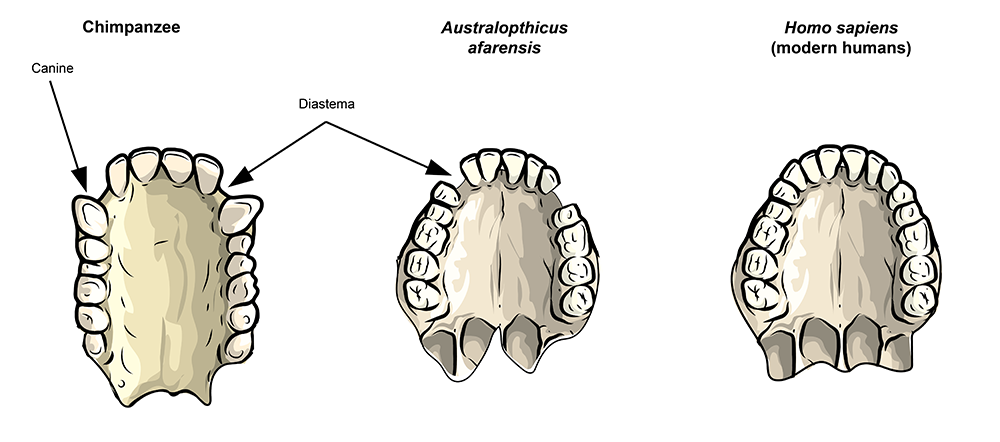
The image below illustrates the development of a parabolic dental arc from a more square arrangement of the teeth. Additionally, we observe the reduction and eventual disappearance of the gap between the incisors and canines, known as the diastema. A reduction in the size of the canines and molars is also evident.
Skull
The brow ridge (the bony ridge above the eye sockets) has tended to become less prominent as hominins evolved from early to later stages. A trend toward a decrease in the angle of facial protrusion is also evident. Additionally, trends such as a decrease in the size of the lower jaw and a reduction in the size of the zygomatic arch (the bony arch that forms the cheekbone) is observed. These changes reflect the adaptation of hominins from a diet primarily consisting of tougher vegetation to softer foods, and eventually to cooked foods.

