
Competition law principles for ‘vertical’ agreements

By Mel Marquis
Monash Law's Deputy Associate Dean (Engagement) and Senior Lecturer Mel Marquis recently submitted an extensive research report to the Australian Competition and Consumer Commission. The report, entitled ‘Vertical Agreements in the ASEAN Economic Community’ and written with Dr Sven Gallasch, identifies desirable competition law principles for ‘vertical’ agreements (such as distribution agreements) in ASEAN and in its Member States, and incorporates a deep-dive comparative assessment of six ASEAN countries.
The authors’ legal and economic analysis resulted in a 61,000-word report prepared for the ACCC as part of its support for the South-East Asian Nations.
Vertical agreements are agreements between operators active at different levels in a supply chain. Such agreements are generally less likely than agreements between competitors (i.e. ‘horizontal’ agreements) to pose significant risks to competition. Indeed, they may often promote competition and generate efficiencies. But the report also discusses the potentially harmful effects of such agreements.
The competition laws and policies of the following Member States were studied as a foundation for the report: Cambodia, Lao PDR, Malaysia, the Philippines, Thailand, and Vietnam. The report also applies an overarching ASEAN-level perspective on the subject.
Elements for a pan-ASEAN competition law model to be applied to vertical agreements, including distribution agreements
The report begins by stressing that the ASEAN context matters, and that legal and practical convergence across ASEAN toward best practices is normally desirable and will generally contribute to the increasing effectiveness and impact of competition law within and across the Member States. In the context of vertical agreements, however, there is more diversity than convergence, a reflection of inconsistent approaches and statutory frameworks.
From the point of view of the ASEAN Economic Community, some vertical agreements have the potential to impede trade between the Member States; but at the same time, vertical agreements can also promote cross-border investment, thereby facilitating the entry of new competitors. The economics of vertical restraints suggests that the regulation of vertical agreements should be nuanced and should take account of factors such as market power, the nature and severity of particular restraints, and the details regarding the functioning of particular industries and markets.

This does not mean that a sprawling ‘rule of reason’ approach is desirable. It would be counter-productive for the authorities to devote resources to the detailed analysis of vertical agreements that are unlikely to impose significant restrictions on competition, or of vertical agreements likely to generate efficiencies that outweigh any moderate restrictions on competition.
The EU has had success employing a combination of a core set of prohibitions against vertical restraints deemed to be harmful, a relatively clear and practical ‘block exemption’ for vertical agreements, and highly detailed analytical guidelines to establish a largely efficient system based on three basic tenets:
i. ‘self-assessment’ by businesses to ensure their agreements conform with the requirements of competition law, supported by analytical guidelines published by relevant authorities;
ii. legal certainty in the form of a ‘safe harbour’; and
iii. use of enforcement resources, if necessary, where vertical agreements fall outside of the safe harbour and pose significant risks to competition.
The report argues that the ASEAN Member States and their competition authorities would benefit by developing an analogous approach. A proposed analytical framework for vertical agreements is provided in the diagram below. There are three possible steps in this model: consider whether a safe harbour applies in the Member State concerned; if not, determine whether the agreement falls within the scope of a prohibition; and if the agreement appears to be prohibited, determine whether there is an overriding defence or justification.
A model for establishing compatibility of a vertical agreement with competition law
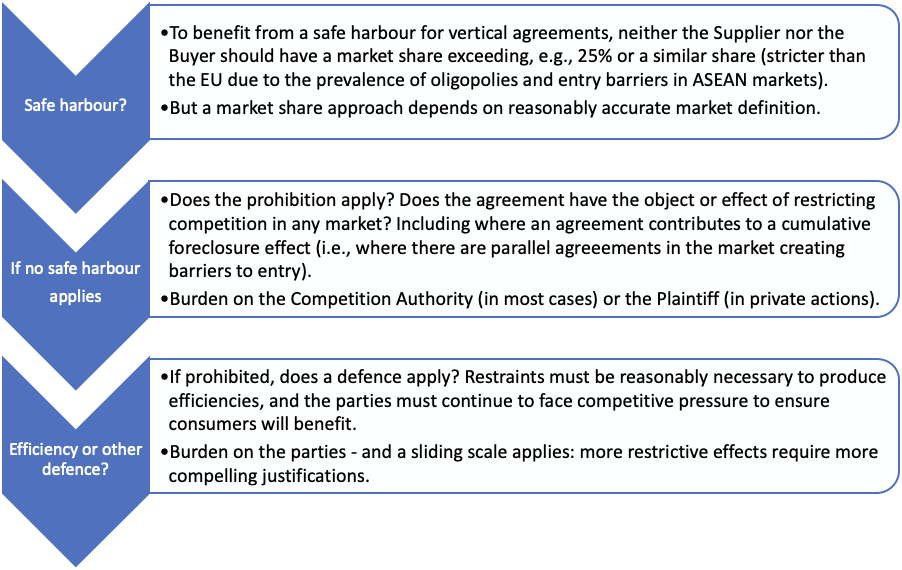
The report favours a competition law enforcement model for vertical agreements based upon the following characteristics: a clear prohibition; an easy-to-apply safe harbour (set at an appropriate level); case-by-case analysis where no safe harbour applies; and sufficiently detailed guidelines to promote legal certainty and predictability.
It will be up to the Member States, taking account of their national priorities and requirements but also the needs of the developing Single Market in the ASEAN Economic Community, to consider whether and to what extent to adopt the principles advocated in the report.
Register to receive the quarterly Monash Law Research Newsletter