
Deborah Glass OBE comes full circle in Monash Law’s Impact Clinic

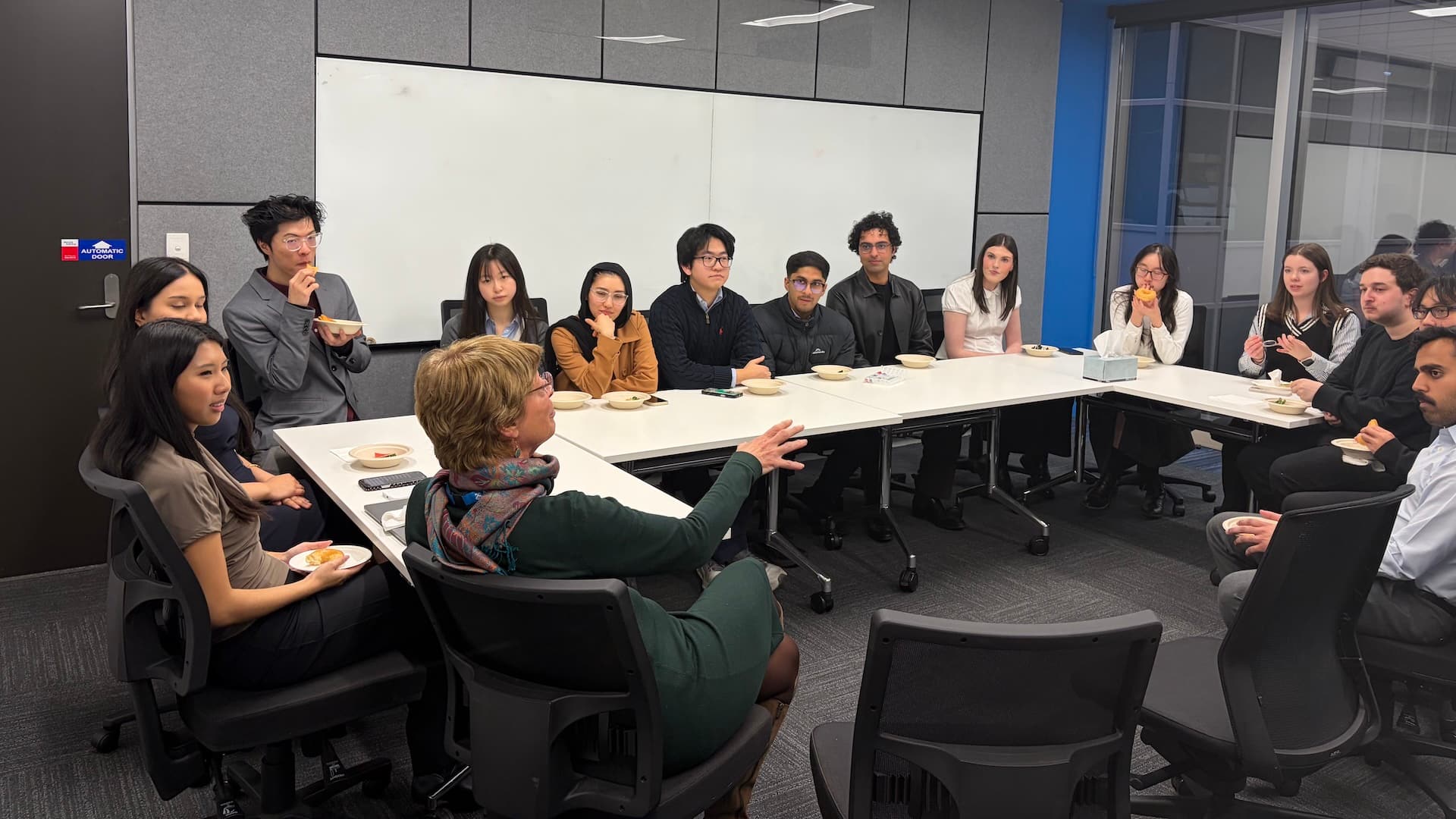
More than four decades after a clinical placement at Springvale Legal Service changed the course of her life, Adjunct Professor Deborah Glass OBE has returned to Monash Law Clinics. This time, she is not a student discovering the law's human impact for the first time. She is one of Australia's most respected public sector leaders, mentoring the next generation of lawyers through the new Impact Clinic.
This is an exceptional opportunity for Monash Law students. They are learning alongside a former Victorian Ombudsman whose career has spanned financial regulation in Hong Kong, police oversight in the United Kingdom, landmark investigations into public integrity and human rights, and a decade leading one of Victoria's most important accountability institutions.
For Glass, the experience is equally meaningful.
"It’s wonderful," she said of returning to Monash. "There is an extraordinary feeling of coming full circle.”
“I felt that really powerfully last year when I was standing on the graduation stage having been presented with my honorary doctorate by the Chancellor."
“ Some decades before I received my degree on that same stage, and to come back there and to have that opportunity to deliver the graduation address to the students and their families, and to impart a few life lessons that I've picked up over the decades – that was an extraordinarily special moment,” Adjunct Professor Deborah Glass OBE said.
A Monash Law Clinic focused on systemic change
The Impact Clinic is one of the newest additions to Monash Law's popular clinical program.
While many clinics focus on assisting individual clients with immediate legal issues, the Impact Clinic asks a different question: what happens when the same problems keep appearing?
For Glass, that question sits at the heart of effective social justice work.
"What the Impact Clinic is intended to be is a clinic that looks at the themes coming out of the clinical program, and looks at areas of systemic advocacy where we could aim to make changes as a result of the issues we see in casework," she explained.
“ It sits alongside the Law Reform Clinic for very similar reasons. Law reform is one way of achieving a change, but it's not the only one.”
Students work on projects that investigate broader legal and policy problems emerging from community legal practice. Rather than resolving a single matter, they explore pathways to reform through research, advocacy, policy development, submissions and strategic intervention.
The clinic aligns closely with the work that defined Glass's decade as Victorian Ombudsman.
" I was the Victorian Ombudsman for 10 years. The aim of this clinic resonates with me as the former Ombudsman because one of the things I used to do as Ombudsman is ask the question, 'What are the systemic issues coming out of complaints? What is it that the public is concerned about that we might want to investigate more systemically and achieve change?'"
While the setting has changed, the underlying principle remains the same. It’s about understanding the experiences of individuals and using those experiences to improve systems for entire communities.

Adjunct Professor Deborah Glass with Yvonne Chen and Nandira Xavier.
From Monash Law student to internationally recognised leader
Glass's return to Monash Law brings an extraordinary career story back into the classroom.
After completing a Bachelor of Arts and Bachelor of Laws at Monash, she briefly practised law in Melbourne before leaving Australia on what she has previously described as a one-way journey into the unknown. Her career took her to Switzerland, Hong Kong and the United Kingdom, where she held senior leadership roles in financial services regulation before moving into police oversight and public accountability.
As Commissioner and later Deputy Chair of the United Kingdom's Independent Police Complaints Commission, she led major investigations into police conduct, including work connected to the aftermath of the Hillsborough disaster. In 2012, she was appointed an Officer of the Order of the British Empire (OBE) for her services to policing.
Returning to Australia in 2014, she became Victoria's first female Ombudsman and served a ten-year term characterised by high-profile investigations, systemic reviews and a commitment to transparency, accountability and fairness.
Despite the scale of those achievements, Glass still holds her experience in Monash Law’s clinical legal education program as a touchstone and turning point.
Her Monash clinical experience remains one of the most important influences on her professional life.
"The biggest revelation was that the law was about people," she said.
”One of the things you do as a student is you're so focused on cases and precedents and books and dusty volumes found in the library that you don't focus on the human story that sits behind all of that.”
"When you're in the clinical environment, there is this person sitting in front of you, and they've got a problem, and you need to help them fix it, and that is a revelation."
That lesson has remained with Glass throughout a career dedicated to addressing power imbalances, increasing accountability and creating fairer outcomes.

Nandira and Anubhav in the Impact Clinic.
Students discover a different side of legal practice
The Impact Clinic introduces students to a form of legal work that many have never encountered before.
Like many students, Nandira Xavier arrived with uncertainty.
"Before joining the Impact Clinic, I actually didn't know what to expect. I don’t think many students did because it's a new clinic – this is only the second time the Impact Clinic has run," Xavier said.
As Glass suggested and to Xavier’s delight, she soon found herself immersed in questions of systemic change and legal impact.
Working in a small team with fellow student Anubhav, Xavier helped develop a framework to assist Monash Law Clinics in identifying and prioritising systemic legal issues to strengthen future advocacy efforts. Through that work, she developed a deeper understanding of how meaningful reform occurs.
Xavier relished her experience with Adjunct Professor Deborah Glass OBE, with one lesson in particular staying with her.
"I remember Adjunct Professor Glass saying something to me which really stuck with me – 'Impact is power.'"
“ Impact isn't just the moment a systemic legal issue gets written up in a spreadsheet, it's part of a chain. The first link in the chain is when a systemic legal issue is identified at Monash Law Clinics, and it's prioritised against need in the sector. That reform is advocated for, and then that reform is achieved, and then the reform is monitored to track whether it's actually being applied in the way that it's intended to be. So that's the chain of impact.”
Xavier came to see impact not as a single event but as a process that begins with identifying a legal issue, continues through advocacy and reform, and ultimately measures whether change has improved outcomes for affected communities.
That shift in perspective transformed her understanding of legal practice.
"It was fun to come to the clinic," Xavier said.
“ We had a great placement group, everyone got along well, we all supported each other and the supervisors were amazing as well, Sally Anderson, Professor Joel Townsend, and Deborah especially.”
“I really looked forward to my placement days,” she said.

Yvonne and team partner in the Impact Clinic.
Learning from experience that cannot be taught in a lecture theatre
For student Yvonne Chen, the clinic offered exposure to an area of law she had never previously encountered.
"Systemic advocacy was very new to me and unfamiliar, but with the guidance of the supervisors, it's been a really pleasant experience and I've really enjoyed my time at the clinic," she said.
Chen’s project examined how infringement fines are treated in bankruptcy law and explored whether current arrangements unfairly disadvantage people already experiencing financial hardship.
The work brought her into discussions with a pro bono law firm and counsel, experiences that provided insights well beyond traditional classroom learning.
When difficult practical challenges emerged, Glass helped the students find alternative paths forward.
"Something that I've learned and also found challenging is that a strong legal argument sometimes isn't always enough on its own," Chen said.
“ When we started looking for a test case for our project to settle the question in court, we found out that it can be quite difficult in practice, and there's high barriers in these sort of cases.”
“ Deborah helped us to work out a different path, to achieve the same goal, and she's been really helpful in steering us in the right direction.”
That lesson reflects one of the key strengths of the clinic. Students learn not only how to analyse legal problems, but how change actually occurs in practice.
Glass sees that practical perspective as one of the most important benefits of clinical education.
"When you're writing an academic essay, you have a very different mindset from when you're writing in the clinical environment where people, by and large, don't have time,” Glass said.
“If you go into practice, your boss doesn't want pages of your glorious legal reasoning. They just want the answer with enough information to make them feel confident that you're on the right track."
"It's a very different style of writing, it’s a very different style of presenting, and it's something that I've been doing for a long time. So I can provide a perspective to students that they're not going to get from their academic studies."
Helping shape a new Monash Law Clinic
As one of the newest offerings within Monash Law Clinics, the Impact Clinic is still evolving.
For Glass, that flexibility is part of the appeal.
"What I'm enjoying is helping to shape the clinic as opposed to coming into an established environment where things are done a certain way. I like to shake things up, so coming into something that's new that I could help to shape is an attractive proposition," she said.
That flexibility is carried through to the clinic's projects which can follow different pathways. Some may conclude with valuable research that informs future work. Others may progress into policy advocacy, test cases, submissions to government agencies or broader reform campaigns.
Glass points to projects such as hardship licences in regional Victoria as examples of how students can investigate practical legal problems, analyse solutions used elsewhere, and contribute to conversations that may lead to policy change.
“ We have case studies that show how disproportionately disadvantaged, people can be by the absence of something called a hardship license that would allow [disqualified drivers] to drive under very limited, very controlled circumstances.”
"We have students here who are doing that research, looking at other jurisdictions, looking at the pros and cons," she said.
“They’re coming up with, what I hope will be a useful research piece that will allow us to think about, ‘Okay, now what's the next step? How do we, how do we achieve change?’”
For students interested in social justice, law reform, public policy and systemic advocacy, this is the attractive proposition that Adjunct Professor Deborah Glass offers in return.
A new chapter built on old foundations
The Impact Clinic may be new, but many of the values underpinning it run deep within Monash Law's clinical tradition.
Glass was among the early generations of students who experienced community-based clinical legal education at Monash. Decades later, she is helping a new generation understand that legal problems do not exist in isolation, and that lawyers have the capacity to improve systems as well as resolve disputes.
For prospective students considering their clinic preferences, the message from current participants is to put this one on top of your list.
"I would 100% say to include this in your preferences," Xavier said.
Chen is equally encouraging.
"Go into the clinic with an open mind and let your project lead the way."
For Glass, the opportunity to contribute to these journeys is the rewarding continuation of a career built on fairness, accountability and public service.
"What I'm hoping people get from the clinic is that practical experience that you just don't get from sitting in the library reading the cases," Glass said.
“It's a different perspective.”