
Movement Towards Reproductive Justice requires vigilance and action
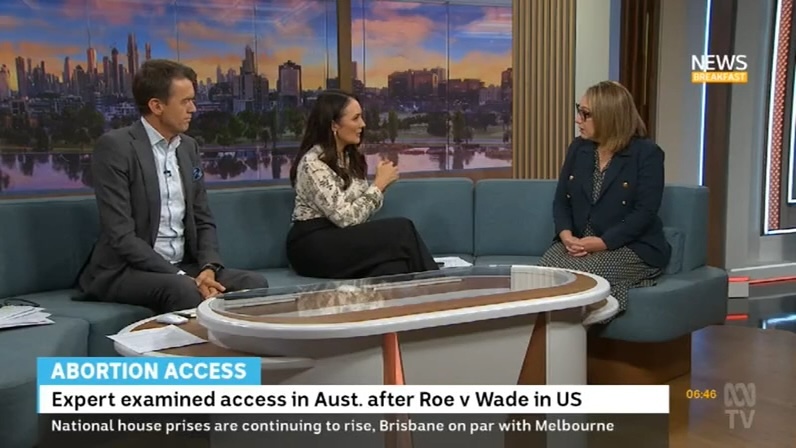
Associate Professor Ronli Sifris discusses her new book Towards Reproductive Justice on ABC TV News Breakfast
Towards Reproductive Justice is the new book from Associate Professor Ronli Sifris. The title may surprise some who assume that the ‘Lucky Country’ already enjoys reproductive justice.
“The reason why I call the book Towards Reproductive Justice is because I believe reproductive justice is really the end goal. We're not there quite yet, though I should say that we have made significant progress towards it in recent years,” explains Prof Sifris.
From a legal perspective, we’ve stepped closer to achieving reproductive justice through abortion being completely decriminalised across Australia over the past 15 years.
“We also have all Australian jurisdictions implementing what are known as safe access zones around abortion clinics. Those are zones within which no anti-abortion conduct, such as picketing directly outside abortion clinics, can take place.”
Ronli Sifris is an Associate Professor in Monash University’s Faculty of Law and Deputy Director of the Castan Centre for Human Rights Law. Her research is predominantly focused on issues at the intersection of women’s reproductive health and the law including abortion, surrogacy, assisted reproduction and involuntary sterilisation.
Outside of the law, Prof Sifris points out that there are a number of additional barriers that are also impeding access to reproductive justice. Then there are events taking place internationally that can bring seemingly unassailable human rights into question.
“This book is for that whole group of people who watched news reports of Roe v. Wade being overturned and were absolutely flabbergasted. People who started asking how could this happen, and to what extent are our reproductive rights protected here in Australia and at the international level.”
Roe v. Wade was a 1973 decision of the US Supreme Court which ruled that the Constitution of the United States generally protected a right to have an abortion. Almost half a century later later, in June 2022, the Supreme Court overruled that landmark decision.
“The decision was not surprising in the sense that people have been predicting that this would happen for some time. Anti-choice advocates had been advocating for the overturning of Roe v. Wade, basically since that decision was passed in 1973,” clarifies Prof Sifris.
Regardless of that awareness, the decision still sent shock waves across America and around the world, because one day abortion was a constitutionally protected right, and the next day it just wasn’t.
“Several states in the US had what are known as ‘trigger laws’ on their books which became enlivened as soon as Roe v. Wade was overturned. So one day abortion was constitutionally protected, and then the next day it was completely banned.”
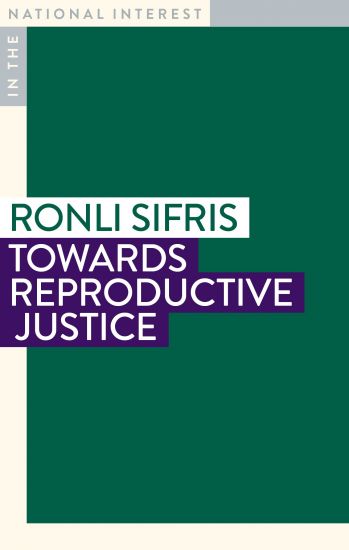
Towards Reproductive Justice is available now from Monash University Publishing.
If the constitutional right to abortion could be taken away overnight in the United States, is it possible that access to abortion could be restricted in Australia?
“Australia's social, political and legal landscapes are quite different to that of the US. So I don't think we should feel as though abortion is suddenly going to be banned here in Australia or in any Australian State,” says Prof Sifris.
Nevertheless, some Australian politicians appear to be borrowing from some of the anti-choice advocacy tactics in the United States.
“One example is a bill that was put before the Federal Parliament last year by three senators which tried to regulate an aspect of later-gestation abortions which really just did not need to be regulated. The regulations, guidelines and clinical practice in place are more than adequate to deal with those situations.”
“So it would seem as though the rationale behind bringing that kind of bill before Parliament was to bring these issues into the public discourse, and to try to start a debate around later-gestation abortions.”
In addition to addressing the threats to reproductive justice, writing this book was an opportunity for Prof Sifris to distil the research she’d conducted since completing her PhD in 2011.
“My PhD was focusing on abortion and reproductive rights more broadly as well. But it was looking at that issue within the context of the right to be free from torture under international human rights law,” outlines Prof Sifris.
“So what this book does is pull together, the international human rights work that I began with my PhD and the domestic legal work that I've been doing post PhD.”
The book also highlights that while there have been significant legal advancements in the protection of reproductive rights in Australia, abortion is still unavailable to many people because of other obstacles, such as geographic and financial barriers.
“There are lots of people who don't live in capital cities and it can be challenging to access abortion services, particularly surgical abortion, which is the only form of abortion available after nine weeks gestation,” reveals Prof Sifris.
“There's a lack of public provision because hospitals, both public and private, are allowed to choose whether or not they provide abortion services. And because a lot of our public hospitals are faith-based hospitals that has meant that entire hospitals have chosen to refuse to provide abortion services.”
In locations where abortion services are available and accessible, the lack of public provision means that people may need to go through the private system, and the cost of private providers can vary significantly.
“Even an early-gestation abortion may cost hundreds of dollars, which is a cost which can be out of reach for many pregnant people.”
Towards Reproductive Justice is a book that does more than outline the challenges and threats to reproductive justice posed by the Roe v. Wade decision, geography and finances. Prof Sifris identifies opportunities to influence real legal change and support human rights.
“I think the biggest thing that needs to happen is, there needs to be a real push towards making sure that public provision of abortion services increases. Back in 2019, when Tanya Plibersek was the Shadow Minister for Women she said that public funding of public hospitals would be tied to a willingness to provide abortion services," recalls Prof Sifris.
“That policy has since been abandoned by the Labor Government and I think that's something which really needs to be put back on the policy agenda. Because until we have adequate public provision of abortion services, abortion will not be appropriately accessible for the people that need it.”