
Elizabeth Wood: A moment of clarity
50 Years / 50 Voices: Learning law and changing lives is a commemorative volume marking the 50th anniversary of the ongoing Monash Law Clinical Program, a pioneering initiative in clinical legal education undertaken by the Faculty of Law at Monash University. 50 alumni of the Monash Law Clinical Program shared their story with 50 current students of the same program. This is an excerpt from the book.

Read more about 50 years of Monash Law Clinics and buy 50 Years / 50 Voices here
As CEO of Capital Punishment Justice Project (CPJP), Elizabeth Wood has built a career on conviction, compassion and quiet courage.
CPJP is Australia’s only NGO focused on the abolition of the death penalty. It is a small but determined organisation that works across Asia and the Pacific, supporting active litigation, law reform and advocating against capital punishment in all its forms. Leading it, Wood says, brings together everything she is passionate about: human rights, social justice, legal advocacy and policy.
Wood did not take the typical path through law school. She studied journalism after school, and completed her degree part-time while working full-time in government, often studying late into the night after long days at the office. By the time she enrolled in the Eleos Anti-Death Penalty Clinic in 2018, she was in the final stretch of her degree and unsure of where her law qualification would take her. ‘I was not convinced I would use it,’ she says. ‘Maybe I would have stayed in government. I never thought a full-time job in the anti-death penalty space was even possible.’ But from the moment she heard about the clinic, she knew she had to apply.
‘The idea that a government could kill someone as punishment just never sat right with me,’ she says. ‘It felt retributive, not just. I did not think that sort of work happened in Australia. I thought it was something you would have to go overseas to do.’
Wood and her small clinic team were assigned to work on a clemency application for a man who had spent more than 20 years on death row in Indonesia. ‘It was heavy,’ she says. ‘He had been convicted on questionable evidence, and we were supporting the legal aid organisation trying to keep him alive.’ Alongside her teammates, Wood worked directly with barristers and international human rights lawyers, researching legal arguments and helping piece together a detailed case for mercy.
What struck her most was not just the legal challenge, but the human connection. ‘It felt real. You were not just writing an essay or answering a problem question. This person’s life was in the balance. It was humbling and motivating.’
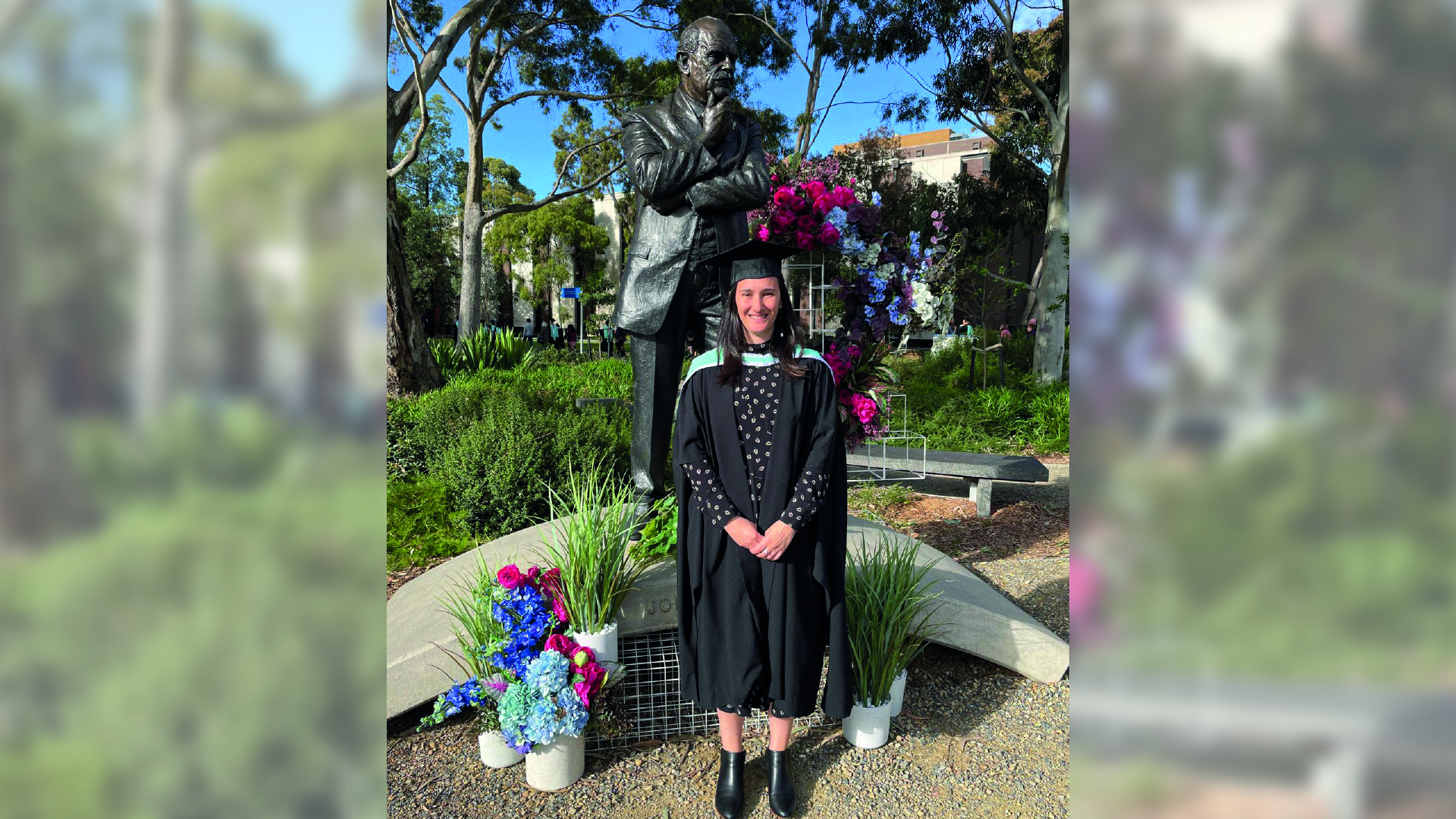
A graduation day tradition, celebrating with Sir John Monash (statue).
Read more about 50 years of Monash Law Clinics and buy 50 Years / 50 Voices here
After her clinic ended, Wood and her group did not want to stop. They volunteered an extra night every week for another 10 weeks, working on new cases, including research for a Malaysian couple arrested on drug charges. Looking back, she says that work was a moment of clarity. ‘That is when it clicked,’ she says. ‘You can actually do this from here. You do not have to be in Geneva or The Hague. You can do it from Melbourne.’
It was this clarity that would eventually lead her to become CPJP’s CEO. She kept volunteering long after graduation, balancing her public sector work with ongoing advocacy. By the time she took on the CEO role in 2022, it felt like a full-circle moment. ‘It was never part of the plan,’ she says. ‘But it made sense. The clinic gave me the foundation, the confidence and the connections.’
Wood says that kind of work comes with emotional weight, urgency and pressure. ‘I remember meeting [Australian] Richard Bourke, who runs a capital defence centre in Louisiana. I asked him if he ever feels like the responsibility is too much. He said something I always come back to: “You can’t stay on high alert all the time. You do your job well, and you let go.” That helped me understand sustainability in this work, that you can care deeply without burning out.’
Wood’s advice to students thinking about doing a clinic is simple: just do it. ‘It is the one time in your degree where the work feels completely real,’ she says. ‘You are not just learning, you are doing. And that makes all the difference.’
Wood is leading a national organisation, dealing with cases where life is on the line, but she speaks with such humility. It is clear she is not in this for accolades. She is in it because it matters.
Read more about 50 years of Monash Law Clinics and buy 50 Years / 50 Voices here
Get involved with Monash Law Clinics
Monash Law Clinics combine legal education with real-world impact, supporting access to justice while equipping students with practical, ethical and professional skills.
If you are a student interested in undertaking a clinical unit as part of your studies, explore the available clinical placements and elective options.
Whether you’re an alum, practitioner or organisation keen to support the clinics through hosting placements, partnerships, volunteering or funding, there’s a way to be involved. To learn more, contact Emily Collard, Industry & Alumni Engagement Manager, at emily.collard@monash.edu.