
Jessie Taylor: The front lines of justice
50 Years / 50 Voices: Learning law and changing lives is a commemorative volume marking the 50th anniversary of the ongoing Monash Law Clinical Program, a pioneering initiative in clinical legal education undertaken by the Faculty of Law at Monash University. 50 alumni of the Monash Law Clinical Program shared their story with 50 current students of the same program. This is an excerpt from the book.

Jessie Taylor’s time in the clinical legal education program left an enduring mark. ‘I did Professional Practice at Springvale and then Advanced Prof Prac as well, in the Sexual Assault Legal Clinic,’ she says.
These placements were not just academic milestones – they connected with her on a deeply personal level and were fundamentally transformative. Taylor’s clinical work exposed her to the real-world barriers faced by vulnerable communities. One of her earliest cases involved a recently arrived Sudanese woman who had driven her injured child to hospital without a licence.
‘She had no idea what to do, but she knew there was a hospital nearby, so of course she put him in the car. Of course she drove to the hospital. Of course she had an accident on the way, and of course she got charged.’
That incident was not uncommon among Springvale Monash Legal Service clients, which led to the development of a community engagement project aimed at newly arrived migrants.
‘It was amazing for me to learn how simple and profound the barriers were to people who were not literate in English or in their own language, or just not given the basic information about how to access emergency services,’ Taylor says.
These moments helped shape Taylor’s understanding of justice, not as an abstract legal principle, but as something lived and experienced.
‘Law is not just about how to interpret the Summary Offences Act, the Crimes Act, or how to write an affidavit. It’s about the part of legal practice that requires you to engage meaningfully with your clients.
‘We’ll all remember the cases that we worked on, but we’ll mainly remember the people that we met and the way that the law interacted with their lives.’
While Taylor’s passion for justice was ignited at the start of her clinical legal education experience, it became a raging fire in response to Australia’s treatment of refugees.
‘A friend of mine asked me if I wanted to visit an immigration detention centre, and I said, ‘that sounds horrendous. No, thank you,’ she admitted. ‘But then, I started to feel really deeply uncomfortable about the narrative that was being touted around boat people. So I went and visited immigration detention and that changed the course of my life and my career really significantly.’
After completing her undergraduate studies at Monash University, Taylor did a Master’s degree in Sweden through a Monash-EU scholarship. When she returned to Australia, she worked in a range of roles – from Legal Aid to the Federal Court of Australia – before being called to the Bar.
Taylor’s work has spanned public law, health law, executive power, refugee law, human rights law and racial discrimination, including a landmark case against controversial right-wing senator Pauline Hanson in 2024.
‘We ran a case on whether the phrase “go back to where you came from” is inherently racist – and the court found that it is a strong form of racism.’
Thankfully for Monash Law Clinics, Taylor’s connection to Monash Law didn’t end with graduation. In 2015, she returned to teach Foundations of Law, invited by her former clinical supervisor, Ross Hyams.
‘I loved getting my claws into the students in their first days of law school,’ she says with a laugh. ‘ I loved using that course as a foundation. It was like saying, here’s the way that we approach the practice of law.’
Read more about 50 years of Monash Law Clinics and buy 50 Years / 50 Voices here
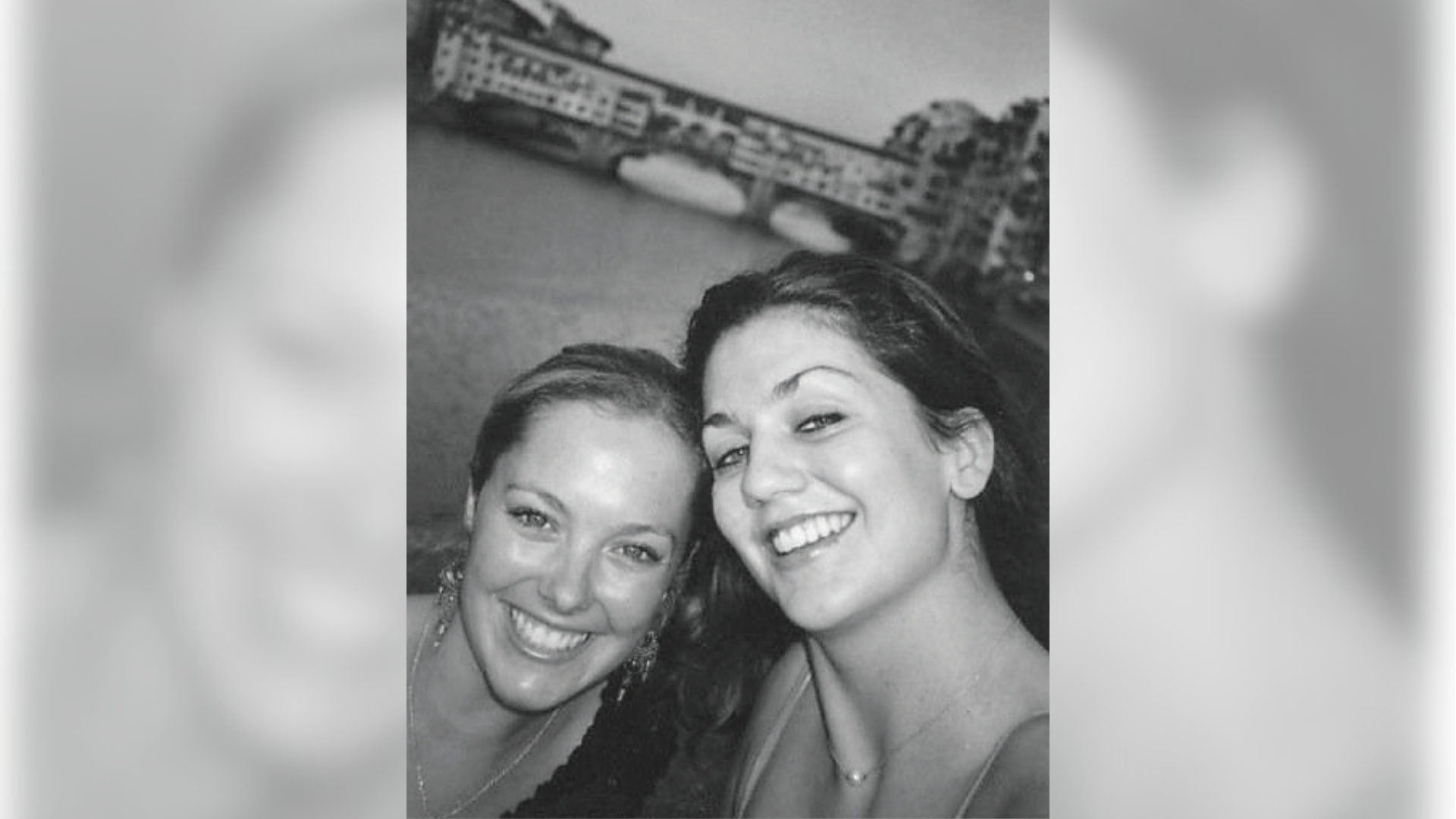
A semester in Prato, Italy. Jessie Taylor on right with friend.
She now teaches non-adversarial justice at Monash Law, a unit that challenges students to rethink what it means to be a lawyer. Taylor remembers one student who told her: ‘I just think you should know that this is the first class I’ve ever been to in my whole degree where I felt like I could actually be a lawyer.’
Taylor sees non-adversarial justice as a vital part of legal education.
‘Law schools have a real risk of churning out arrogant, narrow-minded practitioners who are not great at asking the hard questions of themselves in terms of the assumptions and unconscious biases that they might have. I really try and encourage people to be aware of their own blind spots.’
Taylor’s teaching is grounded in humility, empathy and a deep understanding of intersectionality.
‘You cannot approach working with a 65-year-old Afghan woman who can’t speak or read in English or her own language and assume that you know what’s best for her.’
Continuing her connection with Monash Law Clinics, Taylor now hosts Monash Law students in her chambers. ‘Everything’s come full circle,’ she says.
Her commitment to mentoring the next generation of lawyers is rooted in her own experience. ‘The seeds were planted at Monash Law,’ she reflects. ‘It’s about using the law as a tool for justice and healing, not harm.’
She also emphasises the importance of self-awareness in legal practice. ‘You think you know better than this person? What’s making you think that? Interrogate those assumptions.’
Despite the challenges of working in human rights, Taylor remains committed to advocacy. ‘ Being a human rights lawyer is often an exercise in allowing optimism to triumph over reason,’ she says.
She draws inspiration from the words of Sudanese Australian writer Yasmin Abdel-Magied. ‘ When I was the President of [civil rights organisation] Liberty Victoria, I had the immense pleasure of awarding Yasmin the Young Voltaire Award for human rights advocacy. She was just amazing.’
In her acceptance speech, Abdel-Magied referenced a quote from Martin Luther King Jr when she said, ‘the arc of the moral universe is long, but it bends toward justice.’
‘ Yasmin, being a scientist and an engineer, talked about the presumptions in physics that underline the idea of an arc bending in a particular direction. Objects will respond and be moved and be influenced and shift in space in response to forces that are being exerted upon them.
‘ So when you are looking to bend a moral arc towards justice, you need to exert force on it in that direction. And there needs to be pressure and there needs to be a sustained, energetic, relentless, foolishly optimistic effort placed toward bending the arc of the universe towards justice.’
Taylor’s advice to today’s students?
‘Keep taking that one step forward. Even when it feels like you’re going backwards, you must keep taking that one step forward.’
Read more about 50 years of Monash Law Clinics and buy 50 Years / 50 Voices here
Get involved with Monash Law Clinics
Monash Law Clinics combine legal education with real-world impact, supporting access to justice while equipping students with practical, ethical and professional skills.
If you are a student interested in undertaking a clinical unit as part of your studies, explore the available clinical placements and elective options.
Whether you’re an alum, practitioner or organisation keen to support the clinics through hosting placements, partnerships, volunteering or funding, there’s a way to be involved. To learn more, contact Emily Collard, Industry & Alumni Engagement Manager, at emily.collard@monash.edu.