
Professor Jennifer Hill Moderates Global Panel on EU Sustainability Directive
CLARS Research Leadership on the World Stage
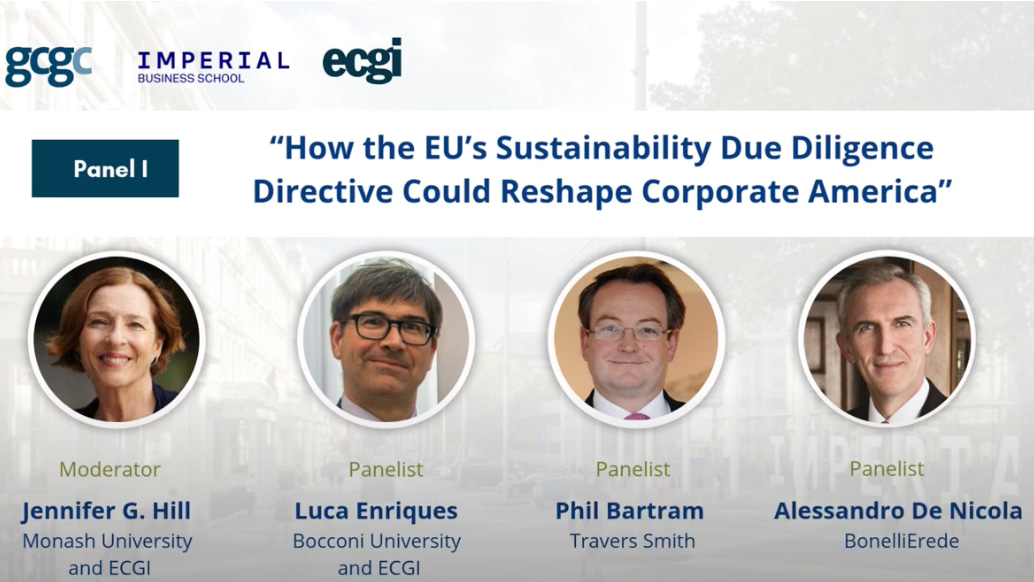
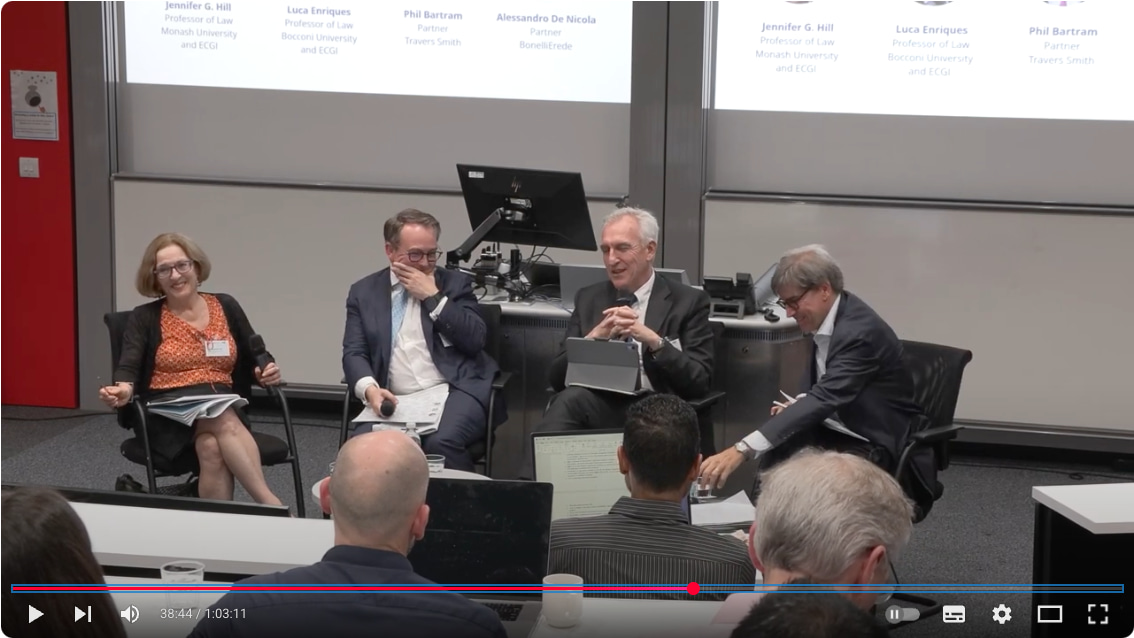
Monash Law’s Professor Jennifer Hill, Director of the Centre for Commercial Law and Regulatory Studies (CLARS), moderated a high-profile international panel at the 2025 Global Corporate Governance Colloquium (GCGC), held in London on 13–14 June. The session, titled 'How the EU’s Sustainability Due Diligence Directive Could Reshape Corporate America', brought together leading legal and governance experts to explore the global ripple effects of Europe’s landmark ESG legislation.
“This is a fantastic paper to finish the day,” Professor Hill said in her opening remarks.
“It brings up a lot of the themes we’ve been discussing - executive pay, legal transplantation, and the tension between shareholder and stakeholder models at a transnational level”.
A Directive with Global Reach
The panel centred on a paper co-authored by Professor Luca Enriques (Bocconi University), Roy Shapira, and Mateo Gatti, which examines the EU’s Corporate Sustainability Due Diligence Directive (CS3D) and its potential impact on US companies.
“This is one of the most ambitious pieces of legislation promulgated so far on ESG,” said Professor Enriques.
“It imposes onerous due diligence requirements on firms which are either from the EU, or have significant turnover, above €450 million, including non-EU companies”.
The Directive mandates companies to identify, prevent, and mitigate adverse effects on human rights and the environment across their entire value chain.
“Even small firms dealing with covered companies will be indirectly subject to these obligations,” Enriques explained.
Legal Cultures in Collision
The panel explored how CS3D interacts with US corporate law, particularly the Caremark doctrine, which governs directors’ oversight duties.
“Historically, Caremark wasn’t that relevant,” Enriques noted, “but that changed dramatically in 2019 with the Marchand decision. Courts are now more willing to scrutinise director compliance efforts”.
Professor Hill prompted discussion on the Directive’s extraterritorial reach and its implications for global governance.
“Be careful what you wish for,” she quipped, referencing the potential for unintended consequences in regulatory enforcement.
Insights from Legal Practitioners
Panelists Phil Bartram (Travers Smith, London) and Alessandro De Nicola (BonelliErede, Milan) shared practical insights from advising multinational clients.
“Despite me sending panic-inducing memos, I can’t really get my clients to properly engage with this yet,” Bartram admitted.
De Nicola added, “Italian companies are quite accustomed to intrusive compliance… They think CS3D is dead on arrival”.
He also raised concerns about the Directive’s vagueness and its potential to harm the very communities it aims to protect.
“There’s no clear literature on the economic impact of the Brussels effect,” he said.
Litigation and Enforcement Risks
The panel discussed how CS3D could increase litigation risk for US companies.
“If a European regulator sends warnings about how your supplier treats the environment or how that supplier treats human rights, that’s a red flag,” said co-author Roy Shapira.
"As a plaintiff lawyer, I have all the information I need, even before section 2.20 because I have all the information that you submitted to the European regulators”.
Bartram noted that the Directive initially included fines of up to 5% of global turnover, and allowed for direct civil liability claims.
“ It does depend on whether those regulators are toothsome and whether they pursue it. One has to be a bit skeptical about that. We don't even know who we're talking about here,” he said.
CLARS at the Forefront of Global Governance
Professor Hill’s role as moderator reflects CLARS’ growing influence in international corporate law and governance. As the Bob Baxt AO Professor of Corporate and Commercial Law, Hill leads research that bridges academic insight and policy relevance.
CLARS continues to engage with global partners through events like the Bob Baxt AO Address, the Law and Business Seminar Series, and international conferences. Its work spans ESG, shareholder activism, regulatory reform, and corporate accountability.
A Global Conversation with Local Impact
The session concluded with reflections on enforcement complexity and the Directive’s broader implications.
“ The shareholder governance part of it is kind of tangential in the end,” one participant noted.
“ Either the company is able to satisfy shareholders or not. And it's partly how the law enforcement would work on the given law, which gather from what you're saying is complicated.”
Professor Hill thanked the panel and audience for a lively and thought-provoking discussion.
“ I told our commentators that it was a lively audience and to expect it to be fast and furious.” she said.
“Thank you for not proving me wrong”.