
New research lab creates Friction and wins a hackathon
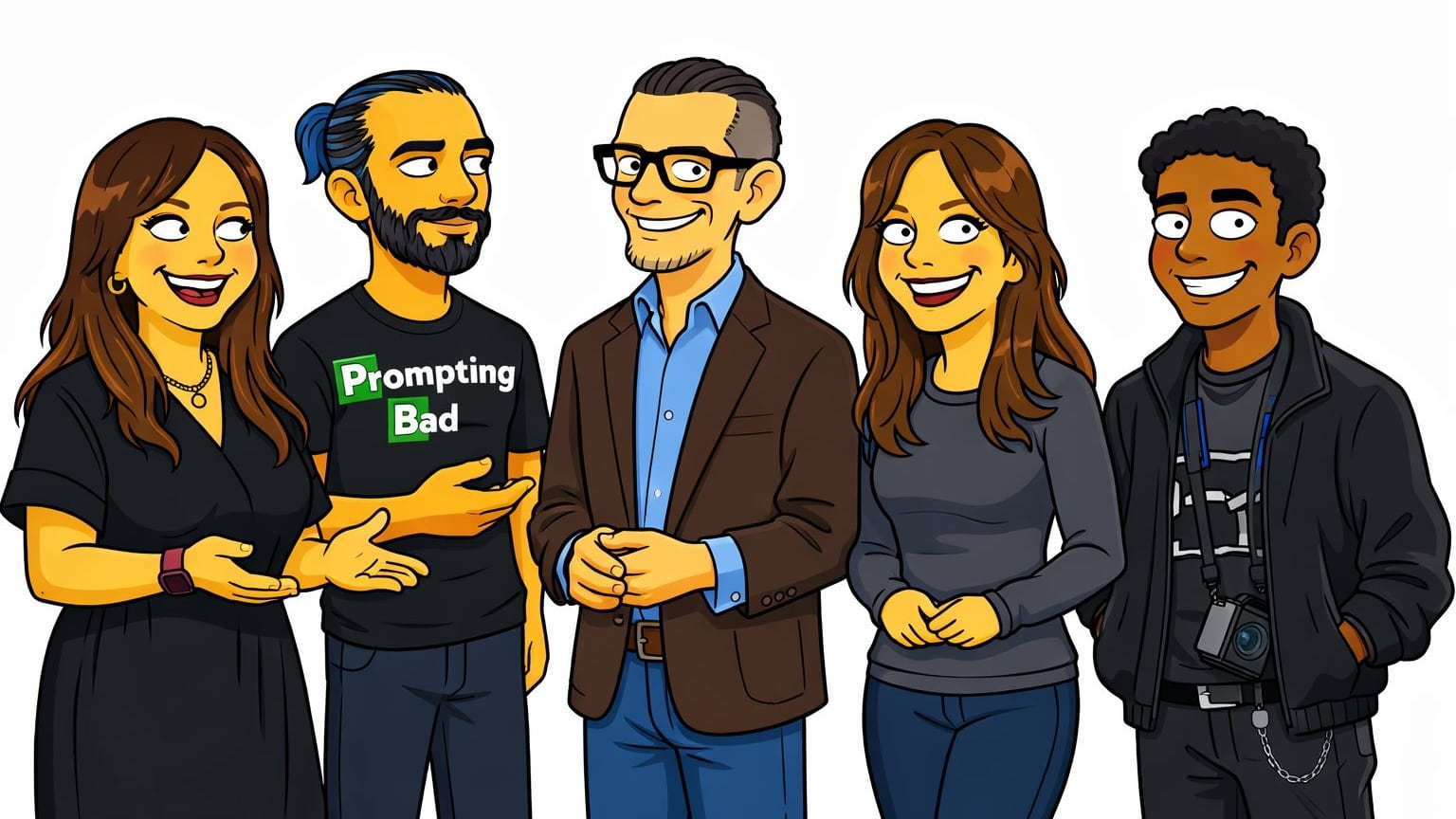
On the Thursday before the Easter long weekend, Dr Paul Burgess got an urgent message from Western Sydney University researcher Dr Armin Alimardani.
“What have you got planned for the next four days? Do you fancy doing a hackathon?” Burgess recalled.
The hackathon was the Cambridge EduX Hackathon 2026, Oceania Edition, a premier AI in education innovation event held in Sydney. For Burgess, it was his first hackathon, so he quickly roped in several other hackathon newbies.
The ‘Vibe Coders For Life’ team included:
- Dr Armin Alimardani, School of Law, Western Sydney University
- Dr Jacinta Sassine, School of Law, Western Sydney University
- Dr Paul Burgess, Faculty of Law, Monash University
- Dora Vanda Velenczei, Faculty of Law, Monash University
- Isam Elsheikh, Law and Computer Science student, Monash University (and the top performer in Burgess’s ‘AI for lawyers’ unit in 2025)
By the end of the weekend, the group had built a working prototype called Friction, and they had won their challenge stream.
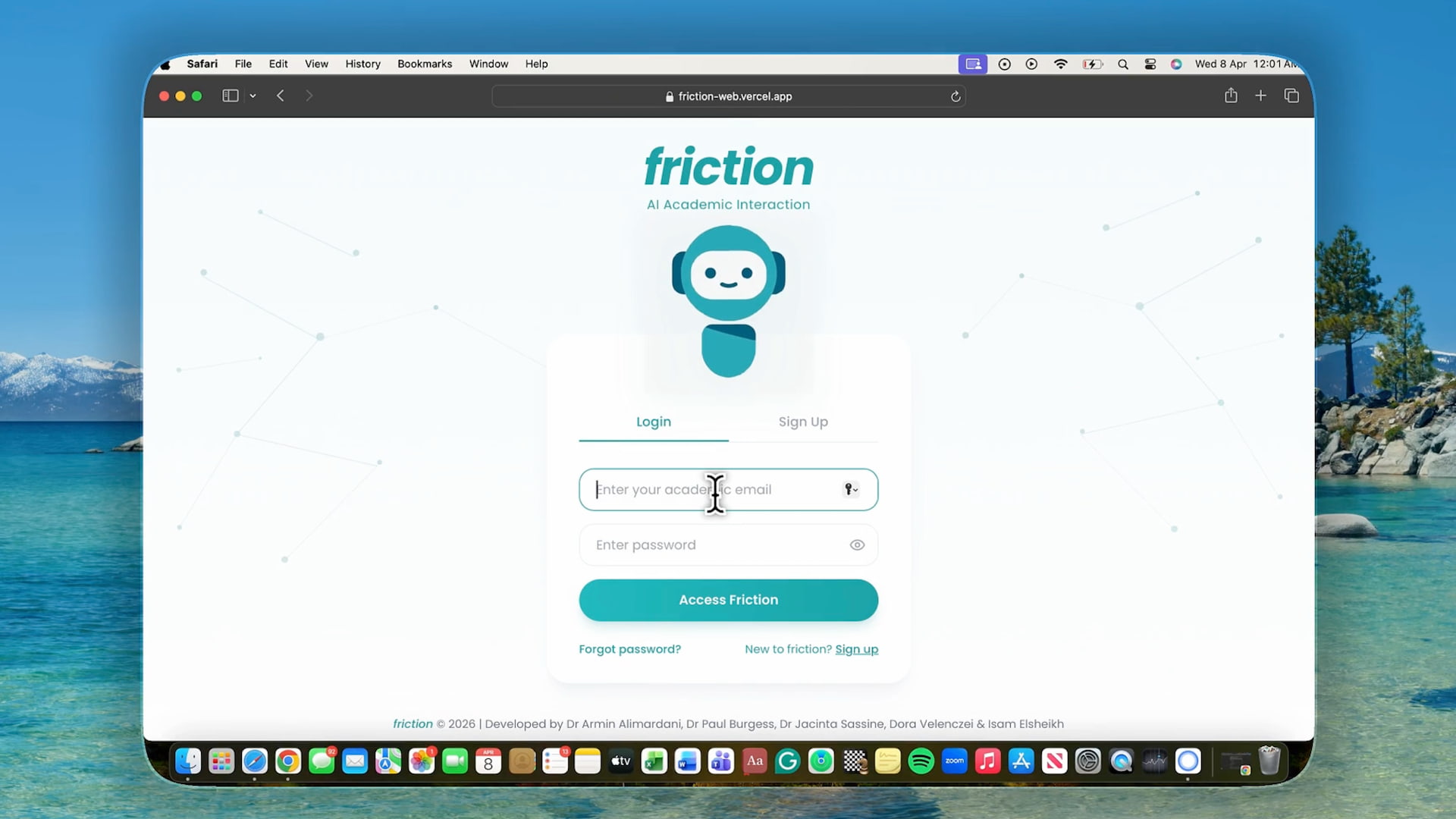
Watch a demonstration of Friction in action.
For the Technology and AI in Legal Education Research Lab (TAILER Lab), the result was more than a nice line on the lab’s website (coming soon!). It was quick, public proof of the lab’s aim which is to bring people together across disciplines, build things that can be used, then test what they do to learning.
What the TAILER Lab is, and why it exists
The TAILER Lab is one of Monash Law’s 6 new labs that were established at the start of this year.
Its name is plain on purpose - Technology and AI in Legal Education Research Lab.
“The lab does exactly what it says on the tin,” Burgess said.
Burgess founded the TAILER Lab with Law Faculty colleague Marnie Brown and Ehsan Shareghi. Shareghi is a long-term collaborator on the computer science side, who has recently moved from Monash’s Faculty of IT to University College London.
The lab’s remit is broad, because the question it is trying to answer is broad. Burgess described it as, “really focused on trying to push forward some research,” in legal education, including what happens within a law faculty and also in the profession.
He also pointed to community education as part of the agenda, mentioning a project about to start that would involve educating women in Bangladesh on their legal rights in relation to family violence.
“We’ve got people from many Monash faculties involved, including the Faculty of IT, Faculty of education, and the Faculty of business,” Burgess said.
The TAILER Lab extends beyond Monash and includes members from Swinburne, the University of Melbourne, and Western Sydney University.
“It’s come out the traps at a thousand miles an hour,” Burgess added, describing the lab as enormous fun and hugely collaborative.”
“I think we have 30 members and we’ve already identified 11 projects and counting,” he said.
The team and the point of mixing experience levels
The hackathon group formed quickly as a subset of the TAILER Lab, but the membership was by no means random.
Alimardani and Sassine joined from Western Sydney University. Burgess had worked with Alimardani previously - most recently at the second annual Digital Law Symposium.
He described Dora Vanda Velenczei as a PhD candidate, a colleague and core member of the Lab, who also serves as the Higher Degree by Research coordinator who liaises with HDR candidates.
That HDR link matters to how Burgess thinks the lab should work.
“One of the key things about the lab is we’re trying to integrate HDR colleagues with more senior researchers in projects so that those students benefit from working with a senior researcher,” he said.
The other Monash team member was Isam Elsheikh, an undergraduate student and a research associate connected to the lab. Elsheikh had excelled in Burgess’s ‘AI for Lawyers’ class.
When the hackathon popped up, Burgess’s thinking was blunt and practical. He wanted, “people who would be passionate, keen, interested and most importantly who might have time.” He also wanted someone with a solid grounding in coding.
Despite the lack of lead time, Burgess and Alimardani quickly composed a winning team with legal education experience, research background, a strong student coder, and enough trust between people to move fast.
What the hackathon was like and how the challenge worked
For most of the team, the novelty was not only the topic. With almost none of them encountering a hackathon before, the novelty was also in the format.
“It was an amazing experience,” Burgess said.
The event offered four challenge streams. Teams chose a stream and then built toward a pitch under time pressure. Burgess explained that there were eight teams of up to five people in their challenge, with four days to solve the problem.
One of the reasons that this disparate team worked well was that they mostly worked virtually. Alimardani attended in person later and delivered the presentation in Sydney.
Day one was selection and direction-setting. Then came the key meeting.
“We spent two hours in a brainstorming meeting,” Burgess said, where the group tried to turn an enormous assessment question into something buildable.
He described it as wide-ranging, fast, and a little chaotic, as you would expect when five people are trying to build a new assessment model in a few days.
How “Friction” got its name, and the learning problem it’s trying to solve
Instead of addressing the problem of “students using AI”, the TAILER Lab team asked what happens when speedy student work becomes a habit.
“Students are going to use Generative AI - we know that,” Burgess said.
Instead of preventing students from using AI, the team wanted to facilitate a way that these tools could be used well - in a way that can be hugely valuable.
“It’s the most useful research tool we could possibly have in this day and age,” he said.
But the risk is that students using AI are skipping the slow work which builds knowledge, such as checking, questioning and verifying.
“There’s a problem with students not critically engaging when they use AI. They're creating content too quickly and not slowing down and thinking about what the problem is.”
During the brainstorming call, someone said the process needed “some friction.” Burgess remembers jumping on it straight away.
“That’s the product name, job done.”
Rather than taking the rest of the day off, the TAILER Lab used the name for focus and the concept started to sharpen. Friction would be an assessment workspace that encourages students to use AI, but it would also push back at the exact moments where passive copy-and-paste starts to look like they’re not engaging.
The three-layer design, and what it does while students write
The design the team settled on has three parts.
Layer one is a familiar looking ChatGPT interface, but placed inside the Friction workspace.
Layer two is the part that changes behaviour during the task. Burgess emphasised that this wasn’t monitoring the student’s use of AI, but rather it is observing the interaction between the student and AI.
In practice, the second layer watches for patterns that signal over-reliance. That pattern might be a student asking the AI something, then, “just cutting and pasting straight into the word processor.”
If the student does take the passive path, the layer two AI waits, checks what the student does next, and then intervenes if the student does not go deeper.
“It’ll wait an appropriate amount of time,” Burgess said, and if the student does not add authority or show verification, it steps in with a prompt.
The intervention is meant to feel like coaching, not punishment.
“We really tried to set that up as a coaching tool. It’s asking in a nice and subtle way - how could you do that better?”
Layer three is a reporting function that starts when the student submits their work.
“Once the student presses the submit button the layer three AI kicks in,” Burgess said.
That third layer reads both the final work and the interaction record, then creates a detailed report about how the student engaged, including whether the student took coaching prompts on board and changed approach.
Burgess framed the difference as timing. Instead of students writing first and reflecting later, “the Friction tool creates an opportunity to critically reflect while we’re doing it,” he said.
Five days in the making (with a prototype by day 2!)
Once the concept landed, the build moved quickly.
Good Friday was the hard grind with design, prompts, coding, and using generative AI to speed up development. Burgess described Armin and Isam hammering through the build, with Isam working late and Armin seemingly not sleeping.
By the end of that day, they had something functional.
“We pretty much had a working prototype,” Burgess said.
Saturday and Sunday were spent on refinement. Burgess described waking up to see the early build wrapped in a really beautiful front end, thanks to Isam’s nocturnal efforts.
Then the focus shifted to pitching.
“Day four was very much focusing on the presentational side of things,” Burgess said. This was the moment when virtual became reality, because Alimardani would be presenting in person.
Burgess did not pretend the team was calm by this stage.
“It was a lot of a blur,” he said.
But he was clear on who carried the build and why it worked.
“I have to give massive credit to Armin and Isam,” he said, describing how the tool not only worked but “looks a million dollars.”
What they won, and how judging worked
The win itself came through the stream process and there was a winner for each challenge stream.
Judging included the formal pitch and a more conversational round. Burgess described a room where teams sat while judges, “wandered around and had a chat to you - they stopped with each team for a bit more of an in depth discussion.”
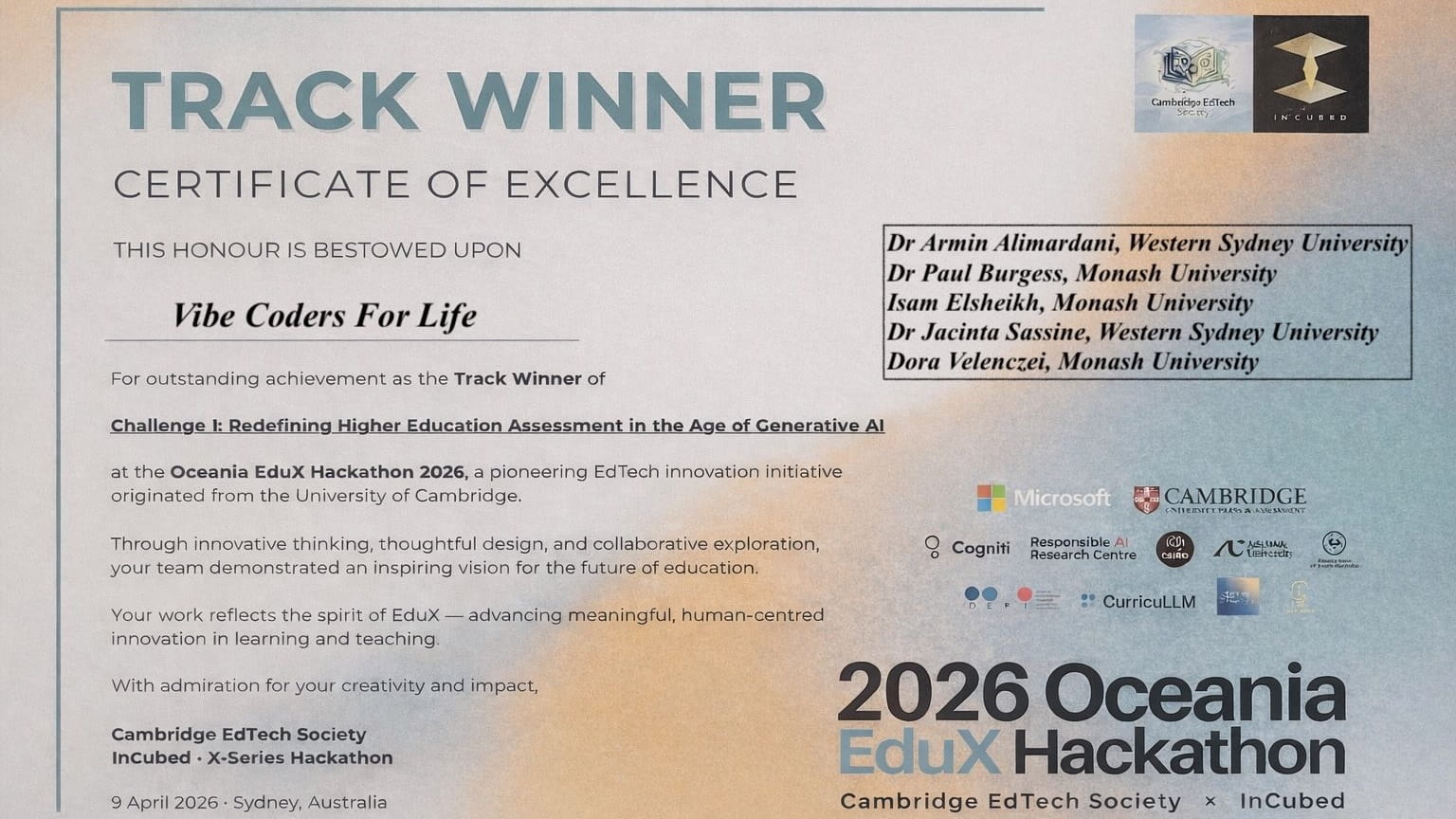
The TAILER Lab were announced as the winners of their stream. The stream winners then went forward to a grand final round.
They did not win the overall prize, but the team was “over the moon” to win their stream as first-time hackathon participants.
What comes next for Friction, and why it fits the TAILER lab’s purpose
Burgess is keen for Friction to move past a prototyping phase and into use, and he’s not wasting any time.
The first step is funding.
“What I would like to do is get some uni based funding,” he said, and he has already started those conversations inside Monash as part of the TAILER Lab.
He also wants to trial it in teaching. Burgess said Friction will be used in his ‘AI for Lawyers’ class in October (LAW5650 - AI for lawyers: Practical applications and theory) and November (LAW4545 - AI for lawyers: Practical applications and theory) this year, and he wants students not only to use the tool but to judge its report back to them.
All of this comes with a practical cost.
“We will need some funding to just pay for the tokens,” he said.
He has applied for “$5,000 in Google credit” to support use of Gemini in the background.
The longer-term question is the one the lab exists to answer - does this sort of intervention improve student judgement, critical engagement, and learning outcomes? Burgess wants to move from a promising build to evidence about the value of a tool like this, how it can be used well, and how it fits into legal education more broadly.
For Burgess, the other great outcome of the hackathon was validating the lab’s broader bet on collaboration.
“Collaboration to me is where it’s all at,” he said, because it produces better work and, “the most fun work.”
“Legal academics generally, we just don’t often do collaboration,” he said.
The TAILER Lab is an attempt to change that culture by bringing educators, technologists, lawyers, and HDR candidates into shared projects from the start.
“In a microcosm,” Burgess said, the Friction project inside the lab was “literally everything we wanted to do with the lab.”
We can’t wait to see what they do next.
If you also can’t wait, and would like to know more about the TAILER Lab, contact Dr Paul Burgess.