
Lessons from a learned lawyer – The Hon. Mark Dreyfus KC MP
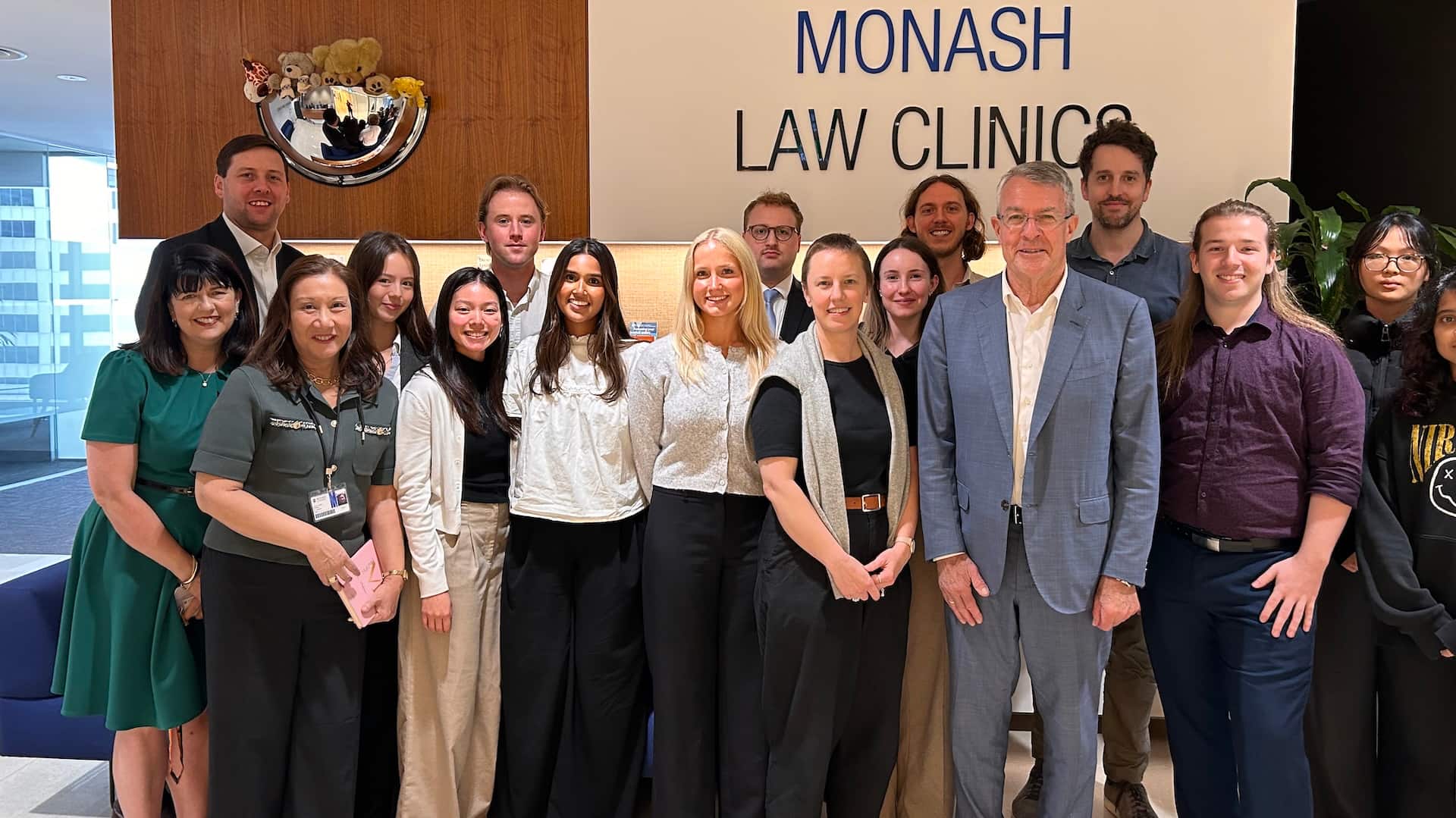
Monash Law Clinics students recently had the privilege of hosting The Hon. Mark Dreyfus KC MP, former Attorney General of Australia, for a discussion with CJC students on legal practice, law reform and climate justice.
His visit to the Monash Climate Justice Clinic (CJC) provided us with the rare opportunity to engage directly with a senior legal and political figure whose career has spanned the Bar, Parliament, and advocacy across many international courts, such as the International Court of Justice (ICJ). Mr Dreyfus shared his reflections on the evolution of his legal career and also engaged in a broader discussion about the role of law in responding to complex global challenges like climate change.
From the Bar to Parliament
I was struck by Mr Dreyfus’s honest and direct response when asked to share his experience entering the law. He described his journey in law as, "a series of accidents" shaped by his work outside of the law. While it surprised me, it was also reassuring to learn that such a significant legal figure started his career in such a non-linear way. He shared how informative he found his early work experiences in the Northern Territory. Supporting Aboriginal communities on legal and land rights issues helped him to contextualise the social purpose of law.
Reflecting on his career at the VicBar, Mr Dreyfus noted that the cases he remembered most were pro bono matters because they carried broader societal meaning or had a direct impact on individuals who would not otherwise have had access to justice.
Mr Dreyfus’ reflections felt particularly relevant given our work at the Climate Justice Clinic which is also grounded in the idea that legal practice can extend beyond commercial outcomes and contribute to wider law reform, and systemic change.
It was encouraging to hear such a significant legal figure share candid reflections on his own career path and how he found a meaningful career in law by remaining open to opportunities and finding purpose in his work.
The Attorney General as a Law Reformer
On his role as the Attorney General for Australia and what he would like law students to understand about the role of Attorney General, Mr Dreyfus reflected that, “It’s an opportunity to reform the law like no other”.
He emphasised law reform as an ongoing responsibility and described it as a duty of government to continually revisit the law and ask whether it remains 'fit for purpose' in a changing society. The idea that laws must be actively re-examined, whether they were created 10, 30 or 50 years ago highlights how dynamic the legal system is, and how it's essential that it evolves alongside social, environmental and technological change.
He also identified the lasting impact of the role, particularly through judicial appointments, in the way it shapes legal interpretation and decision-making for decades - well beyond a minister’s time in office.
I found Mr Dreyfus’s perspective on law reform particularly impactful, his perspective on the Attorney-General’s role as an opportunity to actively shape the law in meaningful ways highlighted the diverse forms and methods of law reform.
Climate Law
Given the focus of the CJC, the discussion quickly moved to climate law and Mr Dreyfus emphasised the value of being persistent in driving legal change. While acknowledging that progress in climate law can feel slow and contested, he reinforced the importance of continuing to advance legal arguments over time.
“Progress can be slow, but it doesn’t mean you mustn’t argue for it,” Mr Dreyfus said.
This resonated with the reality of climate justice legal work at the CJC, which can feel incremental with the longer term goal being to test the future of the law. Mr Dreyfus pointed to the growing significance of international decisions, particularly advisory opinions of the ICJ, as examples of evolving legal norms. He reflected on the complexity of these international cases from his personal perspective, sharing how impossibly difficult it can feel during efforts to balance competing policy, environmental and economic considerations.
This discussion showed climate litigation as part of a broader process of law reform. It reinforced the value of the work undertaken in the CJC- where our matters, discussions, research, and advocacy may form part of that longer trajectory towards reform. It reinforced for me the importance of persistence and reminded me of the role that our arguments could play over time.
AI and the future of legal practice
Mr Dreyfus also acknowledged how technological developments, including AI, are transforming the nature of legal work. He emphasised that the core of legal practice will remain inherently human.
“What lawyers do is mostly human dispute resolution. There is still going to be room for human beings in the profession,” Mr Dreyfus said.
As someone about to enter the profession, I found this both reassuring and thought-provoking. While the technical aspects of legal work may evolve, the importance of judgement, reasoning and advocacy of lawyers remain critical.
Mr Dreyfus's visit to the CJC was such a unique opportunity for us to engage with such an important lawyer and politician in Australia. Experiences like this highlight the value of a clinical legal education in bridging the gap between our academic studies and practice. The opportunity to engage directly with the perspectives of a leading figure in the Australian legal system offered a valuable perspective on the role lawyers can play in shaping both law and policy in response to emerging challenges like climate change.
On behalf of Monash Law Clinics, I thank the Hon. Mark Dreyfus KC MP for generously sharing his time and insights with CJC and Law Reform Clinic students.