
Warren Centre for Civil Justice celebrates the Hon Marilyn Warren AC KC
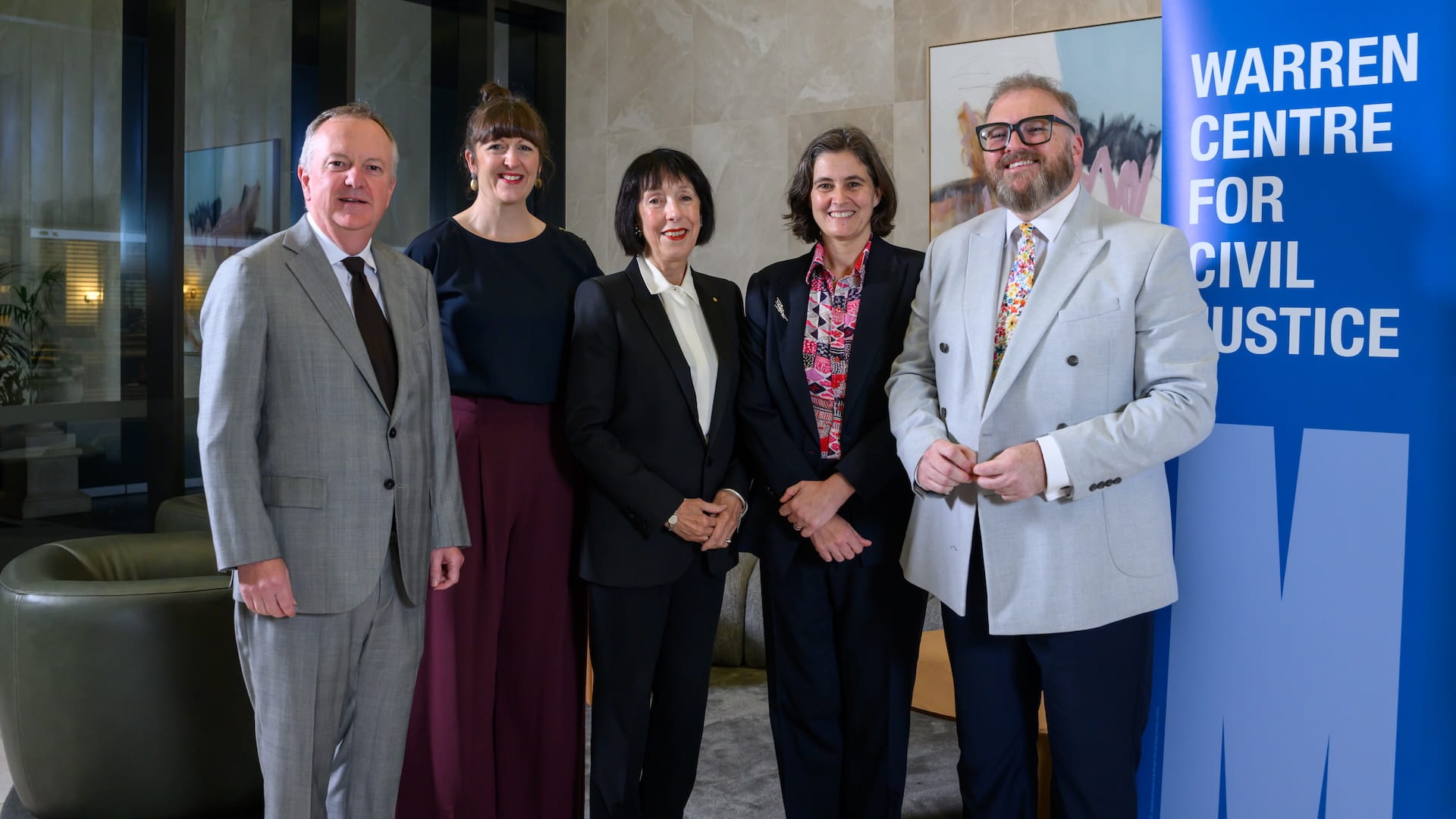
The Honourable Chief Justice Richard Niall KC, Associate Professor Genevieve Grant, Professor the Honourable Marilyn Warren AC KC, Justice Elizabeth Bennett and Professor Steven Vaughan.
Monash Law has celebrated the life, work and impact of alum Professor the Honourable Marilyn Warren AC KC at the launch of the Warren Centre for Civil Justice.
Formerly the Australian Centre for Justice Innovation (ACJI), the Centre has been renamed in honour of Professor the Honourable Marilyn Warren AC KC. The renaming reflects a clearer civil justice focus, and an intention to strengthen civil justice systems through evidence-led research and collaboration.
The auditorium at Monash University Law Chambers was filled with judicial officers, legal practitioners, academics, students, policymakers and justice-sector partners for the launch. While the primary reason for coming together was to mark a new chapter for the Centre and to recognise Warren’s legacy, it was clear that each individual had their own unique connection to the former (and first woman) Chief Justice of the Supreme Court of Victoria.
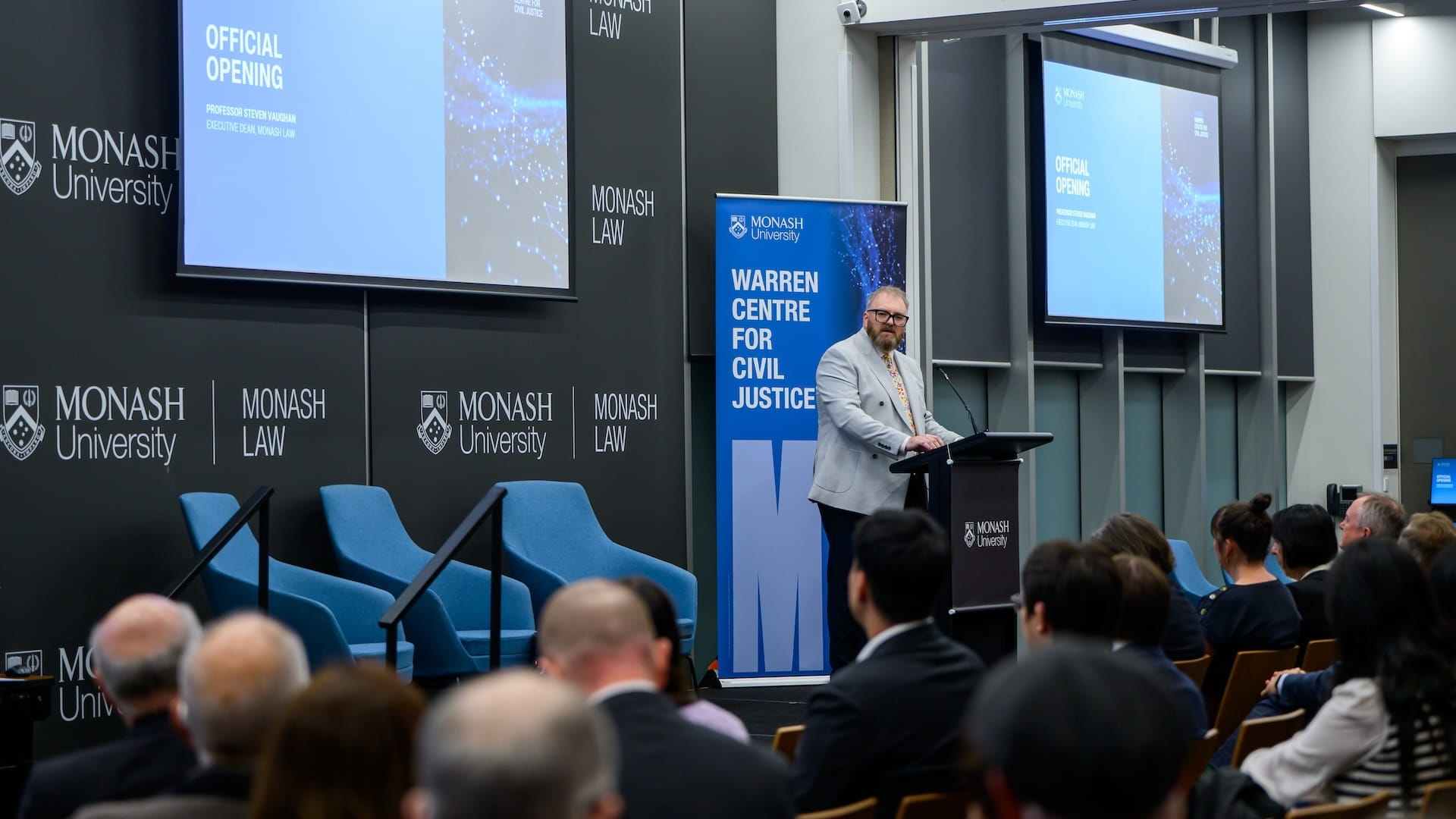
Professor Steven Vaughan.
Launch of the Warren Centre for Civil Justice
Professor Steven Vaughan, Dean of the Faculty of Law, took on the role of MC, welcoming guests and setting the tone early.
“ I think it’s very important that we recognise that we stand on a land where a sophisticated system of law and kinship and dispute resolution has existed for tens of thousands of years.”
“What we're doing here is trying to work together to innovate and improve our current civil justice systems. And we do so with due respect for the enduring sovereignty and justice seeking of First Nations peoples,” Vaughan said.
Vaughan framed civil justice as a fundamental and central branch of the justice system, which is where members of the general public are most likely to encounter lawyers and courts. Despite this, civil justice and research into this area are often overlooked.
“ For many years, the ACJI has been at the heart of our Faculty's research into how the law actually works - not just in books, but in the lives of people with rights and legal needs. It’s done so in a space where civil justice is often the silent pillar of the legal system, and yet also the one that touches the lives of everyday Australians most directly,” Vaughan said.
This observation highlights the Warren Centre for Civil Justice’s clear mission which is to strengthen civil justice systems so they are fair, efficient, and accessible for everyone.

Associate Professor Genevieve Grant.
From ACJI to the Warren Centre for Civil Justice
The Warren Centre for Civil Justice continues the work of ACJI, which was established within Monash Law in 2011 and built a strong reputation for research and evaluation focused on justice system practice and reform.
The shift in name is much more than a rebrand. The change comes after a Monash review that recommended the Centre adopt a clearer, more focused identity that reflects its contemporary work which sits firmly within civil justice research.
Associate Professor Genevieve Grant, Director of the Warren Centre for Civil Justice, highlighted the elements of continuity that sit within this change.
“Built on the foundations of the Australian Centre for Justice Innovation, which served our Faculty with distinction for the last 15 years, the Warren Centre really represents the next chapter in Monash Law’s commitment to understanding and improving civil justice,” Grant said.
Professor Steven Vaughan made it clear that one of the most important lines of continuity though this change is the stewardship of the Centre by Associate Professor Grant.
”Genevieve is a preeminent figure in empirical legal scholarship globally, and her research has had a profound real world impact, making the lives of thousands of people better. She truly represents the very best of our faculty, combining world class academic excellence with an unparalleled dedication to mentoring the next generation of legal minds and to improving the quality of justice,” Vaughan said.
The Warren Centre will continue to be collaborative and transdisciplinary, producing research and evaluation to support policy and practice innovation, while also building research capability through training opportunities for students and partners.
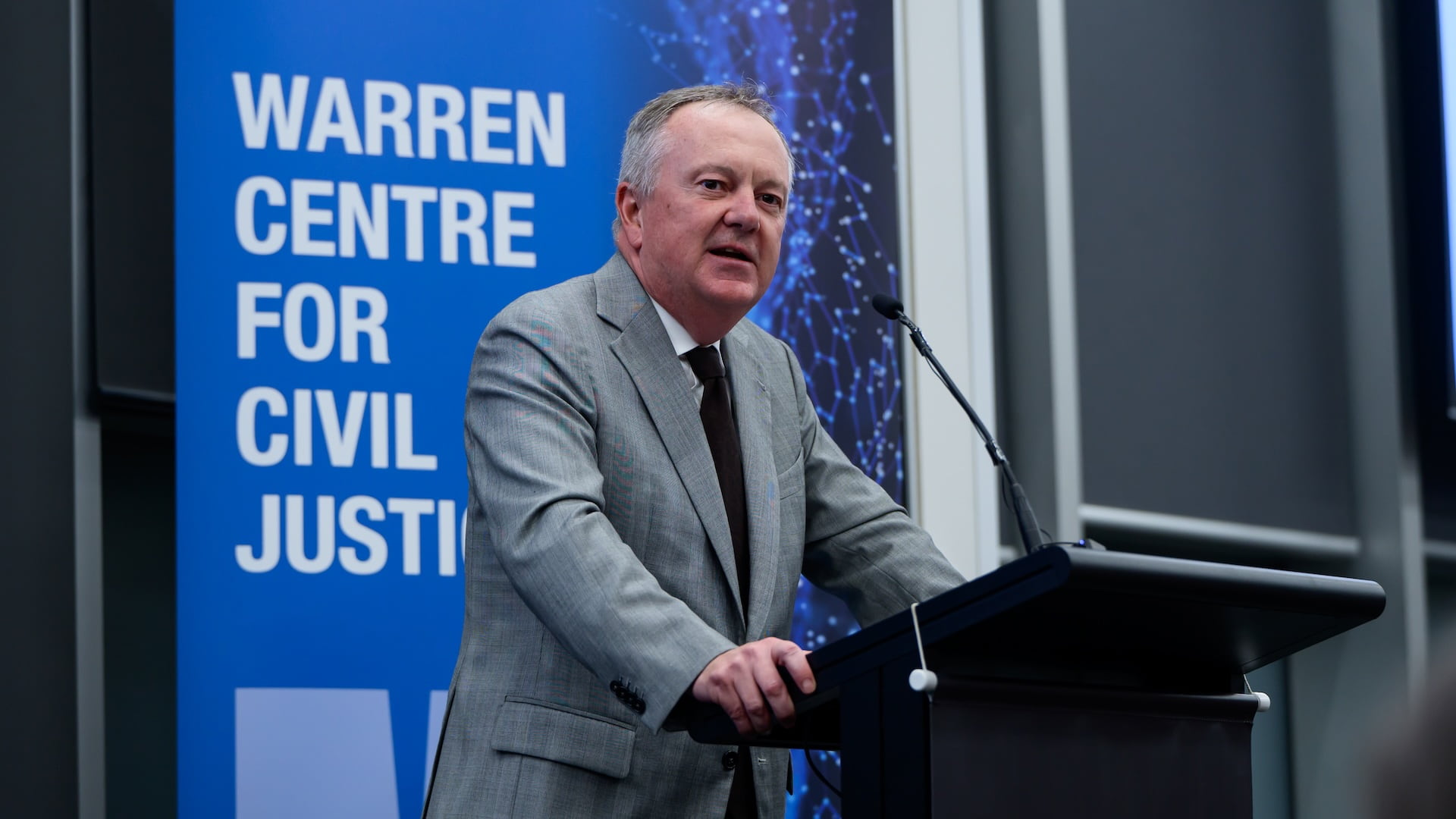
The Honourable Chief Justice Richard Niall KC.
Evidence, not instinct: why courts and the sector need the Warren Centre
The Honourable Chief Justice Richard Niall KC expressed his delight, both personally and on behalf of the Supreme Court, to mark the renaming and the launch of an exciting new chapter for the centre.
Without minimising the formality of the occasion, he brought himself into proceedings to emphasise the singularity of the guest of honour’s name.
“Without any disrespect to her considerable achievements, I will refer to our guest of honour as Marilyn.”
“When anyone refers to Marilyn, everyone knows exactly who is being spoken of.”
“ The name has inspired affection and respect from judges, the profession and beyond, and occasional anxiety in officials of the state. The renaming of the center in honour of Marilyn is a fitting recognition of the significant and enduring contribution she has made to civil justice in this state, particularly in her 14 years as Chief Justice of Victoria,” Niall said.
His remarks traced a career defined by firsts and by practical reform, including Warren’s role as the first woman appointed Chief Justice of the Supreme Court of Victoria, and her long-standing emphasis on innovation, adaptation, and institutional independence.
Niall described Warren’s focus on access to justice and the human experience of courts.
“ She has strong and clear visions and was tireless in her efforts to ensure the court delivered for the Victorian community as Chief Justice. She cared deeply about access to justice, fairness, and the experiences of all who entered the court and those who worked within it. There is no doubt that Marilyn had a transformative effect on the court as an institution.”
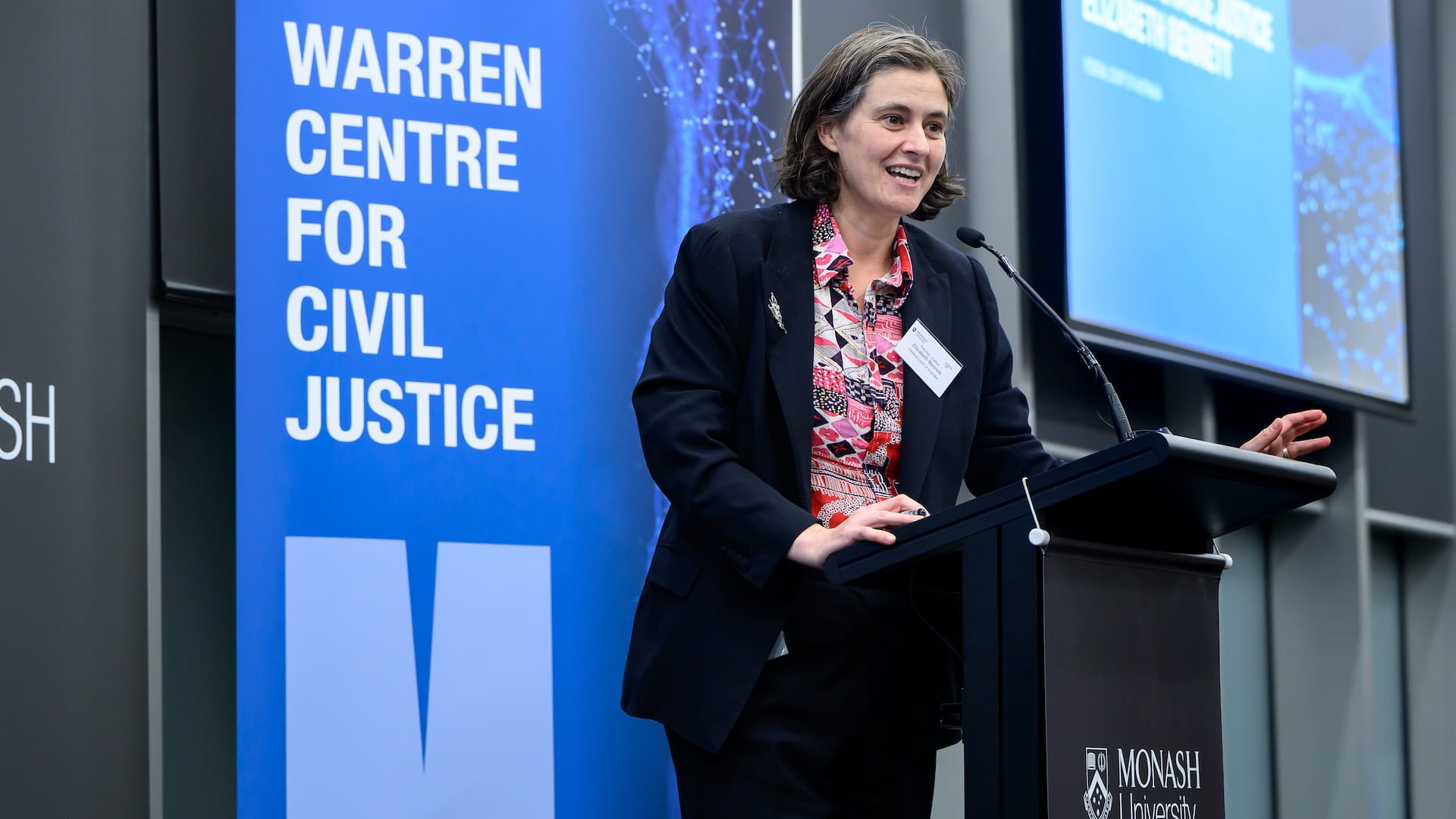
Justice Elizabeth Bennett.
Justice Elizabeth Bennett of the Federal Court took up the thread but stopped short of referring to the guest of honour as Marilyn.
“ Chief Justice Niall will forgive me if I excuse myself from using the Honourable Professor Warren's first name tonight, and he will forgive me when he realises that I was in fact an associate at the Supreme Court while her honour was the Chief Justice.”
“And it is hard to move on from that - to first name basis,” Bennett said.
Acknowledging the myriad ways that members of the general public are touched by civil justice, she looked at the possibilities of the Warren Centre for Civil Justice from a different angle. Bennett discussed how courts make procedural choices, and how those choices are often made without the benefit of system-wide evidence.
“ There have been a range of different ways that courts have tried to grapple with the increasing time, complexity and cost in search of fair, efficient, resolute and just determination of disputes. So we've seen, in my court, the rocket docket system. We've seen concise statements, specialised lists and the commercial court in the Supreme Court.”
“What we need and what we will benefit by is actual data about whether they help. Because at the moment, overwhelmingly these are driven by the anecdotal sense of people who have had experience in running litigation,” Bennett said.
She also described the structural limits on judicial visibility, highlighting the fact that judges only see the cases that they’re in.
Bennett was clear - these are the practical niches for a civil justice research centre, especially one embedded in a university. The Warren Centre’s mission makes the same point in institutional terms - universities can support independent, rigorous research that strengthens the evidence base for system improvement, in partnership with courts, agencies, practitioners and communities.
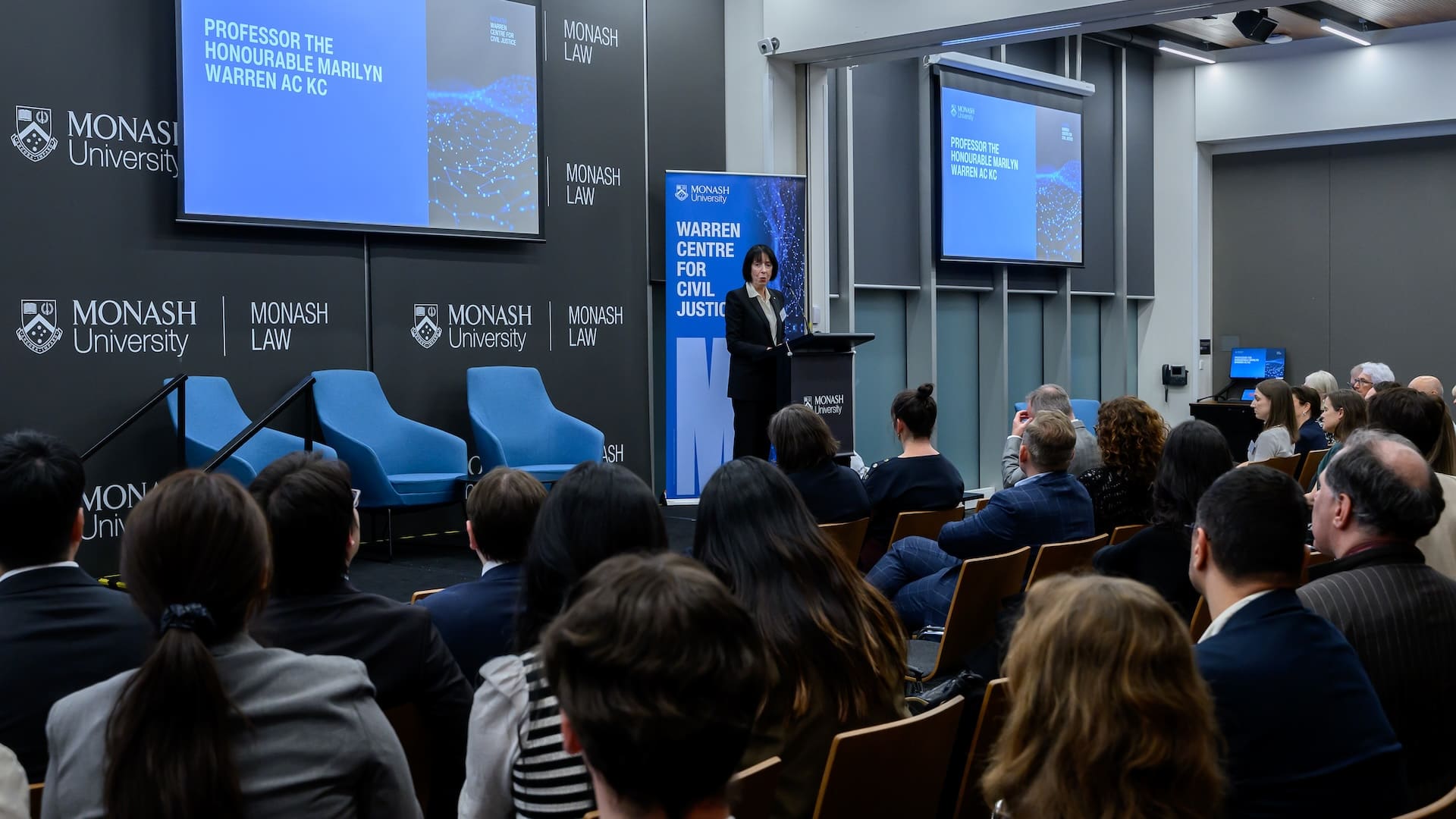
Professor the Honourable Marilyn Warren AC KC.
Celebrating the Hon Marilyn Warren AC KC and her connection with Monash Law
The Warren Centre for Civil Justice is named for the Hon Marilyn Warren AC KC in recognition of her long-standing commitment to fairness, accessibility, and the proper functioning of civil courts. The renaming also reflects the Centre’s ambition to embody that commitment and improve people’s real-world experiences of justice.
Professor Steven Vaughan introduced Warren as the Centre’s namesake and a Monash Law alum, noting that she does not like or appreciate long introductions. He also pointed to the way her work and her values provide a clear and true direction for the Warren Centre to follow.
“To have her name associated with this centre provides us with a lodestar about how we go forward with our research and with our advocacy,” Vaughan said.
Despite her dislike of long introductions, the launch of the Warren Centre was an opportunity for all four speakers - Professor Steven Vaughan, Associate Professor Genevieve Grant, the Hon Chief Justice Richard Niall, the Hon Justice Elizabeth Bennett - to share their own high praise and admiration for the Hon Marilyn Warren AC KC.
When Warren finally took her place at the lectern, she captured the audience’s attention in a way that nobody else could.
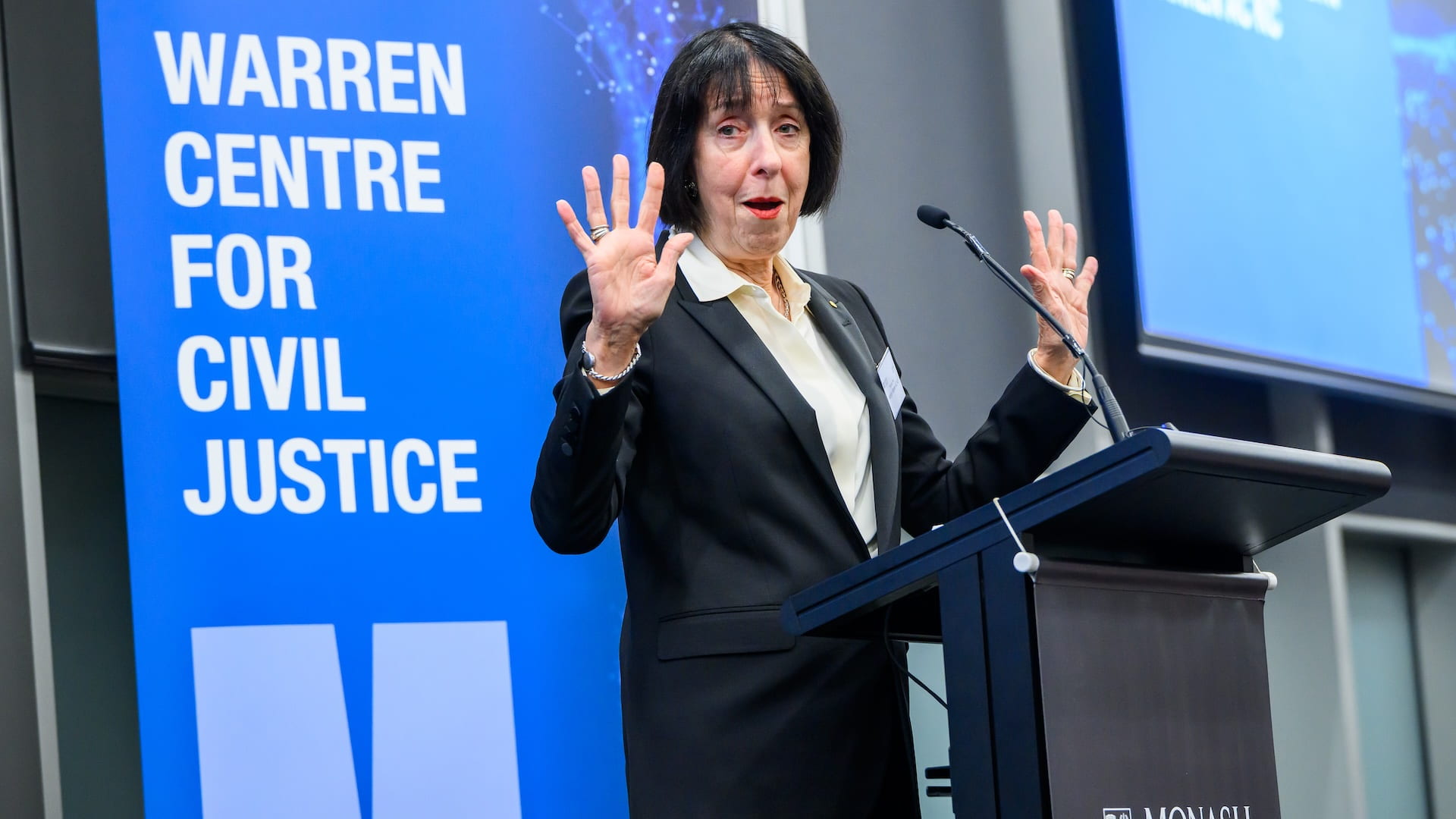
Professor the Honourable Marilyn Warren AC KC.
“I start out by asking you to notice something. My hands are free. The lectern is clear,” Warren said.
“ Now, let me give you a lesson. Do not change your handbag before you go out, which is exactly what I did tonight.”
Laughter and admiration rippled across the room as it became clear that the guest of honour would be speaking without notes. What followed was a masterclass in public address that tied her legacy to the future of the Warren Centre.
“I am deeply, deeply honoured by the gesture of the University and the Faculty of Law in naming the centre as it has.”
Remarkably, she admitted that she wanted to hide when she arrived at the launch, because she thought that there are so many more deserving people.
Warren then shifted the focus away from individual recognition and back to collective effort.
“An institution is only as good as its whole.”
“ I did have the fortune and benefit to be able to face a lot of challenges in my time as a judge and then as Chief Justice. But I was also blessed by the fact that I had colleagues to support me, engage with me, be creative, be innovative, and help to solve the problems.”
“I was indeed blessed by the heads of the divisions of the court, the president of the Court of Appeal, and the principal judges. Each of them in their own way, strove to refine and develop the work of their particular jurisdiction,” Warren said.
Warren also offered a blunt assessment of one of the toughest constraints on court reform.
“ A modern court faces a big problem in that governments by and large don't wish to spend much money on courts. Governments want courts to do what they always do, but do it with the same, if not less.”
“The challenge then for the modern court is how to persuade those individuals in government, particularly the treasury, as to why the court or courts should be funded for particular purposes.”
That funding pressure shaped how courts tried to make their case for investment. Warren recalled being advised to use consultants, which was highly beneficial.
“ Judges are so busy they never have time to stand back and really analyse and think about what is going on, what they are doing, what the lawyers are doing, and how it might be improved on a systemic and systematic basis.”
But she also highlighted the shortcomings of these high level observers. Consultants can fail to grasp the legal principle that underpins exactly what is trying to be conveyed. It’s expensive and consultants are not always able to tell the institution’s stories effectively.
“ I only wish that the Center, which we celebrate this evening, had been available to me the way it is operating now under Associate Professor Grant and her colleagues. It would have been an absolute godsend to be able to turn to Associate Professor Grant and say, ‘this is the problem, this is what we are doing over here, what is your view on the solution that we should seek?’.”
“I personally greatly celebrate the relaunch of this Center, its capacity and the work it will do, the potential and the opportunity it provides.”
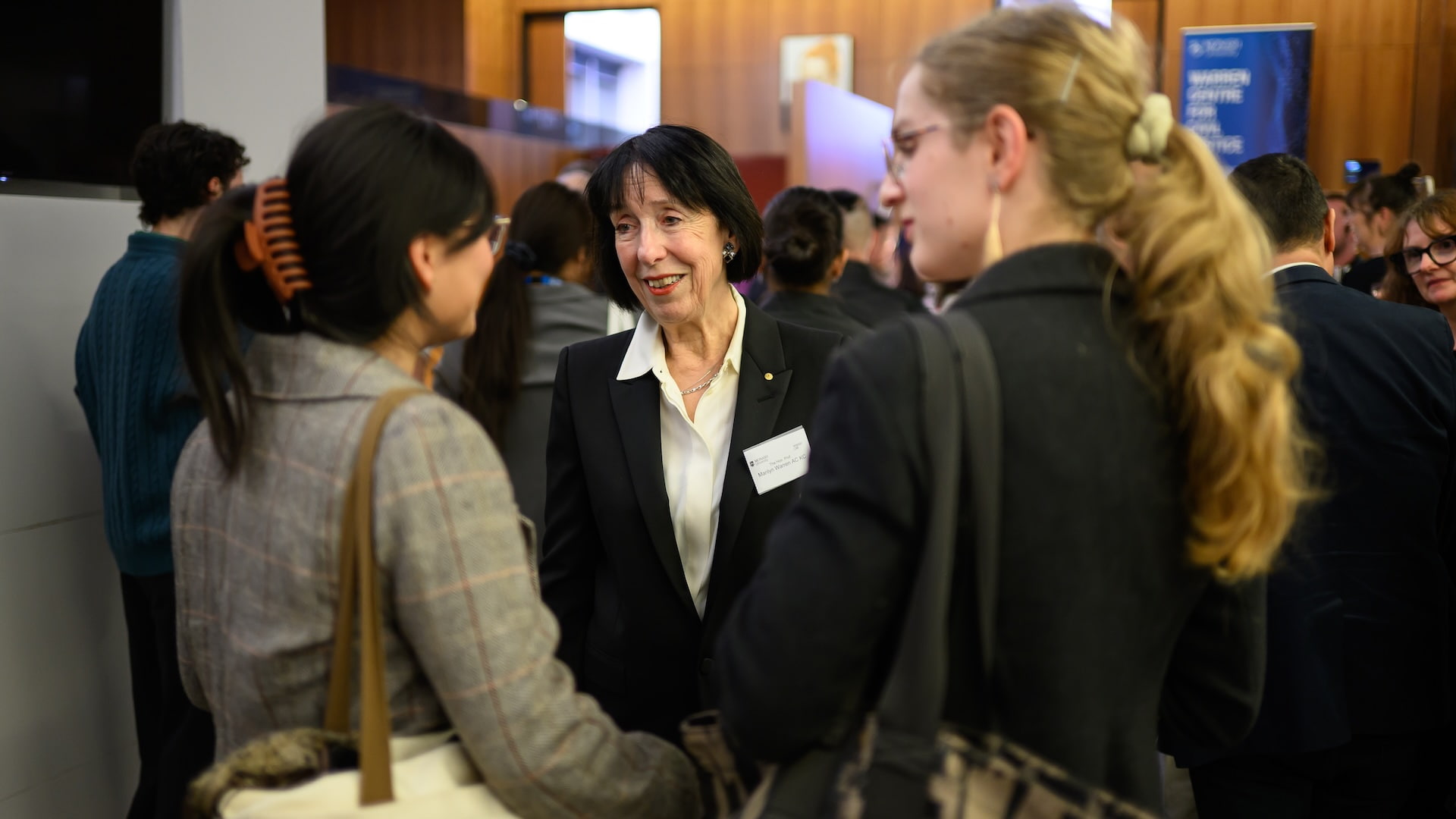
Professor the Honourable Marilyn Warren AC KC talking to students.
Monash Law, students, and civil justice in practice
Associate Professor Genevieve Grant argued that Monash Law is the perfect home for the Warren Centre for Civil Justice, pointing to the Faculty’s commitment to access to justice research and its clinical legal education program.
“ Ours is not just a law school that happens to have a research center. We're a faculty with a deep and genuine commitment to research that advances access to justice,” Grant said
“Our students don’t just learn about law in the abstract. They work alongside real clients in real legal services, grappling with real civil justice problems.”
She described the relationship between the Warren Centre and Monash Law Clinics as deliberately two-way.
“The Warren Centre will work in close partnership with our clinics, so that research informs practice, and practice will inform our research, and in which our students are active participants in the project of improving civil justice.”
“ Our students are one of our greatest strengths.”
This focus on research training and capacity-building is central to the Warren Centre’s mission. It can be seen in the training opportunities for undergraduate, postgraduate and doctoral students.

The launch of the Warren Centre for Civil Justice.
Our mission from Marilyn
Near the end of her remarks, the Hon Marilyn Warren AC KC connected directly with the audience and reminded them of a shared purpose.
“ As I look across the room at academic colleagues and as I see our judicial colleagues past and present, I look at you all and I think there is one thing we are all endeavoring to do in our own way, and that is to deliver justice.” Warren said.
“It is a system that we all play a part in, day in, day out, year in, year out.”
“What we are endeavouring to do is to deliver justice to all.”
Whether we refer to her affectionately as Marilyn, or deferentially as the Hon Marilyn Warren, her challenge to us is true and our mission is clear.
Her faith in the Warren Centre for Civil justice is unwavering.
“I do firmly believe the Centre in its revised form will be a magnificent contributor to that system of justice.”