
Success at the Alfred Deakin International Commercial Arbitration Competition
Monash Law mooters have won the 2024 Alfred Deakin International Commercial Arbitration Competition. What makes this win particularly special is that the winning team consisted entirely of Juris Doctor (JD) students.
The Alfred Deakin International Commercial Arbitration Competition takes place every September over four days. This year, two Monash teams participated as part of their selective enrolment in the LAW4805/LAW5058 Mooting and Advocacy unit. The virtual competition had a total of 47 teams from 43 universities participate from across the globe.
Monash team 2 (Hamish Cameron, Riley Lenard, Anthony Clendinen) won the competition, with Hamish receiving Best Oralist in the Grand Final and an honourable mention for best oralist in the general rounds. Monash team 1 (Erin Page, Prudence Spencer, Claire Qian) made it to quarter-finals and received honourable mentions for both their claimant and respondent written submissions.

Monash team 2, Anthony Clendinen, Hamish Cameron and Riley Lenard, winners of the Alfred Deakin International Commercial Arbitration Competition 2024.
To commemorate this historic victory, Monash Law students from the mooting teams share their first-person insights into the competition and mooting in general.
What is mooting?
Erin Page explains that mooting simulates a court or tribunal environment, providing students with an opportunity to develop their advocacy skills in a realistic legal setting. Participants take on the roles of lawyers, representing either side in a case and presenting arguments on specific legal issues.
The process typically involves two key components: written submissions, where teams draft detailed legal arguments, and oral presentations, where they argue their case before a judge or panel. In competitions, participants may present before a panel of arbitrators instead of traditional judges.
Mooting emphasises several essential skills: legal research, analytical reasoning, persuasive writing, and oral advocacy. By engaging in these activities, students gain valuable, hands-on experience in navigating legal processes and applying legal principles, making it an invaluable experience for those aiming to enhance their practical legal skills.
What was the Alfred Deakin International Commercial Arbitration Competition about in 2024?
As a member of Monash Team 1, Erin Page says this year's Alfred Deakin International Commercial Arbitration Competition centred around an international contract, raising several complex legal issues, including:
- Whether the tribunal had jurisdiction to hear the case;
- The applicable rules of evidence to guide the tribunal’s decision-making;
- Whether oral modifications to the contract were legally permissible; and
- The appropriate laws governing the dispute over the quality of goods under the contract.
Each issue demanded in-depth research and analysis, particularly in the areas of international law and Australian common law—provided the tribunal could be persuaded that Australia was the seat of arbitration. This challenge required participants to not only demonstrate a strong understanding of both legal frameworks but also to craft compelling arguments to establish the tribunal's authority and the relevant laws to apply.
How did you prepare for the Alfred Deakin International Commercial Arbitration Competition, and what happens in LAW4805/LAW5058 classes?
In preparation for the moot, Erin Page says that both teams undertook extensive research to craft their written arguments and refine their case theories.
"In addition, the guidance we received from William Lye OAM KC our opportunities to practise during classes for LAW4805/5058 proved invaluable in shaping our approach to developing case theory and honing our advocacy skills," says Erin.
"We had the opportunity to run the moot several times, presenting before both student judges and barristers. These practice sessions allowed us to strengthen our arguments, identify potential weaknesses in both sides of the case, and significantly enhance our oral advocacy. The feedback and insights we gained from these sessions were instrumental in refining our performance and boosting our confidence for the actual moot. preparation for the moot, both teams undertook extensive research to craft their written arguments and refine their case theories."
What were the highlights and challenges of the Alfred Deakin International Commercial Arbitration Competition?
Prue Spencer says there were many highlights of the Moot!
Firstly, seeing both Monash teams succeed, especially Monash team 2, was rewarding, as we watched our hard work pay off. Secondly, mooting with international teams was an eye-opening experience.
It was interesting to see the different styles mooters adopted in their country. For example, Singapore teams had very polished presentations, strictly adhering to formalities.
"We felt that our technique improved by learning from the international teams. Finally, receiving feedback from esteemed international arbitrators and past mooters was invaluable. Their global perspectives and advice which comes from their own professional experiences ensured we could continue to improve as the rounds progressed," says Prue.
A challenge included navigating the different styles of arbitrator judging. For example, some arbitrators asked limited questions, whereas others were very interactive.
"This meant we had to adapt our performance, because although we sought to finish all our submissions, it is also important to assist the tribunal by answering their questions."
"Overall, it was a wonderful learning experience which could not have been achieved without both the highlights and challenges," says Prue.
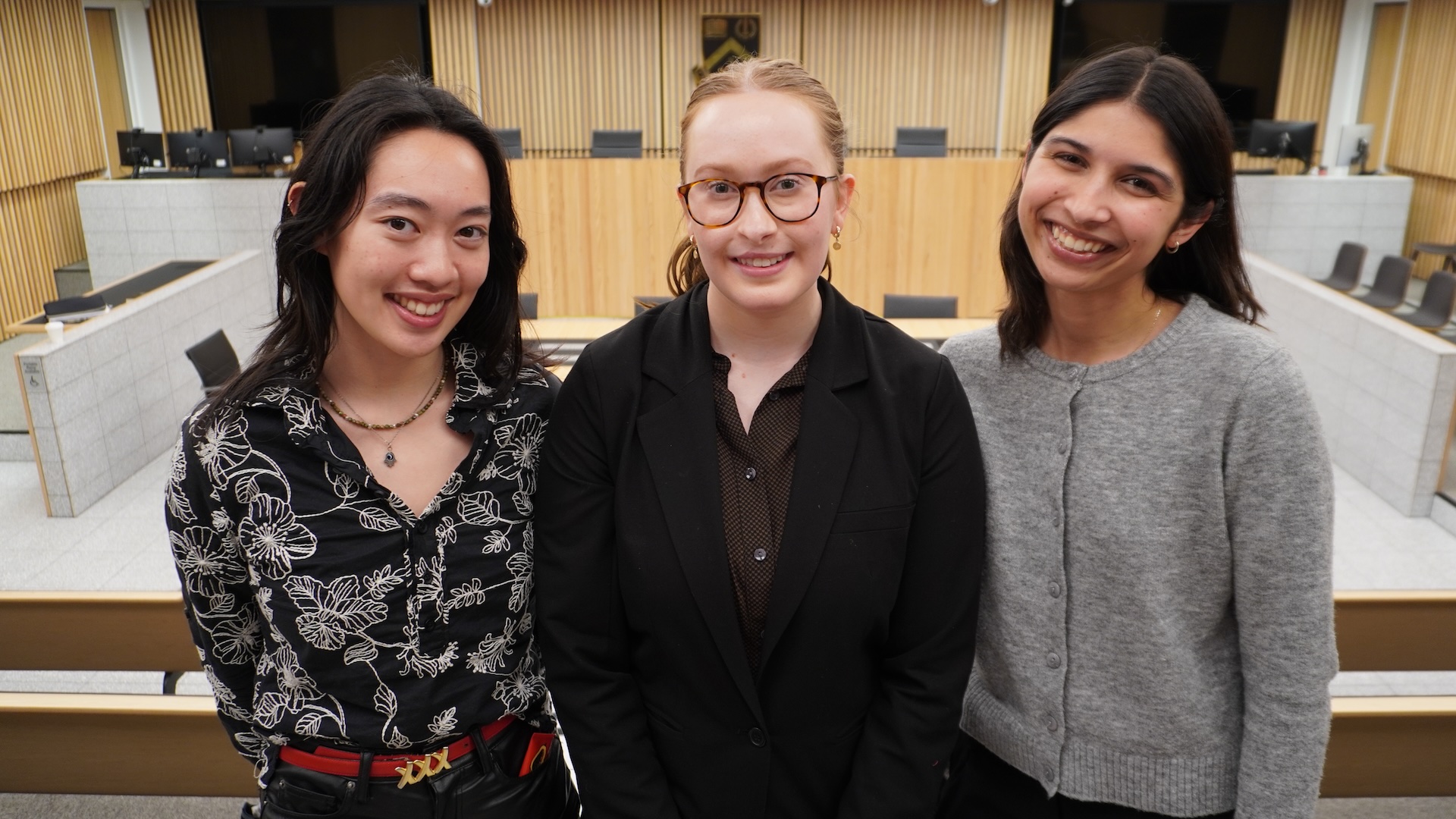
Monash team 1, Claire Qian, Prudence Spencer and Erin Page made it to quarter-finals of the Alfred Deakin International Commercial Arbitration Competition 2024.
What was the experience like competing in the Grand Final?
Anthony Clendinen says it was a privilege for Hamish, Riley and himself to make it all the way through to the Grand Final, and a credit to all the team members for adapting and tailoring our arguments throughout the competition.
"To be honest, after all the rounds prior we were a little worn out, but we approached the Grand Final the same way we had approached all the previous rounds - by focussing on the other team’s submissions and looking at the key points we wanted to make to counter them," says Anthony.
"As the Grand Final was only a few hours after we finished the semi-final we had less time than previous rounds to pull together our points, but by then we had a thorough knowledge of the facts of the matter that we were able to get our thoughts collected and our approach locked in."
"When the time came for the GF there were initial nerves waiting for it to start, but as soon as we got underway it felt just like a moot in the previous rounds. We had a strong opponent and excellent tribunal members who asked insightful questions and tested us on our knowledge of the matter."
"When it was over we had no idea whether we had won it or not, it seemed that close. Indeed there was quite long deliberations and it was a split decision 2-1 that decided it. It was an excellent experience and we celebrated with a bottle of Champagne - well worth having around whether you win or lose," says Anthony.
Hamish Cameron says the Grand Final was far more nerve-wracking than he anticipated.
"I had a real belief in our whole team throughout the entire competition, though I will admit I’m not sure I ever expected to make it right to the end. When we got the news, Anthony, Riley and I went to a cafe for lunch and discussed our strategy, printing out the opposition’s submissions and reading over them together," says Hamish
"We devised our high-level case theory, polished off our pasta and BLTs, and then went our separate ways as we had so many times before - each of us knowing our role and what we needed to achieve in two and a half hours’ time."
"I don’t remember much more from then until about 7:30PM when the moot finished - it really was just a blind rush," says Hamish.
"My strategy in the final revolved primarily around rebuttal and response - I think one of our team’s greatest strengths was an ability to respond to the judges’ questions and gently elucidate the weak points of our opponents’ submissions, guiding the judges through our case theory."
"I still remember sitting in the zoom meeting when it was announced we had won, remaining composed until the camera turned off, and then hearing William burst through the door shouting ecstatically ‘you won the whole thing!’. It was a really great moment," says Hamish.
What is one tip you would pass onto future mooting students?
Claire Qian's one key tip that she would pass onto future mooting students is the importance of practising your oral communication skills by discussing the moot facts with friends and family. This approach not only helps you articulate the relevant issues more clearly and concisely but also enables you to grasp the common-sense problems that can be easily overlooked when focused solely on niche arguments.
"If time is tight, prioritise mastering the facts of the moot problem over delving too deeply into the applicable laws. A solid understanding of the facts will guide your legal research and make it easier to identify the key points to address," says Claire.
"Additionally, effective communication with your team is crucial. By collaborating and delegating tasks based on each member's strengths and interests, you enhance both time management and coherence in your presentations, ultimately leading to a more persuasive and unified argument in your moots," says Claire.
Anthony Clendinen's top tip for future mooters would be to learn to pause. A pause before answering a question from a judge or tribunal member is often stronger than a filler like ‘thank you your honour’ or ‘to answer your question’.
"It gives you time to take a breath, collect your thoughts and it makes you seem more confident. Then you can respond to the actual question simply and in a conversational manner. A pause also works between points you wish to make, giving the bench time to digest before you move to your next point."
"Thank you to William Lye OAM KC for his continued support throughout the semester. His guidance has been invaluable. Additionally, thank you to James Brandis and the Faculty of Law for allowing us to share our success story," says Anthony.

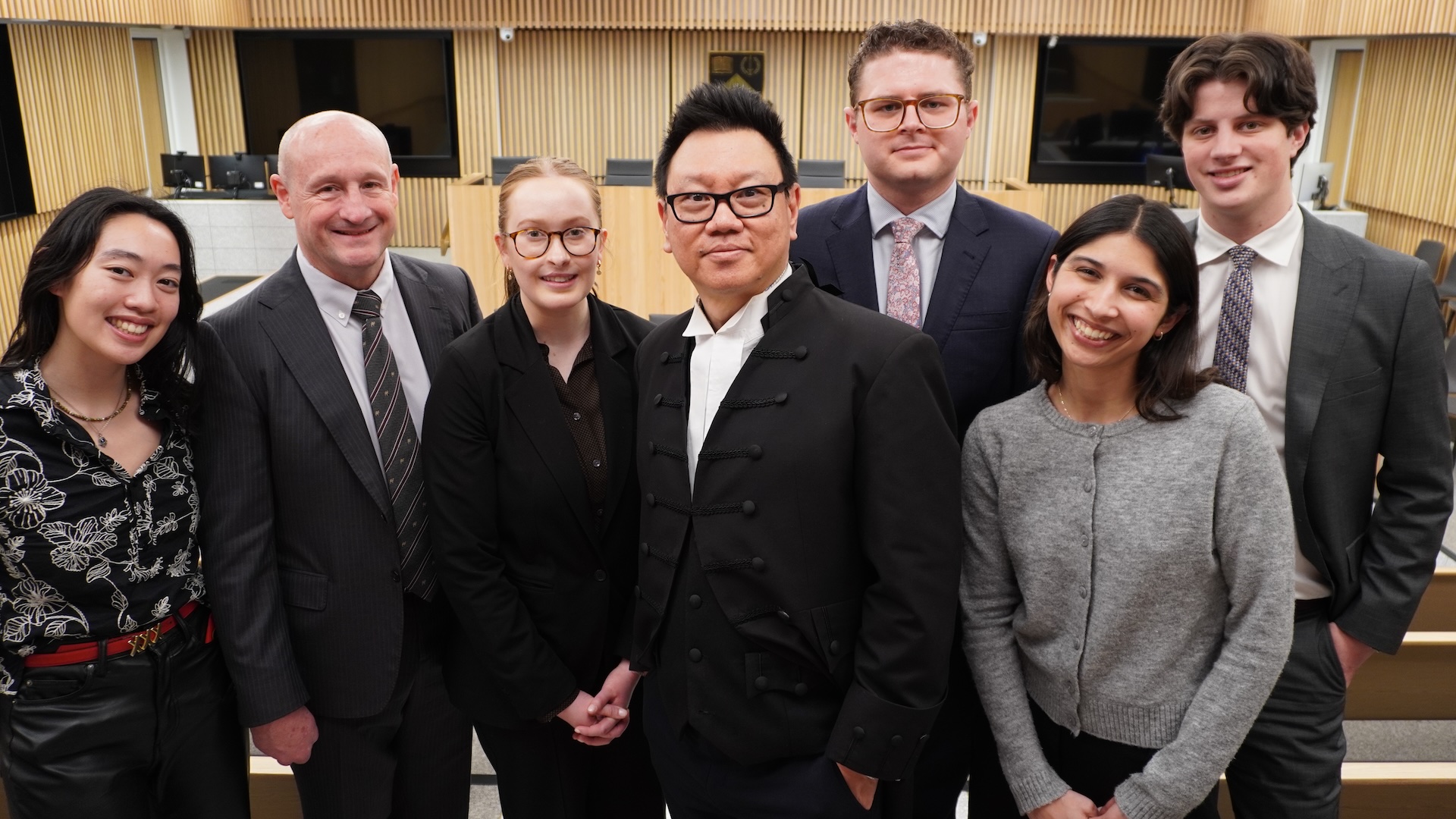
Monash team 1, Claire Qian, Erin Page and Prudence Spencer and Monash team 2, Hamish Cameron, Riley Lenard and Anthony Clendinen.
Hamish Cameron's advice is that questions win moots.
"It takes a good mooter to devise a case theory and present an argument, but it takes a great mooter to leave that structure behind and be guided by the judges’ questioning. If you can learn to listen to the judges’ questions and pick out which topics the judges are interested in, you can adapt your responses and submissions to focus on those areas," says Hamish.
"And if you manage to engage well with the areas the judges are curious about, the judges will rule in your favour. Questions can be quite frightening for a new mooter, but as soon as you can learn not to fear questions but rather to welcome them as an opportunity, you will rapidly improve in and start to truly enjoy your advocacy," says Hamish
Riley Lenard's best advice for future mooting students is to make concessions when appropriate and to focus on the core strengths of your team's submissions.
"Less experienced mooters will often argue a losing point with an aggressive judge to the detriment of their overall case, whereas more experienced mooters generally concede the weaknesses of their client’s position early - but only when pushed to do so by judges - enabling them to focus their submissions on those one or two strongest arguments that may turn the case in their favour," says Riley.
Monash Law congratulates all members of Monash Team 1, Monash Team 2 and their mooting coach William Lye OAM KC for an outstanding performance in the Alfred Deakin International Commercial Arbitration Competition.