
Humans take centre stage in Human Rights Law Conference
By Bethany Duncan
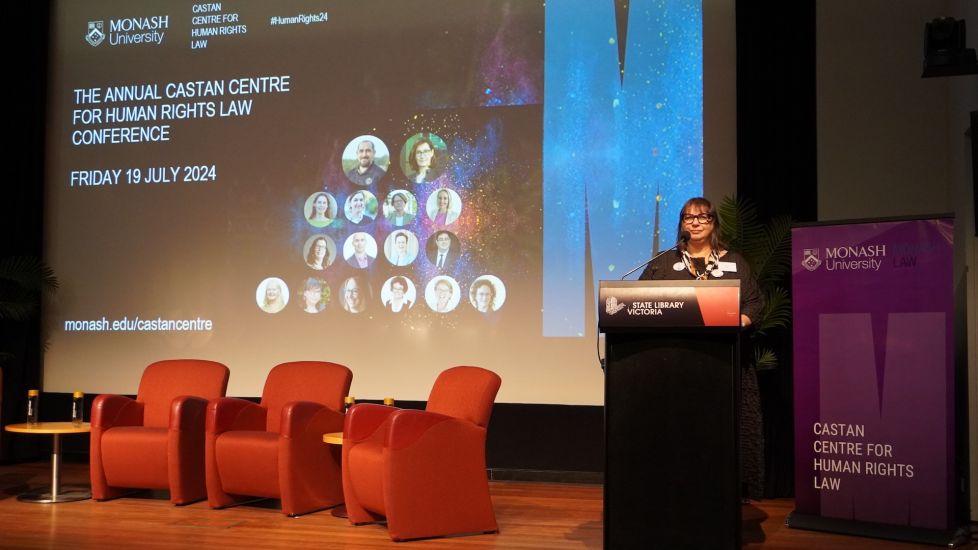
The attendees of the 23rd Annual Castan Centre for Human Rights Law Conference were delighted to meet again in-person. Participants were drawn from legal practice, academic, and human rights activism and heard presentations on the state of human rights in Australia and across the world.
Presenters brought diverse perspectives on issues regarding current human rights issues in Australia and overseas.
Register to receive the quarterly Monash Law Research Newsletter
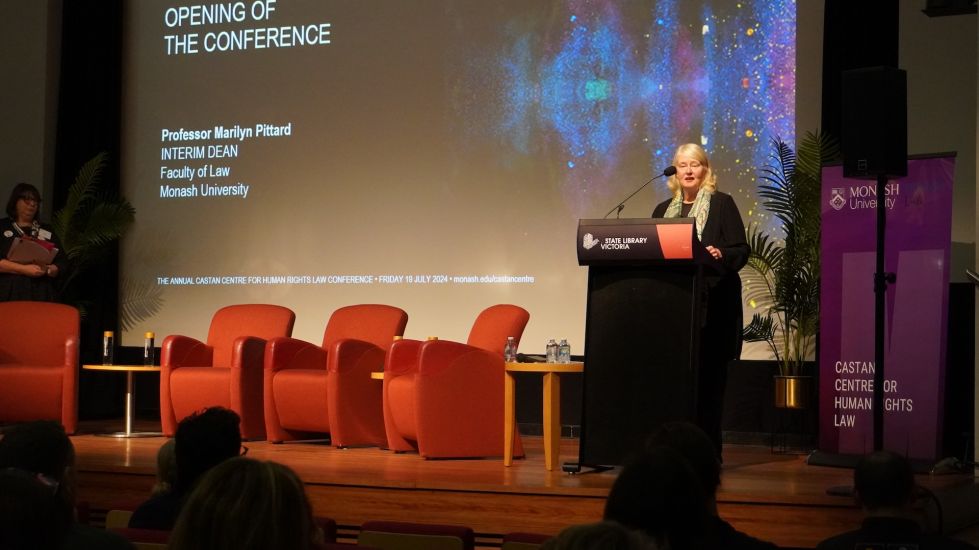
Interim Dean of Monash Law, Professor Marilyn Pittard opens the 23rd annual Castan Centre for Human Rights Law Conference.
This year’s conference focused on issues surrounding First Nations rights; the rights of children in out-of-home-care; truth, free speech and the online environment; and law, human rights and the migrant experience.
Drawing on lived experience and significant research expertise, presenters offered valuable insights on how systems and structures could be transformed to deliver human rights-centred reforms.
Treaty negotiations set to break down government implemented barriers for First Peoples
Co-Chair of the First Peoples' Assembly of Victoria and proud Gunditjmara man Rueben Berg opened the conference by outlining the objective of Treaty to remove government placed barriers that have led to difference in outcomes among First Peoples.
“If we can remove … barriers, if we can actually exercise our rights as First Peoples, we can see us achieving the success we know we should be achieving,” proposed Mr Berg.
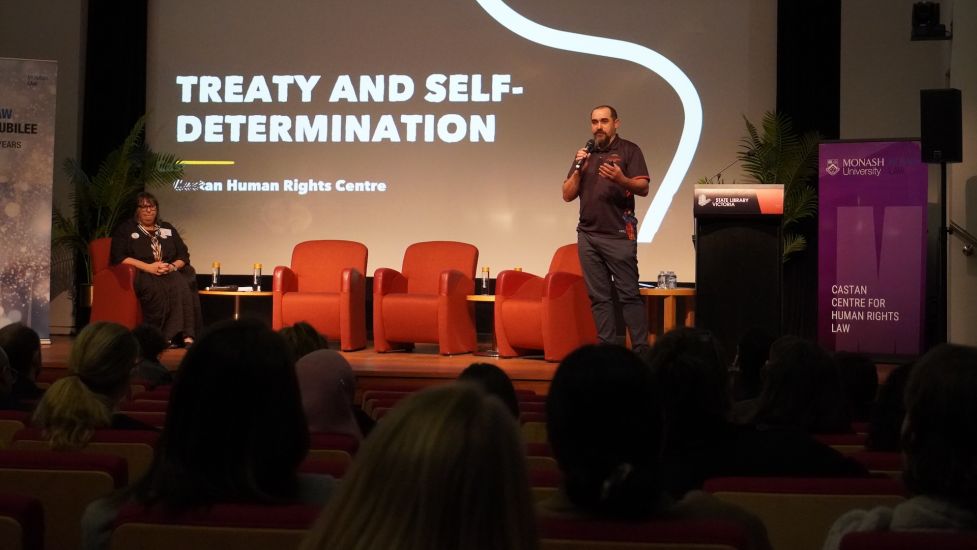
“The honouring of first people's ancestors and activation of inherent rights and benefits as sovereign peoples is now continued through treaty making.”
Treaty negotiations in Victoria are set to begin in the coming months, with aims to secure agreements by April 2025. Mr Berg reports that the First Peoples’ Assembly of Victoria has diligently worked to unite the region’s diverse Traditional Owner groups and Aboriginal communities to focus on common goals and shared aspirations. Mr Berg urged the audience to incorporate support for Treaty into Acknowledgements of Country, and to build community support towards Treaty.
The Assembly has created a negotiation framework that will empower Aboriginal communities to come up with practical solutions at a local level through Traditional Owner Treaties. Meanwhile the First Peoples’ Assembly will pursue big structural reform through a statewide Treaty.
“There are going to be many different things the government does that affect First Peoples that we won't have decision making powers over. So in that case, we want to make sure there are really strong, robust systems in place,” expressed Mr Berg.
The path to securing Treaty extends to a Self-determination Fund, as well as a Treaty Authority to support and facilitate equity in Treaty negotiations between First Peoples and the state.
Mr Berg called on Victorians to come together and support the Assembly in their journey to securing Treaty.
“First Peoples represent 1.2 percent of the Victorian community, and we know that we cannot do this alone.”
Watch Co-Chair of the First Peoples' Assembly of Victoria and proud Gunditjmara man Rueben Berg’s keynote ‘Voice, Treaty, Truth - What's Next?’.
The rights of children in out-of-home care determined by the state
Principal Commissioner for the Victorian Commission for Children and Young People (CCYP), Liana Buchanan, spoke about government actions that impact the rights of particularly vulnerable children living in out-of-home care.
Ms Buchanan acknowledged that many people do not understand the full range of human rights issues faced by children in out-of-home care. She shared that the care of these children is largely overlooked by the community and as a result, even the government, which has specific responsibilities for their rights.
“Even in progressive and activist circles, children's rights can be a bit of an afterthought, or a bit of a niche concern,” shared Ms Buchanan.
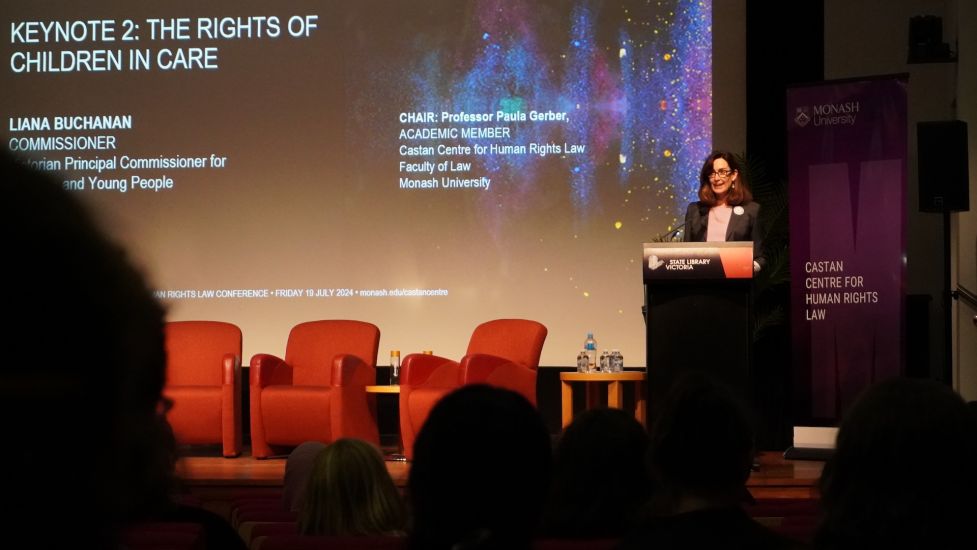
Ms Buchannan highlighted that children in out-of-home care are subjected to a multitude of government systems intended to support them, but they can also leave them exposed to additional harms.
“The State, as parent, decides where children live, who they live with, where they go to school, what kind of access to healthcare they have, what activities they're supported to do, where they can travel, what contact they have with family, and so on,” confirmed Ms Buchanan.
“For children in residential group homes in particular, every aspect of their daily life, right down to the food they get for dinner, is determined ultimately by the State.”
The rights to health and education, as well as children’s ability to participate in decisions that affect them, is not given sufficient consideration by the government, said Ms Buchanan in reference to the first prevalent study on child maltreatment in Australia.
“We need to move to a care system that centres on children's needs, rights, wishes and emotions,” urged Ms Buchanan.
Watch Principal Commissioner for the Victorian Commission for Children and Young People (CCYP), Liana Buchanan’s keynote ‘The Rights of Children in Care’.
Participatory rights for children and young people living in out-of-home care
In a panel discussion following Ms Buchannan’s keynote, Amelia Hunt shared her experience in out-of-home care and as a youth advocate for those in care, as Project Officer for Youth Engagement at CCYP.
“[It’s] like you're a puppet and they're just pulling the strings, is the perfect way to describe the care experience,” illustrated Ms Hunt.
“Even at the age of 16, we were excluded from care team meetings, kept out of the loop and not given space to have a say in decisions affecting us,” expressed Ms Hunt.
The CCYP values the voices of children and young people just as highly as data and research. Ms Hunt takes pride in how her organisation balances these perspectives in their inquiries into systems and services for vulnerable children and young people.
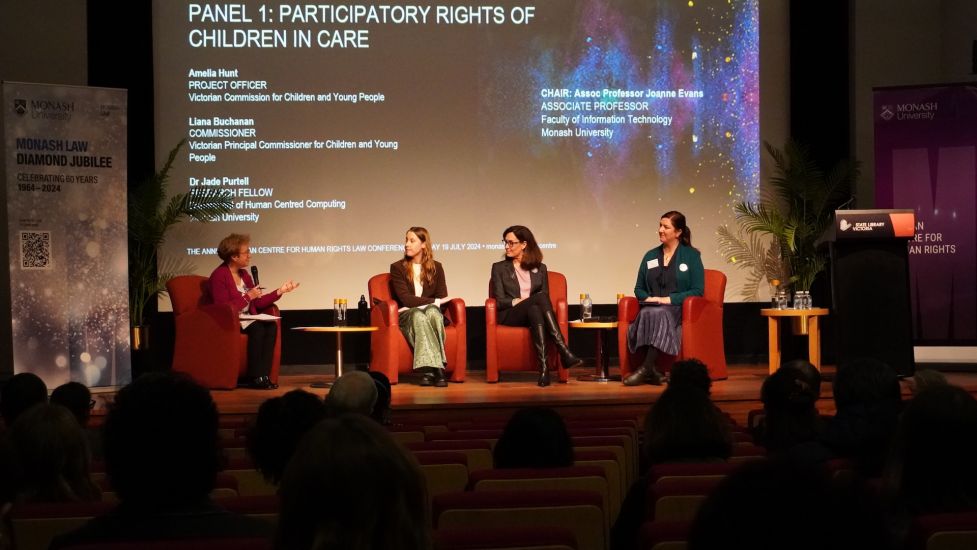
Assoc Professor Joanne Evans (Chair) puts a question to Amelia Hunt, Liana Buchanan and Dr Jade Purtell in the first panel ‘Participatory Rights Of Children In Care’.
Panellist Dr Jade Purtell (Research Fellow in Department of Human Centred Computing at Monash University) supported Ms Hunt’s observations with insight into what propels or determines justice within the out-of-home care system.
“The authorising environments we need for children and young people's participation to increase are created when we overcome epistemic injustices, which tell us that knowledge based on lived experience is less relevant than other forms of knowledge,” argued Dr Purtell.
Amelia Hunt confirmed that this state of affairs could be rectified if the out-of-home care system brought children and young people into the decision making process on their own care.
“There will always be children and young people out there that take on responsibilities that are typically considered adult only. We need to make sure that everything is more accessible to children and young people,” implored Ms Hunt.
Watch the first panel ‘Participatory Rights Of Children In Care’.
The law, human rights and the migrant experience
The Conference’s second panel discussion focussed on perspectives on the law, human rights, and the migrant experience.
Professor Justine Nolan (Director, Australia Human Rights Institute at the University of New South Wales) spoke about the conditions of modern slavery in Australia, noting that Australia's corporate monitoring of modern slavery is focussed more on process than outcomes.
“We have to think about how we design laws more effectively. People who have on-the-ground experience [should be] part of that drafting process rather than the top down approach,” recommended Professor Nolan.
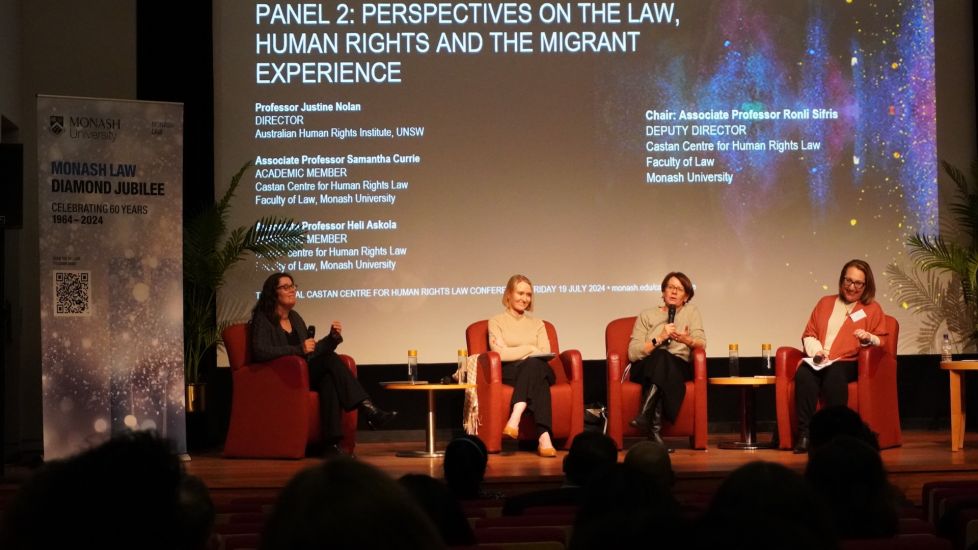
Associate Professor Heli Askola, Associate Professor Samantha Currie, Professor Justine Nolan and Assoc Professor Ronli Sifris in the second panel ‘Perspectives On The Law, Human Rights And The Migrant Experience’.
Castan Centre Academic Member, Associate Professor Samantha Currie, presented a UK perspective on the legal representation of trafficking victims. Associate Professor Currie pointed out that the solution could be more harmful than the initial problem.
“Some of the lawyers would speak about how the clients that they were seeking to have identified as victims of trafficking, actually felt like they'd been treated much more harmfully by the UK's Home Office than they had been by their traffickers,” reflected Associate Professor Currie.
Castan Centre Academic Member, Associate Professor Heli Askola critically explored the current framing of forced marriage in the Australian context.
Highlighting that forced marriage was inserted under the umbrella of various trafficking related offences, Associate Professor Askola criticised a policing-led model. She highlighted the need for victims of forced marriage to receive support from the State.
“The kind of support that you need for [forced marriage victims] is not really the kind of thing that the AFP led model was designed to deal with,” indicated Associate Professor Heli Askola.
Watch the second panel ‘Perspectives on The Law, Human Rights and the Migrant Experience’.
Tensions of free speech and its constraints
Castan Centre Academic Member Professor Luke Beck began the final panel reflecting on it being perfectly legal to lie in a political ad — but it shouldn’t be.
Highlighting the successful regulation of advertising, Professor Beck stated that, “businesses, corporations, and others engaged in commerce are not allowed to engage in deceptive and misleading advertising.”
There are laws that protect consumers from deceptive and misleading advertising, but those laws don’t exist to protect voters.
“In 1983, there was a federal law that banned lying in political advertising federally, but it only lasted for less than a year,” revealed Professor Beck.
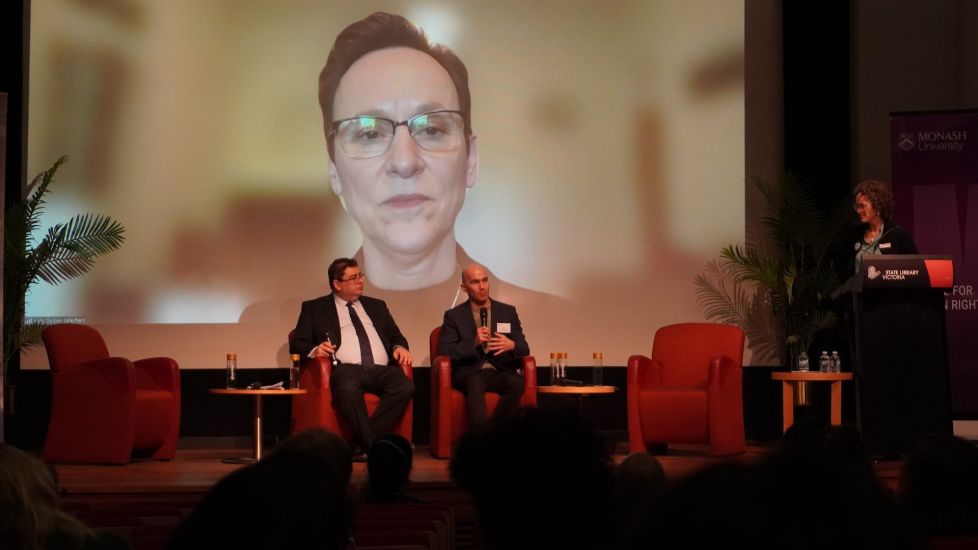
Dr Andre Oboler, Professor Luke Beck, Professor Katharine Gelber (on screen) and Associate Professor Julie Debeljak in the third panel ‘Tensions Of Free Speech And Its Constraints’.
“They've just got to stick with it and not undo it. There were some drafting problems with that law [but] the solution would have been to tweak and amend the law rather than completely get rid of it,” offered Professor Beck.
Professor of Politics and Public Policy at the University of Queensland, Professor Katharine Gelber echoed these sentiments while discussing how claims on free speech are used strategically by politicians.
“Free speech is used opportunistically as a mantra to cover political positions that either have nothing to do with free speech at all, or where they do, they demonstrate broad inconsistencies in the application of any free speech principle,” stated Professor Gelber.
“I think a useful way towards greater understanding and clarity on [the debate of free speech] is to re-emphasise the importance of the responsibilities that adhere to exercising a person's free speech, just as they're inherent to the responsibilities to every exercise of a human right,” suggested Professor Gelber.
Watch the third panel ‘Tensions Of Free Speech And Its Constraints’.
We look forward to seeing you again in 2025
The 23rd Annual Castan Centre for Human Rights Law Conference was a wonderful opportunity for leading academics and human rights advocates to reconnect, build their networks and share their perspectives on government accountability for the protection and fulfilment of human rights. You can see the full recording of the Conference here.
The Castan Centre for Human Rights Law looks forward to welcoming an even broader audience for the 2025 Annual Castan Centre for Human Rights Law Conference, expected to take place on 25 July 2025.
Please direct any enquiries about participating in or sponsoring the Conference to Professor Melissa Castan by email at castan.centre@monash.edu.
In the meantime, please sign up to Monash Law’s human rights events newsletter and follow the Castan Centre for Human Rights Law on social media to stay up-to-date on its work. You can also support the Castan Centre’s work by donating here.
Register to receive the quarterly Monash Law Research Newsletter