
International workshop on the History of Business Law

Monash Law's Centre for Commercial Law and Regulatory Studies (CLARS) invited researchers from around the world to share their work on the History of Business Law and Governance. The result was a masterclass for students of law, business and economics with many leads to follow.
US novelist William Faulkner once famously said ‘The past is never dead. It's not even past’. CLARS first workshop for 2024 sought to examine this statement in the context of the history of business law and governance.
Leading corporate law scholars from a range of jurisdictions, gathered at Monash University Law Chambers to examine the trajectory of business law and governance and the various theoretical and doctrinal twists and turns it has taken along the way.
A History of Corporations and Corporate Fiduciaries
The first session of the workshop looked at ‘A History of Corporations and Corporate Fiduciaries’ and provided an in-depth examination of the history of the corporation and its officers from a comparative perspective.
Professor D. Gordon Smith opened the Workshop with a paper titled ‘Creating the Modern Corporation’, in which he assessed the rise of modern capitalism through a US lens. A critical moment in the journey to modern US corporations was the advent of general incorporation laws in New Jersey, Delaware and other states, which transformed US corporations codes from regulatory codes to enabling statutes. Although this transformation is often depicted as a natural and inevitable result of the Second Industrial Revolution (featuring, for example, massive innovations in steel, chemicals, electricity, transportation, agriculture), Professor Smith’s presentation provided an alternative explanation – namely, the successful overcoming of fear towards big business.
 Prof Donna Nagy, Prof Gordon Smith and Prof Susan Watson.
“Prior to the Civil War, and this just still blows my mind, but people had this idea that each state was a sovereign entity. You couldn't have a corporation that was formed in one state, that would do business in another state, because they literally did not exist in that other state because they were formed in their state of incorporation,” exclaimed Prof Smith.
Professor Smith pointed out that things evolved in the late 19th century as the United States was changing quickly, growing industry through innovation, emancipation, and immigration.
The focus shifted to development of the modern corporation from a UK perspective with Professor Susan Watson. Her presentation on the topic, ‘Good Faith and Corporate Purpose: An Origin Story’, explored the origins of the duty of good faith, tracing it to the oaths sworn by directors of governing bodies of some UK companies in the 1600s and 1700s.
Professor Watson scrutinised the wording of these oaths and argued that there is evidence suggesting that the oaths and resulting duty were designed to ensure that controlling shareholders, as members of governing bodies of business corporations, treated minority shareholders equitably.
“My core argument is that the interests of shareholders aren't the same as the shareholders. Their interest captures in the capital, it's placed in the corporate entity that is separate,” explained Prof Watson.
Professor Watson’s analysis suggested that although the good faith duty is not owed to shareholders collectively at any time - but rather to the company as a separate entity from its shareholders - the duty nonetheless encompasses the interests of shareholders by virtue of their contribution to the capital base of the Corporate Fund of any solvent company.
Drilling down further into the roles and responsibilities of company office holders, Dr Steve Kourabas and Dr Nick Sinanis put forward ‘A Historical Re-appraisal of the Director as a Fiduciary and a New Legal Basis for Director Accountability’.
Dr Kourabas and Dr Sinanis’s research critically analyses, through a historical and institutionalist lens, why equity was used as an accountability mechanism in the 1700s and 1800s, and the effects that this has had on company law in the United Kingdom and in other parts of the world, including Australia and the United States.
Associate Professor Timothy Peters wrapped up the first session of the workshop with a paper titled: On the History of Corporate Office. Here he examined the role and responsibilities of company office holders from the perspective of corporate power.
 Prof Timothy Peters and Dr Tamara Wilkinson
Prof Peters sought to place our contemporary understandings of the corporation and corporate actors, particularly directors and officers, in relation to an older tradition of thinking about the nature of ‘office’. This tradition interpreted office as both a mechanism of responsibility (imposing not only rights but duties and obligations on the officeholder) and a form of irresponsibility (in that the effectiveness of official actions are separated from the intent of the individual performing them).
Corporate Theory, Shareholders and Stakeholders
The second session of the workshop focussed on ‘Corporate Theory, Shareholders and Stakeholders’.
Professor Sarah Haan shared her forthcoming book chapter entitled, ‘The Pathology of Passivity: Shareholder Passivity as a False Narrative in Corporate Law’. She argued that, although shareholder passivity (‘the Passivity Thesis’) has been a potent concept in business law history since the early 20th century, it is ultimately a false narrative in corporate law theory, which is not only descriptively wrong, but also normatively harmful.
Originally presented as a character flaw of the 1930s shareholder, the later Law and Economics movement transformed shareholder passivity into a virtuous form of rational behaviour, whereby the shareholder voluntarily chooses to give up power. Professor Haan showed how the Passivity Thesis has obscured the role of law in shaping the participation by shareholders in governance, arguing that business organisations would have evolved differently if corporate law had created mechanisms to facilitate active shareholder participation in governance.
The theme of myths in business law history continued with Professor Jennifer Hill’s presentation on the topic, ‘The History of the Agency Theory of the Corporation and its Hidden Fallacies’. Although corporate law theory seemed to be missing in action for several decades after the 1920s, it reemerged as a major topic in the mid-1970s, when Jensen and Meckling published their ground-breaking article on the agency theory of the firm.
Professor Hill’s presentation critically examined some of the assumptions generated by agency theory, assumptions that subsequently became bedrock principles of modern corporate law and governance. She assessed the extent to which those principles ‘correspond with the real world’ in the 21st century in relation to matters such as the relationship between corporate managers and shareholders; private ordering; shareholder activism and ESG; executive compensation; and corporate accountability and whether a new paradigm of the corporation is now needed to accommodate governance changes that have occurred since Jensen and Meckling’s famous article.
Dr Tim Bowley’s paper, ‘Australia’s Industry Superannuation Funds: An Origin Story’ examined the distinctive origins and engagement practices of ‘industry’ superannuation (pension) funds, which are some of the largest public company shareholders in Australia. These funds have become dominant players in the governance of Australian public companies as a result of steady fund inflows and a wave of fund mergers.
“I think we need to conceive of them as having become gatekeepers to the Australian listed equities market, and in a current research project, I'm exploring the implications of this development for Australian corporate governance,” revealed Prof Bowley.
Contemporary analysis frequently uses agency theory to explain institutional investors corporate governance behaviour. According to Dr Bowley, however, although agency theory has considerable explanatory power, it provides an incomplete explanation for the behaviour of Australia’s industry funds.
Dr Victoria Barnes closed the second session of the day with ‘A History of CSR’ (co-authored with Ciarán O’Kelly and Ciara Hackett (Queen’s University Belfast, School of Law). In this presentation, Dr Barnes discussed the shift in UK corporate governance over the last few decades from CSR to environment, social and governance (ESG), with its close links to factors, such as equality, diversity and inclusion, as well as human rights and sustainability.
Dr Barnes’ presentation adopted a historical perspective to reveal the ideological basis for CSR and the philosophy underpinning it. In tracing the birth of CSR, together with its demise, Dr Barnes examined when CSR functioned more effectively than it does at present as a tool for corporate regulation.
Regulating Business in Different Contexts Around the World
The final session of the Workshop discussed the historical trajectory of several key areas of corporate governance regulation.
Professor Donna Nagy opened the session with a historical account of insider trading law in the United States. Her paper, Beyond Fiduciaries - US Insider Trading Law and a Broader Embrace of the Common Law, noted that insider trading law in the United States is drawn mainly from administrative and judicial interpretations of Section 10(b) of the Securities Exchange Act of 1934 and the famous Rule 10b-5, which prohibit fraud ‘in connection with the purchase or sale of any security’.
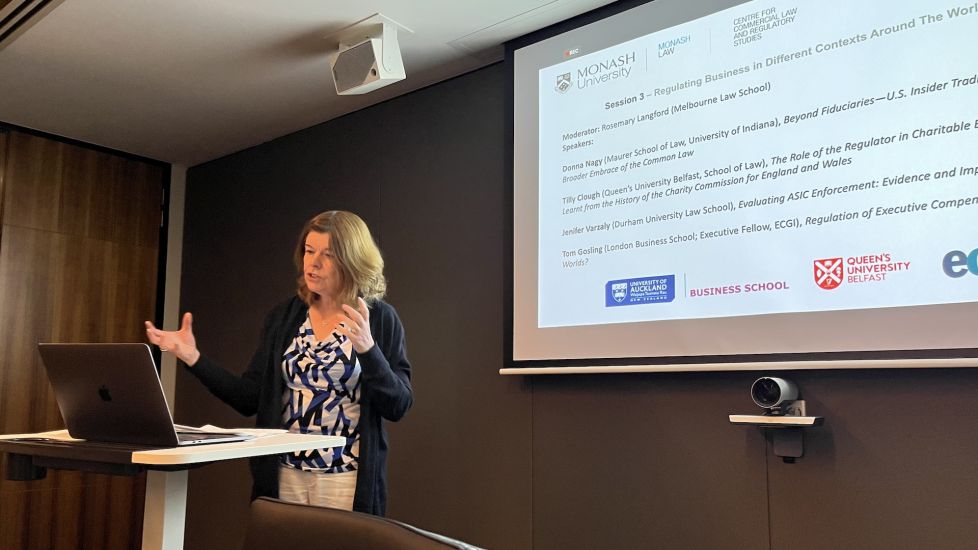 Professor Donna Nagy
“In the United States, to be found liable or guilty, because insider trading can be prosecuted either civilly or criminally, it's essential that there be some type of provable fraud. That is very different than the law in Australia, New Zealand, UK and in just about every other jurisdiction with a developed securities market where there is an express statutory provision prohibiting the purchase or sale of securities on the basis of material nonpublic information,” shared Prof Nagy.
Prof Nagy argued that the US Supreme Court has, in fact, exacerbated the challenge by insisting that disclosure duties will only arise in the context of fiduciary-like relationships between either the trader/tipper and the issuer’s shareholders (the ‘classical theory’ articulated in Chiarella v United States (1980)) or the trader/tipper and the information’s source (the ‘misappropriation theory’ endorsed in United States v O’Hagan(1997)).
Professor Nagy’s presentation highlighted an alternative exception to the general common law principle that only affirmative misstatements can be actionable as deceit - namely, the exception for nondisclosure of material facts in transactions where the knowledgeable party’s informational advantage was wrongfully obtained. While accepting that it is highly unlikely that US courts will reframe the insider trading offence to embrace a broader conception of common law fraud, Professor Nagy argued that attention to this important aspect of legal history may hold considerable persuasive power as the US Congress continues to contemplate legislative reform of insider trading law.
The next speaker in session three was Tilly Clough, who explored the regulation through the lens of charities. Her presentation, ‘Charitable Businesses: Lessons Learnt from the History of the Charity Commission for England and Wales’, noted that the governance of charitable businesses in England and Wales focuses on two key actors. These are (i) charitable trustees of individual charities and (ii) the external charity regulator (i.e., the Charity Commission for England and Wales).
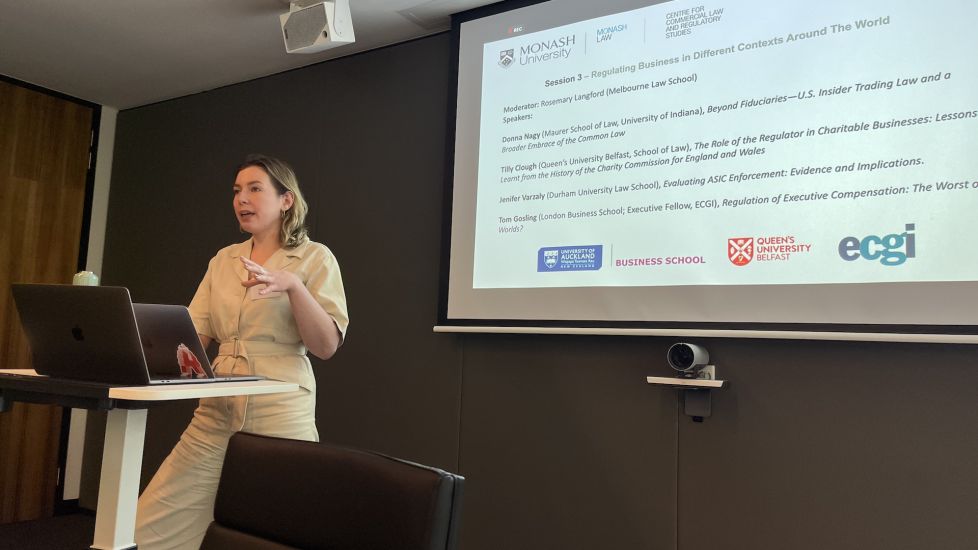 Tilly Clough
“This is what Tony Blair's New Labour government wanted to do and wanted to change in the form of the Charities Act 2006. They wanted to create a regulator that was active enough to actually push these fee charging charities, that were exclusionary to quite a significant proportion of the public, to do more to justify their charitable status and tax advantages, which is what it always centres on. And therefore we've got this shiny new charity commission,” explained Ms Clough.
Ms Clough’s presentation provided a case study of the historical role of the Charity Commission for England and Wales, using external regulators in other jurisdictions as a point of comparison.
Dr Jenifer Varzaly continued the regulatory theme with her presentation, ‘Evaluating ASIC Enforcement: Evidence and Implications’, which examined private enforcement actions by Australia's business conduct regulator, the Australian Securities and Investments Commission (ASIC).
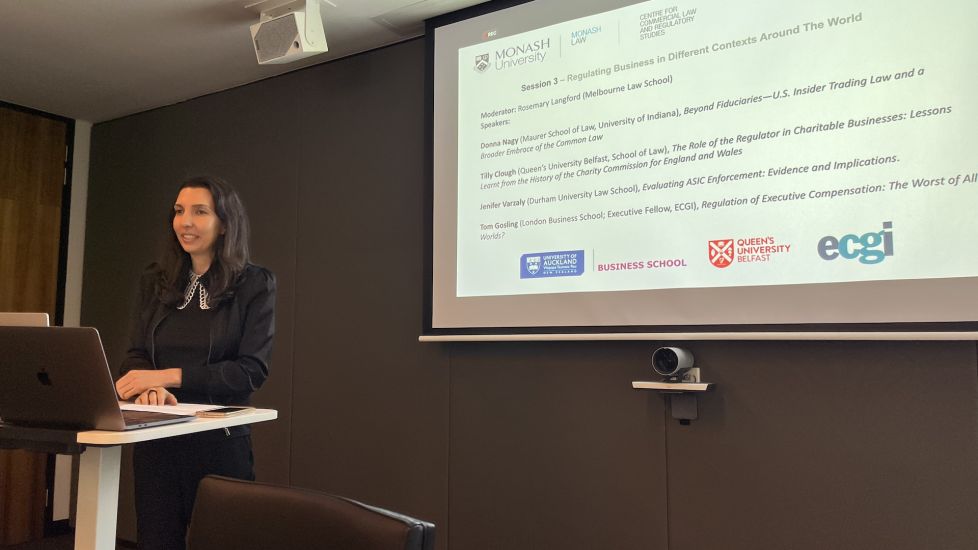 Dr Jenifer Varzaly
“This for me was a very long range project, which is still ongoing. It started as an empirical project where I'm basically looking at 20 years worth of data. And so those data sets haven't been fully completed, but as a working project, I thought, what a great place to seek some feedback on that and see, or say where I've gotten to so far,” shared Dr Varzalay.
Dr Varzaly noted that there are three key overarching contributions from her research. The first of these is a comprehensive description of the Australian enforcement landscape, showing the topographical significance of both public and private enforcement modalities, which is lacking in most research on the topic of enforcement. Secondly, her research provides a theory-based explanation for the contours of this enforcement landscape and its trajectory. Finally, the project offers an evaluation of the effectiveness of Australia’s enforcement regime, together with international implications arising from it.
In the final presentation of the Workshop, ‘Regulation of Executive Compensation: The Worst of All Worlds?’, Tom Gosling provided a brief history of UK pay regulation and its relationship with pay levels and practices. He also discussed the transnational success of the UK’s regulatory approach to executive pay, particularly the ‘say on pay’ technique, which has spread around the world since it was first adopted in the UK in 2003.
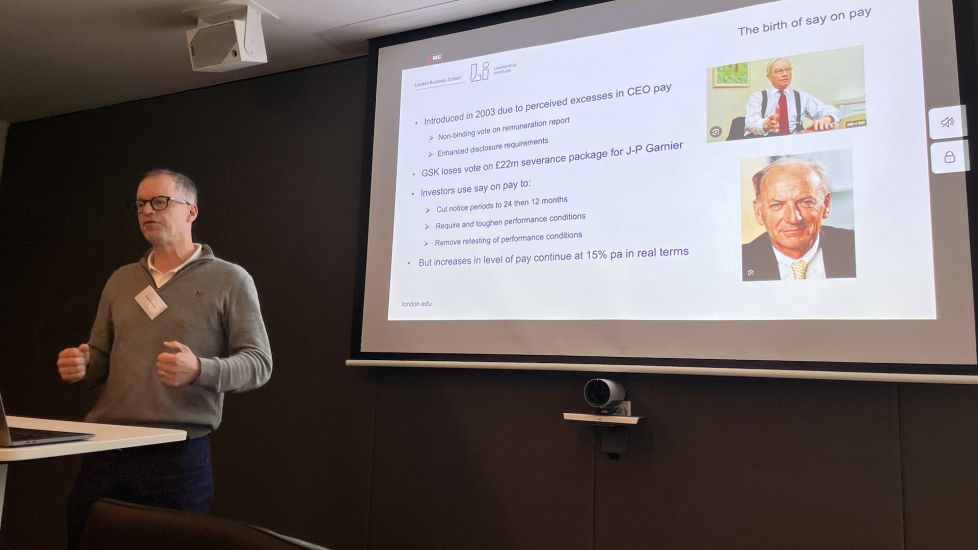 Tom Gosling
Mr Gosling’s presentation put forward the idea that the UK approach has been so influential because such a regulatory style is attractive to politicians. On one hand, it enables politicians to ‘talk tough’ on executive pay, on the other hand, it relies on market mechanisms (particularly shareholders) to regulate pay.
Mr Gosling argued that a consequence of the UK’s attempts to regulate via the market is that the executive pay ‘problem’ has never been solved to the public’s satisfaction. But at the same time, UK boards argue that shareholder interference in pay has damaged UK competitiveness and the ability to attract effective corporate leaders.
The Centre for Commercial Law and Regulatory Studies (CLARS) at Monash University Law School facilitates innovative research in commercial law, corporate governance and regulation. The Centre includes select Monash University academics and postgraduate students, as well as visiting scholars and research partners from around the world.