
Living lessons in Human Rights Advocacy

Professor Paula Gerber is an award winning teacher who is living the lessons she shares in Human Rights Advocacy.
“I am myself a human rights advocate. I've campaigned strongly on a number of different issues - sometimes successfully, sometimes unsuccessfully - so I'm coming with first hand personal experience,” says Prof Gerber.
As Chief Examiner of the Human Rights Advocacy (LAW5381) elective for postgraduate students, she’s passionate about sharing the skills and knowledge required to make a positive difference.
“A lot of our law students want to go out into the world and be human rights advocates, but law schools’ teachings around advocacy tend to focus only on courtroom advocacy.”
“This subject is designed to fill that gap, by helping students learn how to develop a human rights advocacy strategy, and how to successfully implement it. So if they're really passionate about something like raising the age of criminal responsibility, then this subject gives them the knowledge, tactics and the strategies they can use to try and achieve that goal and use their time and precious resources most effectively.”
See LAW5381 in the Postgraduate Elective Timetable
The strategy of Human Rights Advocacy
Sun Tzu said, “Strategy without tactics is the slowest route to victory. Tactics without strategy is the noise before defeat.” It’s this message that underpins Prof Gerber’s philosophy in this elective.
A lawyer for over 25 years, Prof Gerber spent five years working as a solicitor with Baker & Mckenzie in London, five years as an attorney in Los Angeles, returning to Australia to work for Mallesons (now King & Wood Mallesons) and later becoming a partner at Maddocks.
“My many years working in the legal profession mean I have a very practical focus rather than being overly theoretical. All my teaching and everything I write and publish, is about having impact and making change.”

Writing in The Conversation Australia, Prof Paula Gerber and Prof Melissa Castan examine Australia's commitment to UN treaties so far, how some states and territories already have one, and why we need a Human Rights Act.
Prof Gerber moved from private practice into academia in 2000, joining the Law Faculty at Monash University in 2004. In 2023 she was awarded the Vice Chancellor’s Award for Teaching Excellence.
In addition to her academic position, Prof Gerber is the chair of the board of Kaleidoscope Human Rights Foundation, which advocates for the rights of LGBTIQA+ people in the Asia Pacific region.
“We amplify the voices of LGBTIQA+ people in the Asia Pacific region within the UN. I'm proud of the success that we've had in contributing to law reforms, that make life easier for LGBTIQA+ people living in countries that are right on our doorstep.”

Professor Paula Gerber with her 2023 Vice Chancellor’s Award for Teaching Excellence alongside Professor Melissa Castan.
Another proud moment of Human Rights Advocacy was playing a key role in reforms to birth registration in Victoria for Indigenous Australians.
“There was an undiscovered problem for Indigenous people accessing the birth registration system in Victoria, that Melissa Castan and I decided to investigate.”
In 2012, the Victorian Law Reform Commission began a Community Law Reform Project on Victoria’s birth registration and birth certificates laws. It arose from research Melissa and I conducted about barriers faced by Aboriginal Australians in registering births and obtaining birth certificates, and the high number of unregistered births, particularly in rural and remote areas.
Prof Gerber led an ARC Linkage Program titled ‘Closing the gap on Indigenous birth registration’.
“I was able to get that system completely remodelled. Koorie officers were appointed to support and guide Indigenous people through that process, fee waivers were introduced and policies and practices changed, which resulted in many Indigenous people getting birth certificates who had gone their whole life without having one.”
“One woman said ‘I want to get a birth certificate before I get a death certificate’. I'm very proud of that project.”
Applying Human Rights Advocacy in other areas of Law
Prof Gerber is the Associate Dean (Education) in the Faculty of Law and also teaches Construction Law, where she also applies Human Rights Advocacy.
“There's not many things that I look at and don't see as human rights opportunities. In construction law I talk about gender equality, as well as the role that the machismo, adversarial industry culture plays in the high incidents of disputes. So I look at everything through a human rights lens.”

Professor Paula Gerber steals the scene with a microphone and white t-shirt in the middle of the Global Immersion Guarantee 2024 group.
Outside of the Law Faculty, Prof Gerber enjoys sharing her human rights expertise with the wider Monash University family. She plays a leadership role in the Global Immersion Guarantee which takes students from across Monash University to Fiji to learn from local leaders about how they’re working to address the human impact on the environment.
“The Global Immersion Guarantee has a very explicit human rights focus because it’s looking at how Fiji is responding to climate change - one of our most existential human rights threats going on in the world,” says Prof Gerber.
“Students learn first hand how Fiji is being impacted by rising sea levels and how 6 entire villages have had to relocate to higher land. It is a unique opportunity for them to learn about human rights in a different culture and different environment that's life changing and lifelong.”
Human rights even plays a role in Prof Gerber’s downtime, when she’s likely to indulge in one of her favourite pastimes, going to musicals, many of which she finds have human rights themes.
“The Sound Of Music was the first musical I saw and it sparked my lifelong passion for musical theatre . It’s about the Von Trapp family escaping the Nazis (which is a path my own family took - my father came to Australia as a refugee at the age of 14, having fled Nazi Germany). So the fact that it's based on a true story and is about persecution and discrimination and children's rights. It's human rights through and through!”
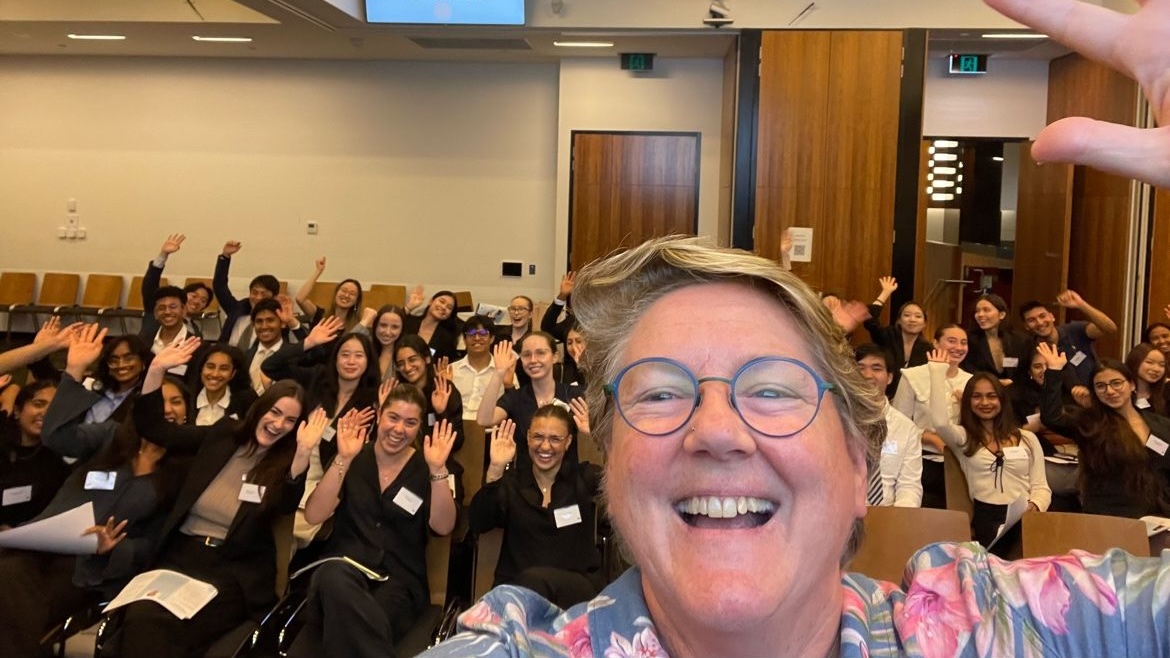
Professor Paula Gerber demonstrates her mastery of the selfie with the Monash Law Students’ Society Just Leadership Program.
Human Rights Advocacy as a Postgraduate elective
Prof Gerber brings every part of her human rights experience to her teaching role in the Human Rights Advocacy (LAW5381) elective for postgraduate students. The ideal candidates for this Law elective are students who have a deep passion and commitment for human rights. Students who have done some human rights study such as (LAW4155) International Human Rights will benefit even more from this elective.
“Law is a great tool, but it's only one piece of the jigsaw puzzle. You need to know how to fit it together with other pieces of the jigsaw puzzle that are needed in order to bring about reform. That might include awareness raising, education, lobbying or gathering a critical mass of people together if you're going to successfully improve human rights in Australia or elsewhere in the world,” explains Prof Gerber.
This unit is about developing advocacy skills, the skills of argument and persuasion. Prof Gerber invokes the words of one of her heroes, The Honourable Ruth Bader Ginsburg, who said, “if you raise your voice, you've already lost the argument.”
“You don't need, or you shouldn't have, the loudest voice in the room in order to be successful. What you need is really good skills in shaping a persuasive arguments and really effective communication skills around human rights,” assures Prof Gerber.
“We'll study successful human rights advocacy campaigns like marriage equality in Australia. But we learn as much from our failures as our successes. So we'll also be looking at unsuccessful human rights campaigns, like the Voice Referendum.”
“This subject is not about black letter law, it's about how to use the law to achieve your goals.”
Measuring the effectiveness of skills in advocacy, argument and persuasion is not something that can be captured in a quiet exam room, so this elective has no exam! Instead students will mount an advocacy campaign of their own choosing - something they are passionate about. All three pieces of assessment will be parts of the jigsaw puzzle that make up that advocacy and include a research plan, an advocacy strategy and a podcast.

Professor Paula Gerber takes 120 construction law students on a field excursion to a building site.
The benefits of studying Human Rights Advocacy
While collaboration is encouraged in this elective, students can expect to complete their assessments as individuals, with no group work required.
Another benefit for always-busy Law students is that Human Rights Law and Advocacy is delivered 100 percent online.
“I've mastered online teaching and developed really good techniques and strategies to make it a highly valuable and transformative educational experience,”
“And being online means that I can bring in guest presenters from around the world. So I've got leading experts working with the UN in Geneva, as well as guests from London and New York, who are happy to share their immense human rights knowledge and expertise with my students.”
According to Prof Gerber this unit is probably the most fun unit that Law students will have in their degree because it's really focussed on developing the skills and capacity to be an effective human rights advocate.
“One of my mantras is, if you're not laughing, you're not learning,” laughs Prof Gerber.
“I always try to make classes fun, because there's lots of neuroscience that tells us that when you are happy and joyful and laughing, your receptors for knowledge are actually more open.”
If Prof Gerber could travel back in time to visit herself as a Law student, what advice would she give herself about this elective?
“I’d say grab it with both hands!”
“Even if you think you're just interested in corporate and commercial law, there'll be stuff in this unit that's for you because it is full of transferable skills about how to be an advocate, both globally and locally.”
“It will be an enriching, engaging and very personable experience.”
See LAW5381 in the Postgraduate Elective Timetable
Need some tips on enrolment and re-enrolment? Take a look at Monash Law's re-enrolment guide.