
Monash Law research features in Human Rights Framework report

Kylie Evans SC, Catherine Dixon, The Hon Pamela Tate AM KC, Associate Professor Julie Debeljak and Dr Bruce Chen.
The Parliamentary Joint Committee on Human Rights has recently reported on its Inquiry into Australia’s Human Rights Framework. The report recommended that the federal government introduce an Australian Human Rights Act.
From the report, we can see that the submissions from Monash Law researchers played a real and valuable role in assisting the Parliamentary Joint Committee on Human Rights in their work.
Associate Professor Julie Debeljak is referred to 74 times, consisting of 23 direct mentions in the body of the report, and 45 citations in footnotes. The Castan Centre for Human Rights Law is referred to 41 times, consisting of 9 direct mentions in the body of the report, and 29 citations in footnotes.
Read Associate Professor Julie Debeljak’s submission
In addition to making a submission to the inquiry in 2023, Prof Debeljak also gave evidence before the Parliamentary Joint Committee on Human Rights in a panel that included the Hon Pamela Tate AC KC, who is currently an Adjunct Prof with Monash Law and Dr Bruce Chen, who graduated from his Monash Law PhD in 2020 (pictured above).
The Castan Centre for Human Rights director, Professor Melissa Castan, gave evidence before the committee in addition to co-authoring the Centre's submission with Associate Professor Ronli Sifris and Scott Walker. Her evidence and other research is referred to 3 times in the body of the report, with 5 citations in footnotes.
Read Castan Centre for Human Rights Law’s submission
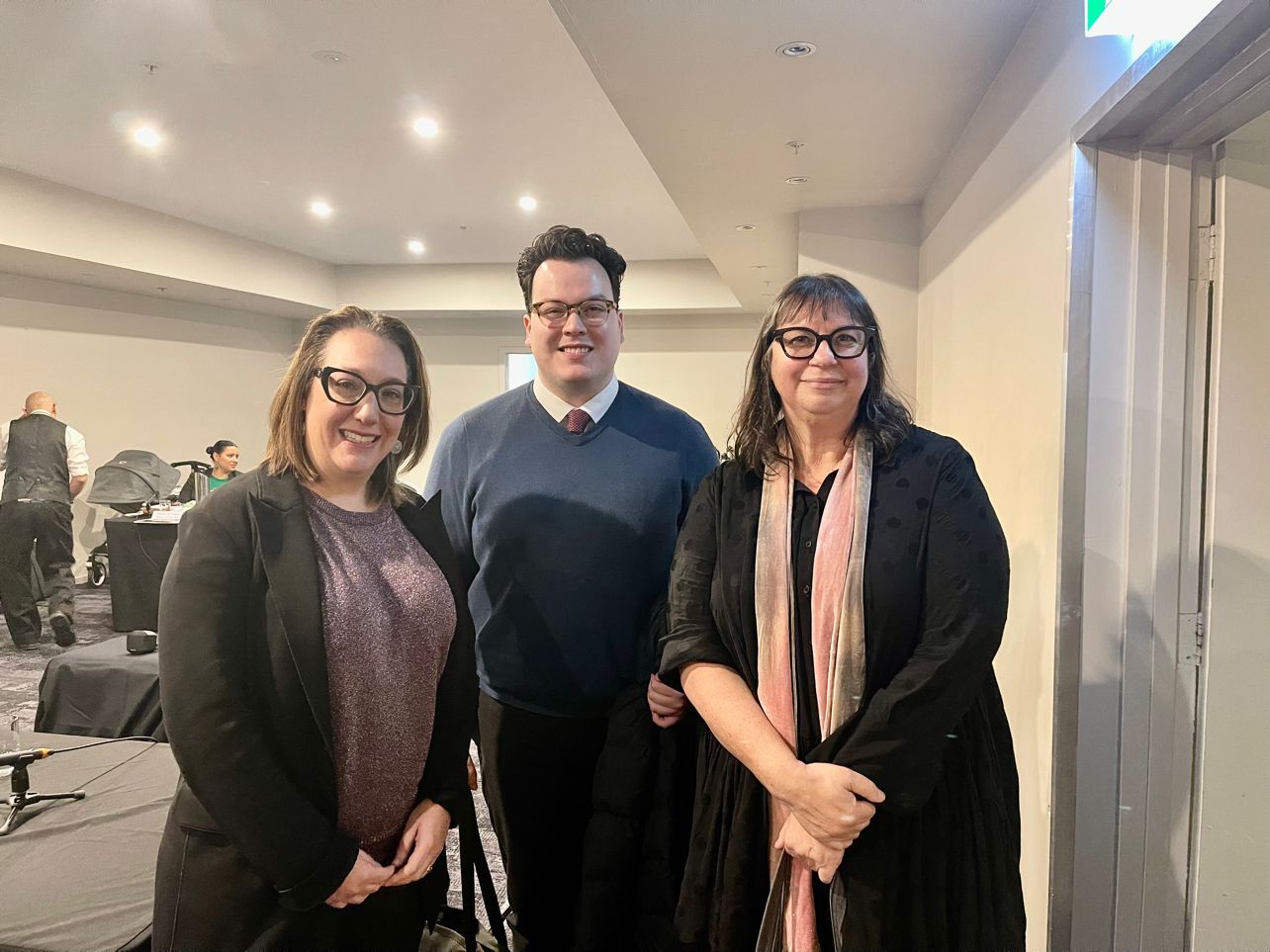
Castan Centre’s Deputy Director Associate Professor Ronli Sifris, Research Fellow Scott Walker, and Director Professor Melissa Castan after giving evidence at the Parliamentary Joint Committee on Human Rights.
As a legal scholar, Prof Debeljak describes the experience of participating in the inquiry as very satisfying.
“When you publish in scholarly journals and books, you don't get any real immediate response. Whereas, when you write for an inquiry, your submission gets put online, you get quoted in the reports, people hook into your research by your SSRN and LinkedIn sites, and people email you to discuss your research with you,” explains Prof Debeljak.
“You get to have live debates with lawmakers about the pros and cons of what they're doing and the pros and cons within your own submission. It really brings to life what is otherwise research that sits in journals for academics to talk to each other about,” enthuses Prof Debeljak.
“Making submissions to inquiries translates the research that I do into real life law reform. I get to debate the law reforms with the people that actually get to enact those law reforms - the government and parliament.”
How to make a submission to an inquiry
On 15 March 2023, the Attorney-General referred to the Parliamentary Joint Committee on Human Rights several matters for inquiry and report by 31 March the following year. That date would later be extended to 30 May 2024.
Prof Debeljak is on the mailing list of the committee and saw the details of the inquiry announcement in their media release.
“Most people involved in human rights are aware of the sorts of inquiries that they're doing. So whether it be academics, lawyers, NGOs or community legal centres, we tend to follow their work because they're the key parliamentary committee for human rights,” reveals Prof Debeljak.

Writing in The Conversation Australia, Prof Melissa Castan and Prof Paula Gerber examine Australia's commitment to UN treaties so far, how some states and territories already have one, and why we need a Human Rights Act.
The National Human Rights Consultation Committee ran a similar inquiry for the federal government in 2008/09 which also recommended a Human Rights Act be enacted. In 2019 the Australian Human Rights Commission commenced a five-year-long project called Free and Equal: An Australian Conversation on Human Rights that again recommended a Human Rights Act be enacted.
Prof Debeljak contributed submissions to both of these projects, but her preparation for the Inquiry into Australia’s Human Rights Framework goes back even further.
“It really goes back to my PhD, because this topic was my PhD thesis. So, to prepare a submission for this inquiry I reached all the way back to my PhD and all the research I've done since then,” reveals Prof Debeljak, whose PhD was conferred in 2004.
“I begin by outlining the general need for a Human Rights Act, and then I speak about the current systems that we have across various jurisdictions, some of which do have Human Rights Acts, and how those Human Rights Acts themselves need reforming.”
“It's a matter of talking generally about the benefits of having a Human Rights Act, describing what is in the federal sphere, and then looking to other examples of Human Rights Acts that we have and promoting them. But it’s also about arguing for the reform of the existing instruments so that we get the best Human Rights Act we can in the federal sphere.”
The value of making a submission to an inquiry
The overall, high-level value of making a submission to an inquiry is likely to be measured by the outcomes revealed in the committee’s report. However, the personal value of putting together a submission can be measured in many different ways and not just by academics.
“No matter what level you're at in your legal studies, if you take the time to write a thoughtful submission to Parliament, they're going to listen. And they will hopefully at least explore if not adopt your ideas in law reform,” encourages Prof Debeljak.
“I think it's very important for people to understand the benefit of evidence based policymaking and lawmaking. Our submissions help to build that evidence base and the resultant laws and policies should be stronger for it.”
As an academic with an impressive track record of publishing journal articles and making submissions to several inquiries, Prof Debeljak still finds deep fulfilment in putting together a submission. It’s even more satisfying when her work and that of colleagues is heavily referenced in the resulting report.
“I think it's recognition that in our field of expertise we take a great deal of time to consider what we put forward. The expertise has been built up over years in terms of our own individual research, as well as the Castan Centre being one of the leading academic institutions in the human rights field. So yeah, it's definitely recognition of our expertise.”
“It may also be recognition of the pragmatic way we were able to convert quite technical and theoretical ideas into a digestible submission. Not every parliamentarian wants to read a thesis about the issue. So our ability to actually translate the heavy thinking into understandable and digestible ideas is also reflected in the fact that we're cited a lot,” shares Prof Debeljak.
The importance of a Human Rights Act
Australia is the only liberal democracy in the world without a Human Rights Act. One of the main challenges of introducing a Human Rights Act is that it underpins so much existing legislation. It’s a transformational change that impacts the foundations of the legal system which is going to take a long time.
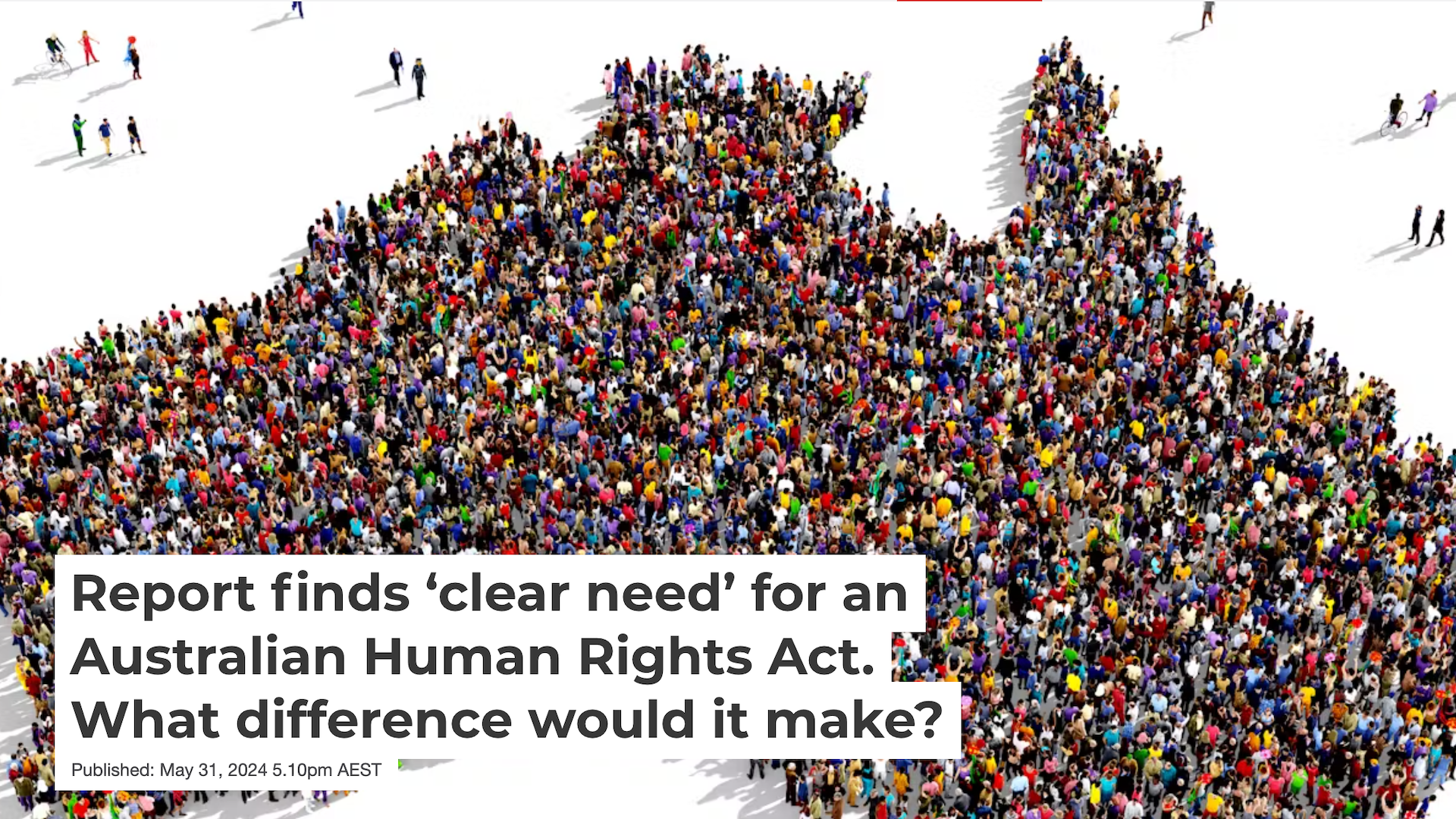
Writing in The Conversation Australia, the Castan Centre's Adjunct Prof The Hon Pamela Tate AM KC and Assoc Prof Julie Debeljak, along with Dr Bruce Chen explain why we need an Australian Human Rights Act, what the report says and where to next.
“As a legal scholar, I have been studying and advocating in favour of the Human Rights Act my whole career because it is the pinnacle within our legal system. Once we actually get a Human Rights Act at the top of the framework, all laws and policies and behaviours underneath it fall into line to ensure that we've got a human rights respecting society,” explains Prof Debeljak.
“As an individual, I think that the basis of a flourishing society needs to be respect for each other's human rights. Without a formal documentation of that within our legal system, there are too many vulnerable people who get left behind.”
As a legal scholar and as an individual, Prof Debeljak believes in the importance of a Human Rights Act and is committed to keep pushing for legal reforms that will make it a reality.
“Although it's discouraging, when you get a report that is in favour of a Human Rights Act and they don't deliver politically, it's still worthwhile being involved time and time again because one day we will secure for ourselves the Human Rights Act for Australia.”
Register to receive the quarterly Monash Law Research Newsletter