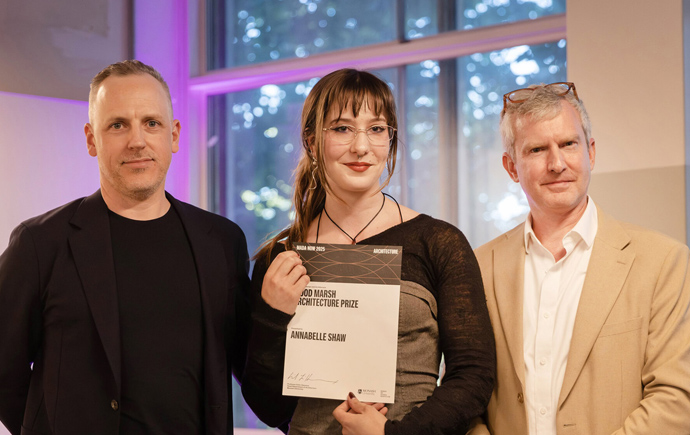
Erik L'Heureux
Professor Erik L'Heureux


Erik G. L’Heureux (PhD, FAIA, LEED AP BD+C) is an architect and design scholar whose work integrates architectural practice, academic leadership, and research-by-design to address pressing environmental challenges in hot, wet, and densely populated equatorial cities facing the impacts of a warming world.
L’Heureux specialises in designing for the dense equatorial city, with a focus on adaptive reuse. He employs simple monolithic forms and delicate veils, carefully calibrating buildings, interiors, and experiences to the hot air of the urban equator in both delightful and unexpected ways. His portfolio spans more than 40 projects across Southeast Asia and has been recognised by institutions such as the Holcim Foundation for Sustainable Construction, the American Institute of Architects (AIA), the Society of American Registered Architects (SARA), the INDE Design Awards, the World Architecture Festival (WAF), and Singapore’s President’s Design Award.
He was awarded the Wheelwright Prize from Harvard University’s Graduate School of Design for his research on mid-20th-century equatorial architecture. He has exhibited at the Venice Biennale, Cité de l'Architecture, the National Design Centre, the Seoul Biennale of Architecture and Urbanism, and the Centre for Architecture in New York City.
Before joining Monash University, L’Heureux spent two decades in Singapore, where he held various academic and leadership roles at the National University of Singapore (NUS). He previously practised in New York City and taught at the Irwin S. Chanin School of Architecture at The Cooper Union. He holds a PhD from RMIT University, where he received an RMIT Award for Research Excellence, a Master of Architecture from Princeton University, and a Bachelor of Arts in Architecture from Washington University in St. Louis, where he was a James W. Fitzgibbon Scholar.
He is a registered architect in the USA and Singapore, NCARB-certified, and a LEED BD+C professional. In 2020, he was elevated to the College of Fellows of the American Institute of Architects for his contributions to architectural education, training, and practice.
News & events
Recent news
Upcoming events
Monash University partners with Victorian Government to launch State Design Book: University Showcase