RetroFit Kit
RetroFit Kit is part of an ongoing research project led by Monash Art, Design and Architecture in collaboration with the Australian Human Rights Commission Disability Discrimination Commissioner, Dr Ben Gauntlett. The project aims to increase the volume and supply of dignified and inclusive homes for people with disability through design-enabled strategies.
Designers and Project Team:
External Collaborator
Dr Ben Gauntlett, Disability Discrimination Commissioner, Australian Human Rights Commission
Project Lead (research design, exhibition design and curation)
Nigel Bertram, Maryam Gusheh, Catherine Murphy
Graphic Design Lead (print and exhibition)
Warren Taylor
Industrial Design Lead (rail and light elements)
Tahl Swieca, Rowan Page
Urban Mapping Lead
Tom Morgan
Contributing Monash Architecture Students
Olivia Basile, Ashleigh Carp, Edward Chan, Chee-Song Chuah, Alexandria van Domburgh, Sylvanna Dong, Georgius Hindarko, Amanda Jap, Cheng Lee, Cyndy Li, Ca Kheng Lot, Annabelle Low, Georgia Rose, Scott Rowe, Taylar Stanton, John Tsitouridis, Lenore Whiteside
Contributing Monash Industrial Design Students
Kat Craine, Jules Kabore, Jo Hutchinson, Walt Liu, Qiuyi Peng
Urban Mapping
Mark Romei, Alexa Gower, Liam Ware
Australian Human Rights Commission
Afton Fife, Clare Lawrence,
Lisa Le Van
In Australia there are 4.4 million people with disability, 96 per cent of whom live in ‘general’ housing that is not accessible and so unsuited to particular needs. Quality, accessible homes would also benefit older people, workers, intergenerational households and young families. Yet the availability of inclusive housing remains a significant challenge. The absence of structured solutions that address the complexities of working with the existing built fabric, coupled with a lack of access to design professionals, results in adaptations for accessibility that are typically one-off, clinical in appearance and devalue existing dwellings.
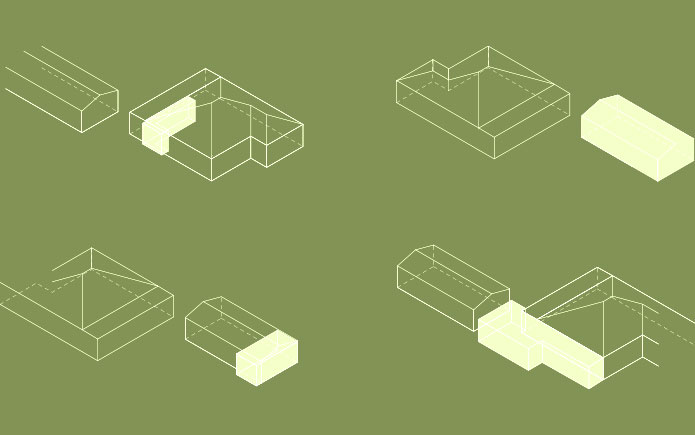
Working in research-led education units, the RetroFit Kit team took a typological approach to the problem by focusing on common building types found across Melbourne’s suburbs – 1950/60s detached houses, 1960/70s walk-up flats, 1980s+ townhouses, 2000s+ row houses and 2000s+ garage houses. They developed a series of flexible design principles and architectural strategies that combine to form a toolkit for accessible conversions that can be applied at scale.
In March 2022, these strategies were tested as part of the exhibition RetroFit Kit: Design Tools for Making our Homes Accessible presented at MADA Gallery on Monash University’s Caulfield Campus as part of Melbourne Design Week. The exhibition was curated by Monash Art, Design and Architecture’s Maryam Gusheh, Catherine Murphy and Nigel Bertram, with support from Warren Taylor and Tom Morgan.
Master of Architecture students collaborated on the exhibition, undertaking research and fabrication as part of education units led by Monash Urban Lab. Students also gained valuable occupational insights by engaging with Australian Human Rights Commission Disability Discrimination Commissioner Dr Ben Gauntlett, who acted as the client.
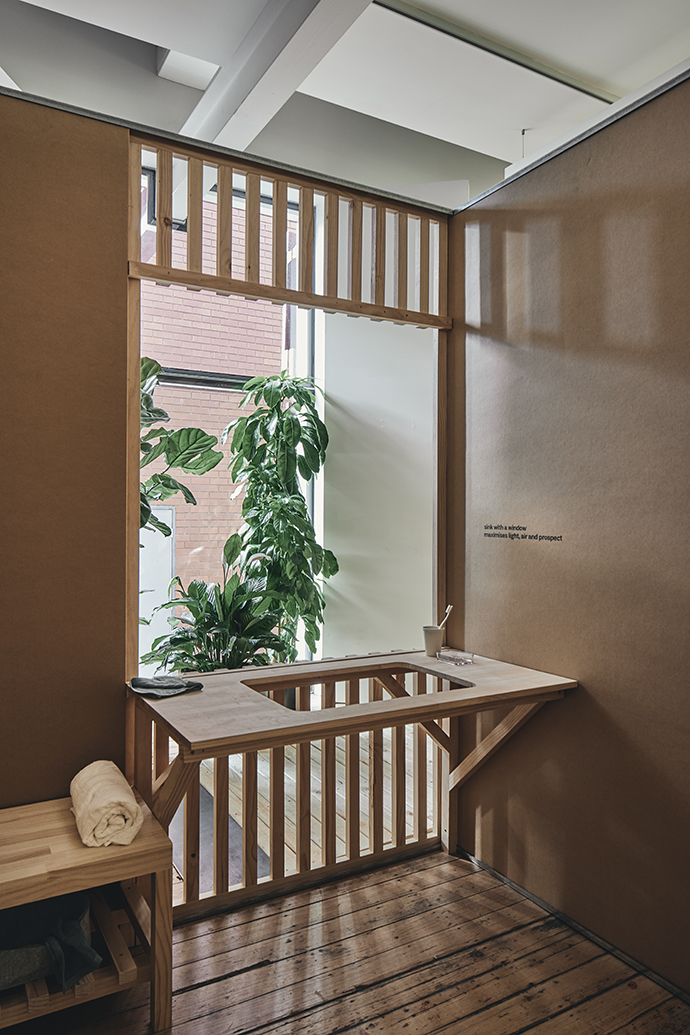
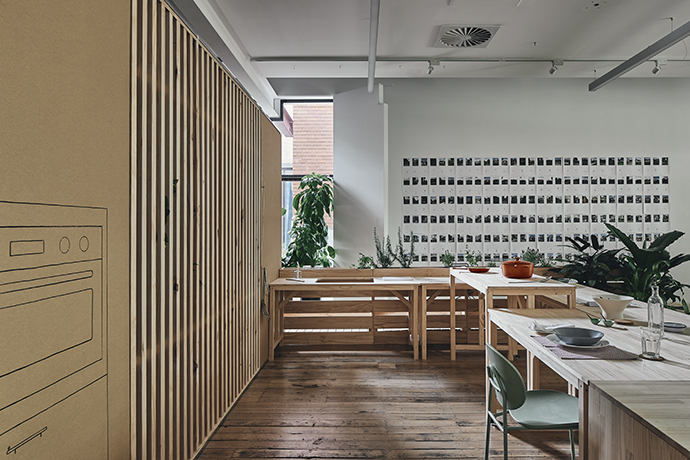
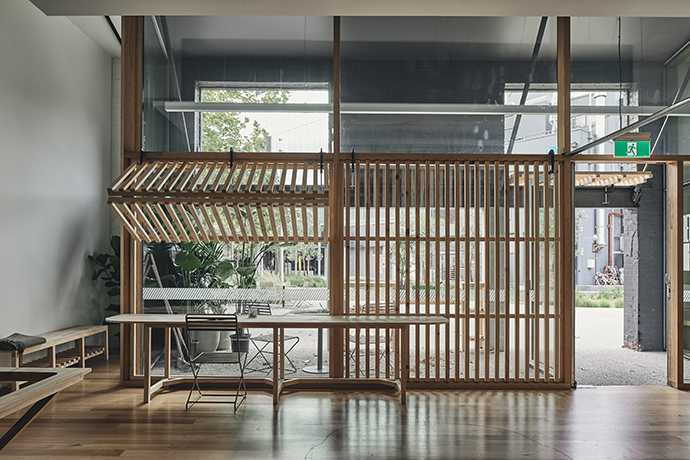
Conceived as a simulated house and installed at 1:1 scale, the exhibition functioned as a prototype for what seamless and dignified adaptable housing might look like. The domestic space was composed from areas both within and outside of the gallery – a drop off/pick up zone and a gathering space; a flexible, converted garage; a safe, dual-key entry; a mudroom as a transitional space; a spacious, adjustable and modular kitchen; a generous, integrated bathroom; and an integrated ramp/terrace.
“RetroFit Kit exemplifies the practice-led education model at Monash Art, Design and Architecture, where academics, students and external partners work together to address social and environmental challenges through design,” says Associate Professor Maryam Gusheh. “It highlights the potential for architectural research and practice in creating more equitable and just cities.”