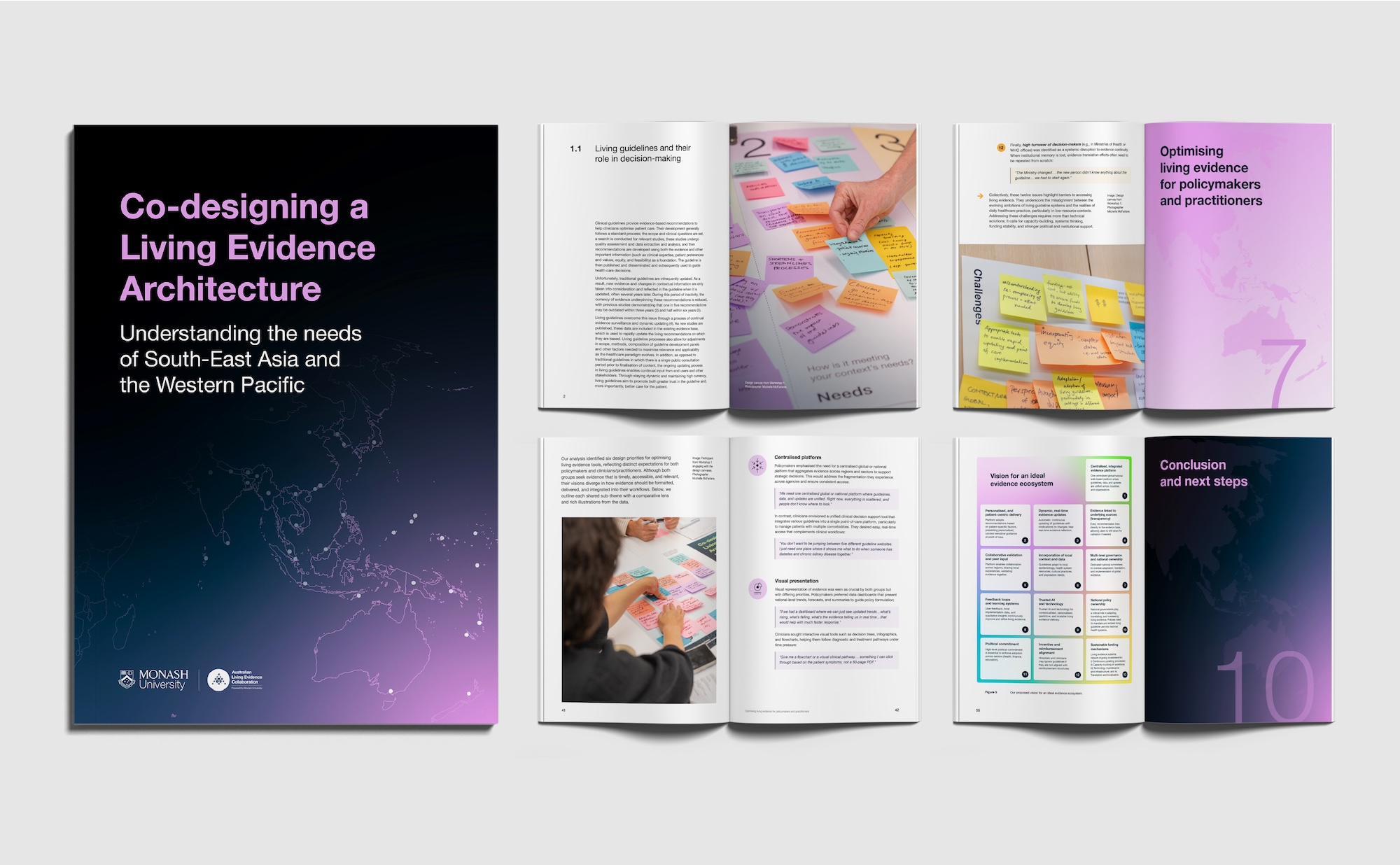
Living Evidence Architecture Report
This report presents findings from the Living Evidence Architecture (LEA) project, a collaborative initiative between the Australian Living Evidence Collaboration, Monash University (Australia and Indonesia), WHO regional and headquarters offices, and partners across South-East Asia and the Western Pacific.
The research brought together experts and end users from clinical, policy, public health, and digital sectors to explore how living evidence systems can better support decision-making across diverse health contexts, with a particular focus on South-East Asia and the Western Pacific.
The report reveals how an AI-supported, regionally coordinated evidence platform could transform how clinicians and policymakers access and apply the latest research in real time.
Over 70 participants from 10 countries joined two co-design workshops hosted by Monash University (Australia and Indonesia), representing Ministries of Health, hospitals, and research networks across the region. Participants identified clear priorities for an inclusive, transparent, and sustainable living evidence system that keeps health guidance continuously up to date.
“Living evidence is a new infrastructure for health knowledge—one that can evolve with our understanding and adapt to local realities,” said Professor Tari Turner, Director of ALEC. “This work shows that through collaboration and co-design, we can make evidence truly living and global in impact.”