
Melbourne Cool Lines
Course
- Master of Architecture Semester 2, 2019
Studio leaders
- Markus Jung
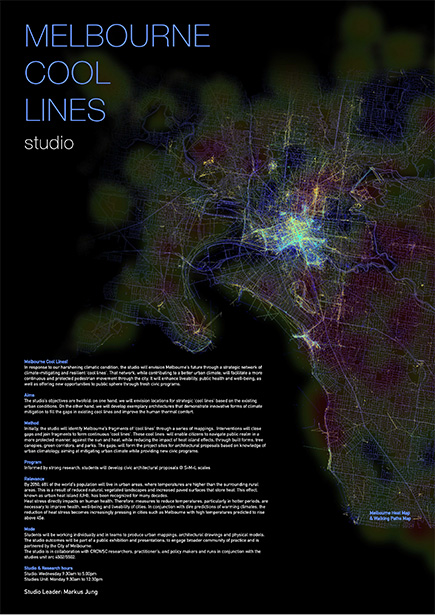
In response to our harshening climatic condition, the studio will envision Melbourne’s future through a strategic network of climate-mitigating and resilient ‘cool lines’. That network, while contributing to a better urban climate, will facilitate a more continuous and protected pedestrian movement through the city. It will enhance liveability, public health and well-being, as well as offering new opportunities to public sphere through fresh civic programs.
Aims
The studio’s objectives are twofold: on one hand, we will envision locations for strategic ‘cool lines’ based on the existing urban conditions. On the other hand, we will develop exemplary architectures that demonstrate innovative forms of climate mitigation to fill the gaps in existing cool lines and improve the human thermal comfort.
Method
Initially, the studio will identify Melbourne’s fragments of ‘cool lines’ through a series of mappings. Interventions will close gaps and join fragments to form continuous ‘cool lines’. These cool lines will enable citizens to navigate public realm in a more protected manner, against the sun and heat, while reducing the impact of heat island effects, through built forms, tree canopies, green corridors, and parks. The gaps, will form the project sites for architectural proposals based on knowledge of urban climatology, aiming at mitigating urban climate while providing new civic programs.
Program
Informed by strong research, students will develop civic architectural proposals @ S-M-L scales
Relevance
By 2050, 68% of the world’s population will live in urban areas, where temperatures are higher than the surrounding rural areas. This is a result of reduced natural, vegetated landscapes and increased paved surfaces that store heat. This effect, known as urban heat island (UHI), has been recognized for many decades.
Heat stress directly impacts on human health. Therefore, measures to reduce temperatures, particularly in hotter periods, are necessary to improve health, well-being and liveability of cities. In conjunction with dire predictions of warming climates, the reduction of heat stress becomes increasingly pressing in cities such as Melbourne with high temperatures predicted to rise above 45ø.
Mode
Students will be working individually and in teams to produce urban mappings, architectural drawings and physical models. The studio outcomes will be part of a public exhibition and presentations, to engage broader community of practice and is partnered by the City of Melbourne.
The studio is in collaboration with CRCWSC researchers, practitioner’s, and policy makers and runs in conjunction with the studies unit arc 4502/5502.