
The Walking Studio
Course
- Master of Architecture Semester 2, 2019
Studio leaders
- Andrew Simpson
...the moment my legs begin to move, my thoughts begin to flow.
Henry David Thoreau
This studio begins with a walk.
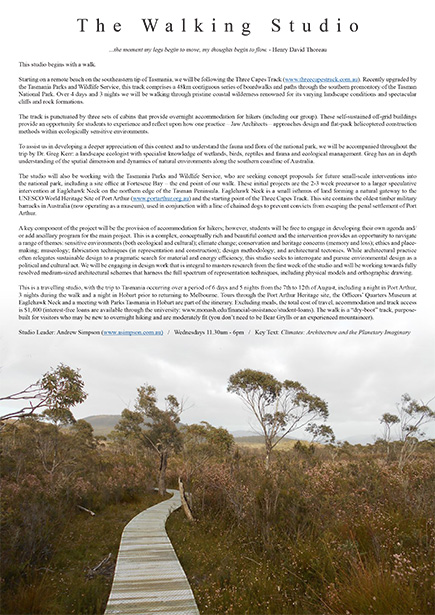
Starting on a remote beach on the southeastern tip of Tasmania, we will be following the Three Capes Track (www.threecapestrack.com.au). Recently upgraded by the Tasmania Parks and Wildlife Service, this track comprises a 48km contiguous series of boardwalks and paths through the southern promontory of the Tasman National Park. Over 4 days and 3 nights we will be walking through pristine coastal wilderness renowned for its varying landscape conditions and spectacular cliffs and rock formations.
The track is punctuated by three sets of cabins that provide overnight accommodation for hikers (including our group). These self-sustained off-grid buildings provide an opportunity for students to experience and reflect upon how one practice – Jaw Architects – approaches design and flat-pack helicoptered construction methods within ecologically sensitive environments.
To assist us in developing a deeper appreciation of this context and to understand the fauna and flora of the national park, we will be accompanied throughout the trip by Dr. Greg Kerr: a landscape ecologist with specialist knowledge of wetlands, birds, reptiles and fauna and ecological management. Greg has an in depth understanding of the spatial dimension and dynamics of natural environments along the southern coastline of Australia.
The studio will also be working with the Tasmania Parks and Wildlife Service, who are seeking concept proposals for future small-scale interventions into the national park, including a site office at Fortescue Bay – the end point of our walk. These initial projects are the 2-3 week precursor to a larger speculative intervention at Eaglehawk Neck on the northern edge of the Tasman Peninsula. Eaglehawk Neck is a small isthmus of land forming a natural gateway to the UNESCO World Heritage Site of Port Arthur (www.portarthur.org.au) and the starting point of the Three Capes Track. This site contains the oldest timber military barracks in Australia (now operating as a museum), used in conjunction with a line of chained dogs to prevent convicts from escaping the penal settlement of Port Arthur.
A key component of the project will be the provision of accommodation for hikers; however, students will be free to engage in developing their own agenda and/ or add ancillary program for the main project. This is a complex, conceptually rich and beautiful context and the intervention provides an opportunity to navigate a range of themes: sensitive environments (both ecological and cultural); climate change; conservation and heritage concerns (memory and loss); ethics and place-making; museology; fabrication techniques (in representation and construction); design methodology; and architectural tectonics. While architectural practice often relegates sustainable design to a pragmatic search for material and energy efficiency, this studio seeks to interrogate and pursue environmental design as a political and cultural act. We will be engaging in design work that is integral to masters research from the first week of the studio and will be working towards fully resolved medium-sized architectural schemes that harness the full spectrum of representation techniques, including physical models and orthographic drawing.
This is a travelling studio, with the trip to Tasmania occurring over a period of 6 days and 5 nights from the 7th to 12th of August, including a night in Port Arthur, 3 nights during the walk and a night in Hobart prior to returning to Melbourne. Tours through the Port Arthur Heritage site, the Officers’ Quarters Museum at Eaglehawk Neck and a meeting with Parks Tasmania in Hobart are part of the itinerary. Excluding meals, the total cost of travel, accommodation and track access is $1,400 (interest-free loans are available through the university: www.monash.edu/financial-assistance/student-loans). The walk is a “dry-boot” track, purpose- built for visitors who may be new to overnight hiking and are moderately fit (you don’t need to be Bear Grylls or an experienced mountaineer).